

Where No. 26 Sits in the Argument
By the time Alexander Hamilton reaches Federalist No. 26, he is no longer trying to prove that the country needs the power to defend itself. He has already made that case. The Articles of Confederation had left the nation weak, divided, and unable to respond with much consistency or force. Here, Hamilton turns to the harder question: if the federal government must have the power to raise and support armies, what keeps that power from becoming a danger to liberty itself?
That is what gives it its place in the larger argument of the Federalist Papers. It is not a stand-alone essay about military policy. It sits in the middle of Hamilton’s case for national defense, where he insists that the Union must have real power to provide for the common defense, but that such power must still operate within a constitutional system of restraint. Federalist 23 lays out the case for national defense powers. Federalist 24 and Federalist 25 confront the fear of standing armies and the comforting fiction that the states could manage major threats on their own. Then Hamilton reaches the next obvious concern: if the federal government may maintain an army in peacetime, what prevents that power from becoming an instrument of tyranny?
That makes this essay the hinge in the argument. Hamilton shifts from necessity to restraint. He is no longer asking readers to accept that the country needs military capacity. He is showing them how the Constitution is supposed to keep that capacity under civilian control. That is the real subject here: whether a republic can possess military power without surrendering liberty to it.
The Fear of Standing Armies
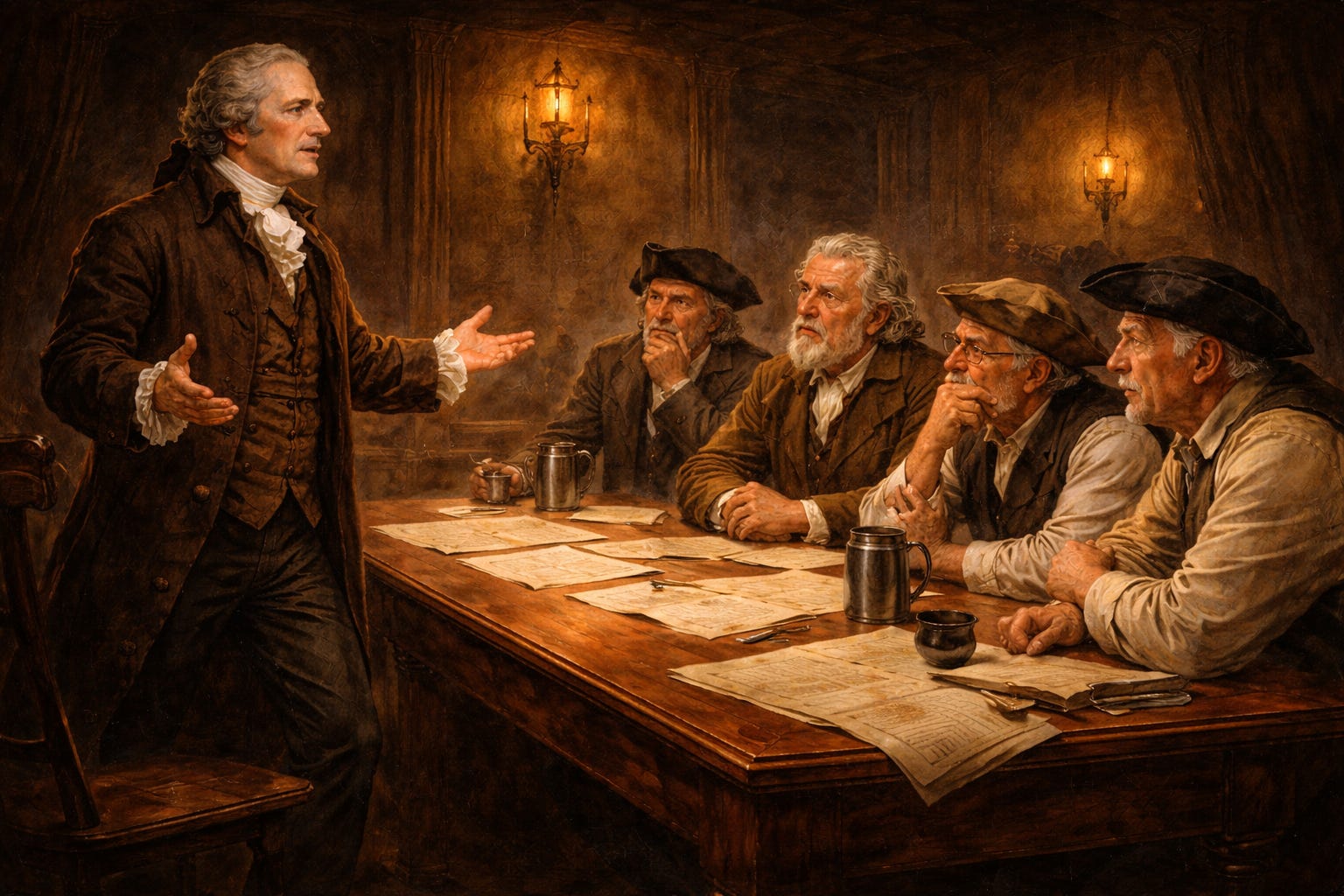
The fear Hamilton is addressing was not invented for effect. Americans had inherited a deep suspicion of standing armies from English history, where military force tied too closely to executive power had long been seen as a threat to freedom. That suspicion only deepened in the colonies, where British troops were not a theory but a lived reality. To many Americans in 1787, the phrase standing army did not sound like safety. It sounded like what Hamilton called an “hereditary impression of danger to liberty.”
He does not dismiss that fear. He takes it seriously and then tries to contain it. The Anti-Federalists were raising a real concern. If the Constitution had simply handed military authority to a permanent executive with no meaningful restraint, the criticism would have landed. But Hamilton argues that the Constitution answers that danger by placing military support in the legislature and forcing that support to be renewed at regular intervals. The power to raise and support armies belongs to Congress, and appropriations for that purpose may not last longer than two years. That is not some dusty procedural footnote. It is the check.
Hamilton also believed that some of the opposition had drifted into what he called an “injudicious excess.” The old fear of standing armies was understandable. But in his view, some critics had carried that fear so far that they no longer distinguished between a monarchy and a republic, between an unchecked ruler and a legislature accountable to the people. His answer was not that power was harmless. It was that a republic with elected lawmakers and recurring votes had to be judged differently from a monarchy. The real question was whether military power remained chained to institutions the public could still see, contest, and control.
Hamilton’s Constitutional Answer
And it is a smart one. The army cannot simply roll on by habit. It must be funded again, debated again, and justified again. For Hamilton, legislative control was the “ultimate point of precaution” consistent with the safety of a free people. His point is not that elected officials are magically virtuous. His point is structural. Military power is safer when it remains dependent on representative institutions, regular elections, and public scrutiny. In his view, liberty is preserved by forcing power to come back, again and again, to the people’s representatives for approval.
That argument only makes sense if you remember the failure that came before it. The Constitution did not emerge from a season of national confidence. It emerged from drift, weakness, and frustration under the Articles of Confederation. The central government struggled to raise money and coordinate defense, and repeatedly depended on the states to act together when they were busy guarding their own prerogatives and pulling in different directions. The framers were not solving an imaginary problem. They were trying to build a government that could survive contact with reality.
Hamilton is responding to two dangers at once. Americans had seen the threat of concentrated military power, but they had also seen the weakness of a government unable to defend the nation. A government too feeble to defend itself is not a guardian of liberty. It is an invitation to disorder, foreign pressure, and national humiliation. That is why this essay is more than a defense of peacetime armies. It is a lesson in constitutional design. Hamilton is asking whether a free people can create enough national capacity to govern and defend themselves without building the machinery of oppression. His answer is yes, but only if power remains tied to institutions that force accountability.
When the Guardrails Go Soft
This is where the essay starts sounding familiar. Hamilton’s argument depends on one core assumption: military power in a republic must remain tied to recurring public consent. The Constitution allows for an army, but it does not treat that army as a permanent force floating above politics. It requires Congress to revisit the question, fund the force, and take responsibility for doing so in public.
Congress still funds the military. It still passes appropriations. But on the deeper question of ownership, the branch Hamilton expected to carry the burden has often seemed more interested in commentary than responsibility. Presidents act. Congress complains, applauds, hedges, and issues statements that vanish by the next news cycle. The money keeps flowing, the machinery keeps moving, and responsibility gets smeared so widely that no one really owns the decision.
His point was not simply that legislators should sign checks every two years. It was that recurring control over military support would force recurring political accountability. Congress was supposed to face that question “once at least in every two years,” not let military power settle into a permanent habit. Members would have to defend the policy, justify the expense, and answer to the public. The appropriations limit was supposed to prevent military power from becoming routine, unquestioned, and separated from real civilian control. But routine is exactly what modern government does best. Give Washington enough years, enough acronyms, and enough press releases, and almost anything can become background noise.
That is the sharper warning inside the essay. The danger is not only executive overreach. It is legislative drift. It is Congress growing comfortable with reacting instead of deciding. A modern superpower cannot function as though it were still a fragile Atlantic republic in 1787. Hamilton would have understood that. He was not arguing for helplessness then, and he would not argue for it now. But he would have recognized the danger of normalized military power that continues with less real debate, less real ownership, and less real accountability.
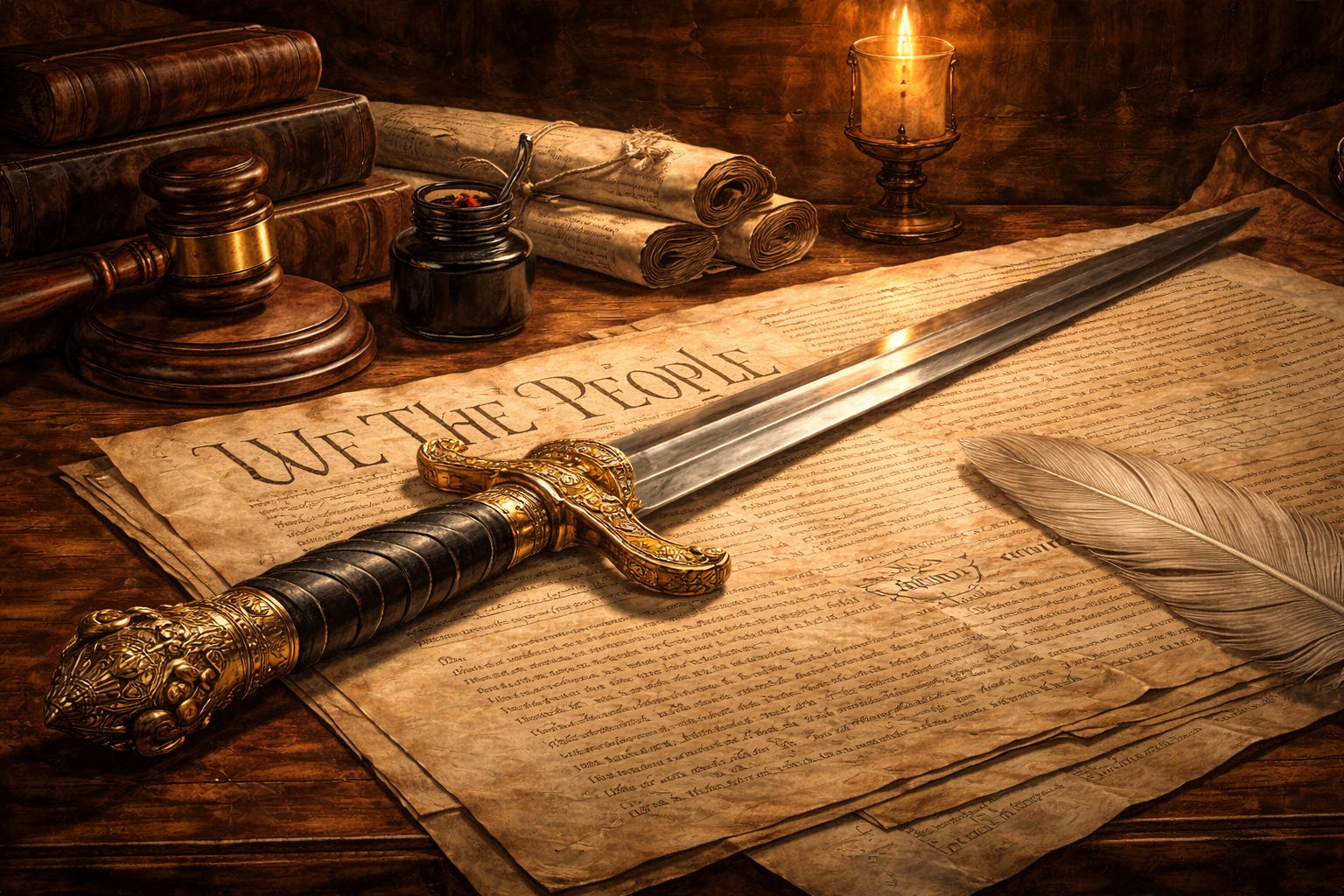
Federalist 26 is Hamilton’s warning that military power in a republic must never become routine. The country may need an army, readiness, and force. But in a free government, those things must remain tied to public consent and legislative control. Hamilton’s answer was structure. Put military power under the “ultimate point of precaution,” review it often, fund it openly, and make elected officials own it. Do not let the sword drift free of the Constitution.
That is where the essay still stings. The danger is not only an overreaching president. It is a Congress that gets lazy, loud, or comfortable enough to let military power become background noise. Once that happens, oversight becomes theater, funding becomes a habit, and accountability starts to look like somebody else’s job.
That is the enduring challenge of Federalist 26. Not whether America should be defended. It should. The question is whether the people’s branch still has the discipline to control the means of that defense, or whether it has settled for clapping, complaining, and cashing the bill.
A republic does not lose its liberty because an army exists. It loses it when elected leaders stop doing the work of controlling it. That was Hamilton’s warning, and it still lands.
Timely essay. For my own work, I have begun looking at the work of Neil Postman before he wrote “Amusing Ourselves to Death: Public Discourse in the Age of Show Business” in 1985. It’s clear that our culture has suffered across many sectors, including government, because of the shift from print media to electronic media. It will swing back; just takes time. Postman’s best book may be “The Disappearance of Childhood” (1982).