


The Crisis at Newburgh
In the winter of 1783, the American Revolution was officially ending and quietly beginning to unravel. The British were still withdrawing from New York, the peace treaty had not yet been finalized, and Congress was broke, powerless to tax, and increasingly unable to keep even its most basic promises. The Continental Army, still in the field, had not been paid in months, and many of its senior officers had gone years without reliable compensation. Promised pensions drifted further into doubt as enlistments expired and the end of the war brought not relief but anxiety. The men who had carried the war to victory were about to be sent home not as honored veterans, but as creditors holding paper that might never be redeemed.
Under the Articles of Confederation, Congress could only ask the states for money and wait, and often it waited in vain. Resentment did not erupt all at once. It accumulated, quietly and steadily, until a series of anonymous letters began circulating among the officer corps, measured in tone and radical in implication, arguing that patience had failed, that Congress would never act unless forced, and that the army, unified and disciplined, might need to remind civilian leaders who had actually won the war. This was not yet mutiny, but everyone who read those letters understood how such stories usually ended, because republics that allowed unpaid armies to linger near weak legislatures rarely remained republics for long.
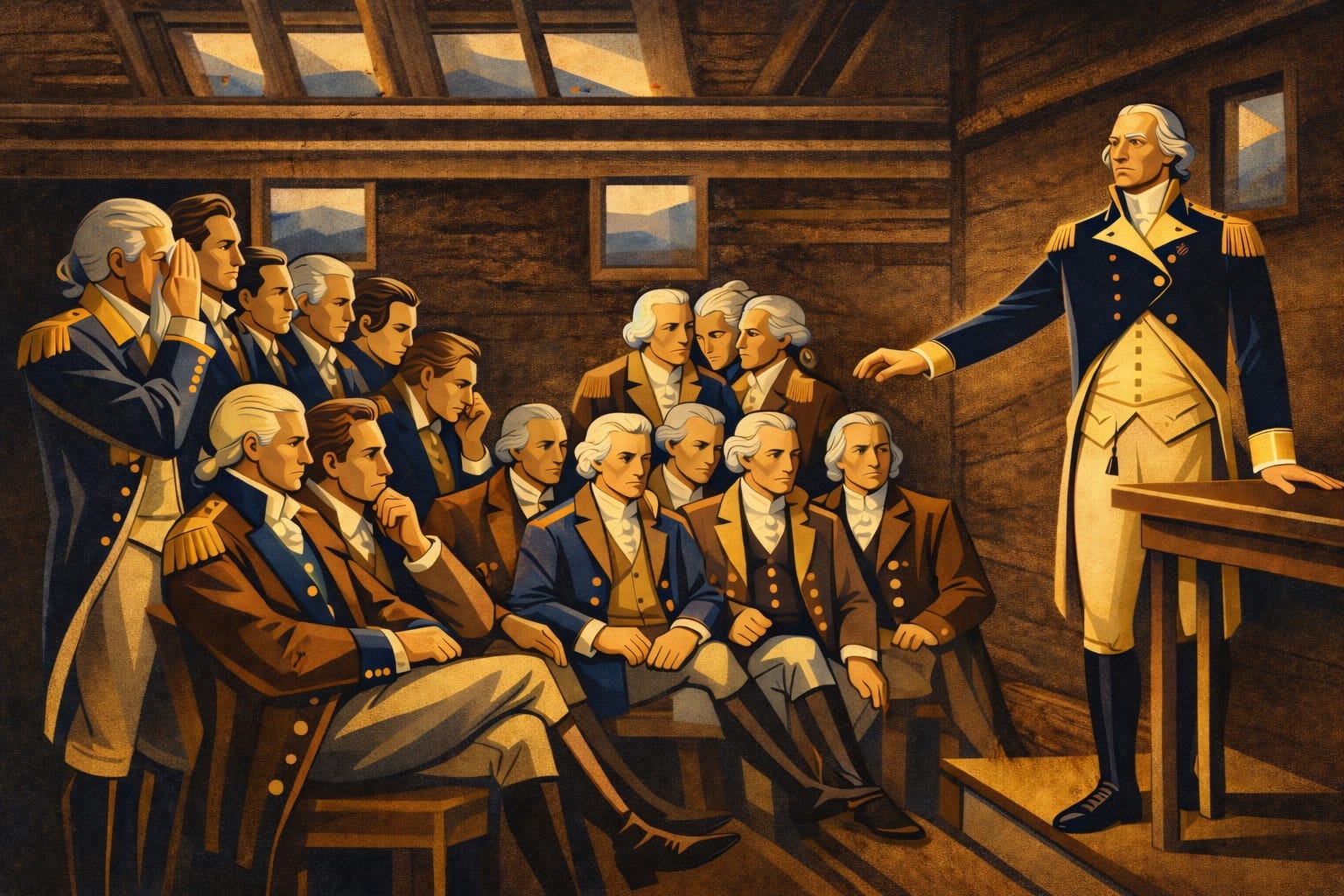
Washington grasped the danger immediately. He called a meeting of his senior officers in Newburgh, New York, and spoke to them not as a commander issuing orders, but as a man appealing to shared honor and long service. He urged restraint and reminded them that the army’s greatest achievement would not be its victories in battle but its obedience to civilian authority when the fighting was done.
When he reached into his pocket to read a letter from Congress and found that he could not see it clearly, he paused, took out a pair of spectacles the officers had never seen him wear, and said quietly, “Gentlemen, you must pardon me. I have grown gray in your service and now find myself growing blind.”
Contemporary accounts describe the room dissolving, men weeping, the agitation collapsing, and the army turning away from a course that might have ended the republic before it had properly begun. A few months later, Washington resigned his commission and returned to private life.
The Lesson the Founders Could Not Forget
That moment stayed with the Founders, not because Washington himself had been dangerous, but because the situation had revealed how fragile a republic could become under strain. They had seen how close the country came to losing itself, not through ideology or ambition, but through debt, delay, and wounded pride. And they understood that standing armies were not dangerous because soldiers were wicked, but because even honorable men, under enough pressure, could be tempted to resort to force in politics.
For them, the danger was never abstract, because weak civilian authority and resentful armies had undone republics before in ways so familiar they hardly needed rehearsal. Rome had crossed that line, and Cromwell after it. History offered no shortage of warnings about what happened when military necessity began to substitute for political consent, and emergency hardened into habit.
By 1787, then, the question was no longer whether armies were risky. Everyone in the debate already conceded that they were. The harder question was whether a republic could design institutions strong enough to defend itself without surrendering control of that defense, and restrained enough to keep force under law even when fear, urgency, and grievance pressed in the opposite direction.
What Hamilton Is Actually Arguing in Federalist 24
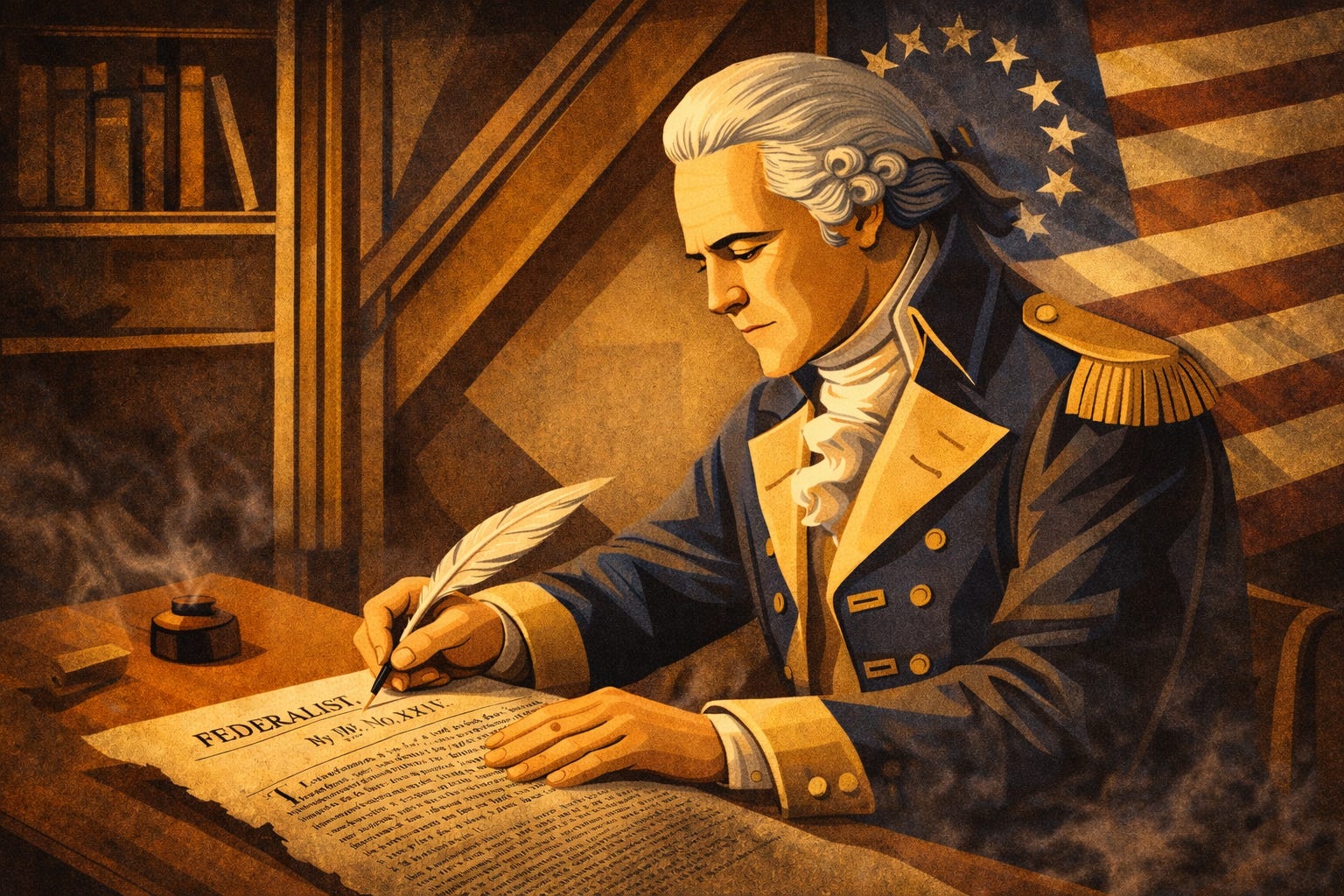
When Alexander Hamilton turns to standing armies in Federalist No. 24, he does not deny the fear or attempt to talk past it. He concedes the point directly, writing that “a standing army in time of peace has always been considered as a dangerous, at times an unnecessary, engine,” and grounding the concern in long and bitter experience rather than imagination. But he refuses to treat absence as a solution, because danger does not wait for legislatures to convene or borders to defend themselves.
“A government,” he writes, “ought to contain in itself every power requisite to the full accomplishment of the objects committed to its care,” and survival is one of those objects, whether citizens prefer to think about it or not. What he rejects is the idea that liberty is preserved by dismantling capacity, because the Anti-Federalist hope for safety through absence merely postpones danger until panic takes over and improvisation replaces law.
The real danger, as Hamilton frames it, is not the existence of force, but the way it appears when institutions have refused to prepare for it. When force arrives suddenly, it does so without discipline, structure, or clear political ownership. The question is not power versus liberty, but whether power is governed in advance or improvised in crisis.
At bottom, Federalist 24 is an argument about institutional design. If force is inevitable, the only question that finally matters is how it is governed before a crisis arrives, not how it is explained after it has already begun.
The Assumption Hamilton Makes About Congress
Here, Hamilton reveals an assumption that now feels almost fragile. He expects Congress to remain engaged, to debate and renew authorizations, and to let the existence of a standing army sharpen civilian oversight rather than dull it, so that the powers to raise and support armies are exercised regularly, deliberately, and publicly rather than quietly and by inertia.
The system he designs depends less on virtue than on process, on debate, appropriations, reauthorization, and shared responsibility, because without those habits, even a well-designed constitution begins to hollow out. Hamilton did not imagine a military that simply ran in the background, funded by habit and governed by momentum, largely untouched by the political scrutiny that was supposed to define civilian control.
Why This Still Matters
We still operate under authorizations passed more than two decades ago. Conflicts migrate, and missions expand, and what began as an emergency hardens into routine, so that war becomes ambient. It is rarely forced back into the political process where it belongs. Responsibility diffuses across time, committees, and administrations, and the habits of authorization that were supposed to discipline force slowly weaken through neglect.
The danger today is not a general marching on Congress, but a permanent condition of low-level war. It is sustained without clear political ownership or institutional pressure strong enough to force a return to first principles. This condition persists largely due to procedural drift. Power, once established, demands continuous governance to prevent it from slipping beyond the boundaries Hamilton conceived.
The system he imagined depended on renewal, debate, and visible responsibility as the mechanisms by which force remained subordinate to law. We have built the army he defended. The harder question is whether we have preserved the habits required to govern it.
Excellent piece, Scott. One among many wishes today is that the Congressional leadership would read and take to heart your message about the need for Congress to act. Sadly, I suspect that the only thing which will protect future generations of our nation is a constitutional amendment codifying restrictions on the office of the Presidency.
Superb, Scott. Re-upped to my Twitter followers.