



A companion to “Who’s in Charge When It Matters.”
Editor’s note: The recent Senate debate over war powers regarding Venezuela underscores the constitutional tensions examined in this essay.
The Constitution gives Congress the power to declare war, but it never assumed danger would wait politely for a vote. From the beginning, the American government lived with a tension it could not eliminate: the need to act quickly and the need to decide carefully. Both mattered, and either one, left unchecked, distorted the system.
The War Powers Resolution grew out of a sense that this balance had given way. After Vietnam, Congress concluded it had surrendered too much authority, too quietly and for too long. Conflicts expanded without sustained consent, responsibility thinned, and lawmakers looked for a way back into the decision at the moment force was used, not years later when momentum was already set.
The intent was restraint through accountability. If force was necessary, Congress would say so. If it was not, the president would have to stop. The goal was never to micromanage military operations, but to ensure that someone clearly owned the decision to begin them.
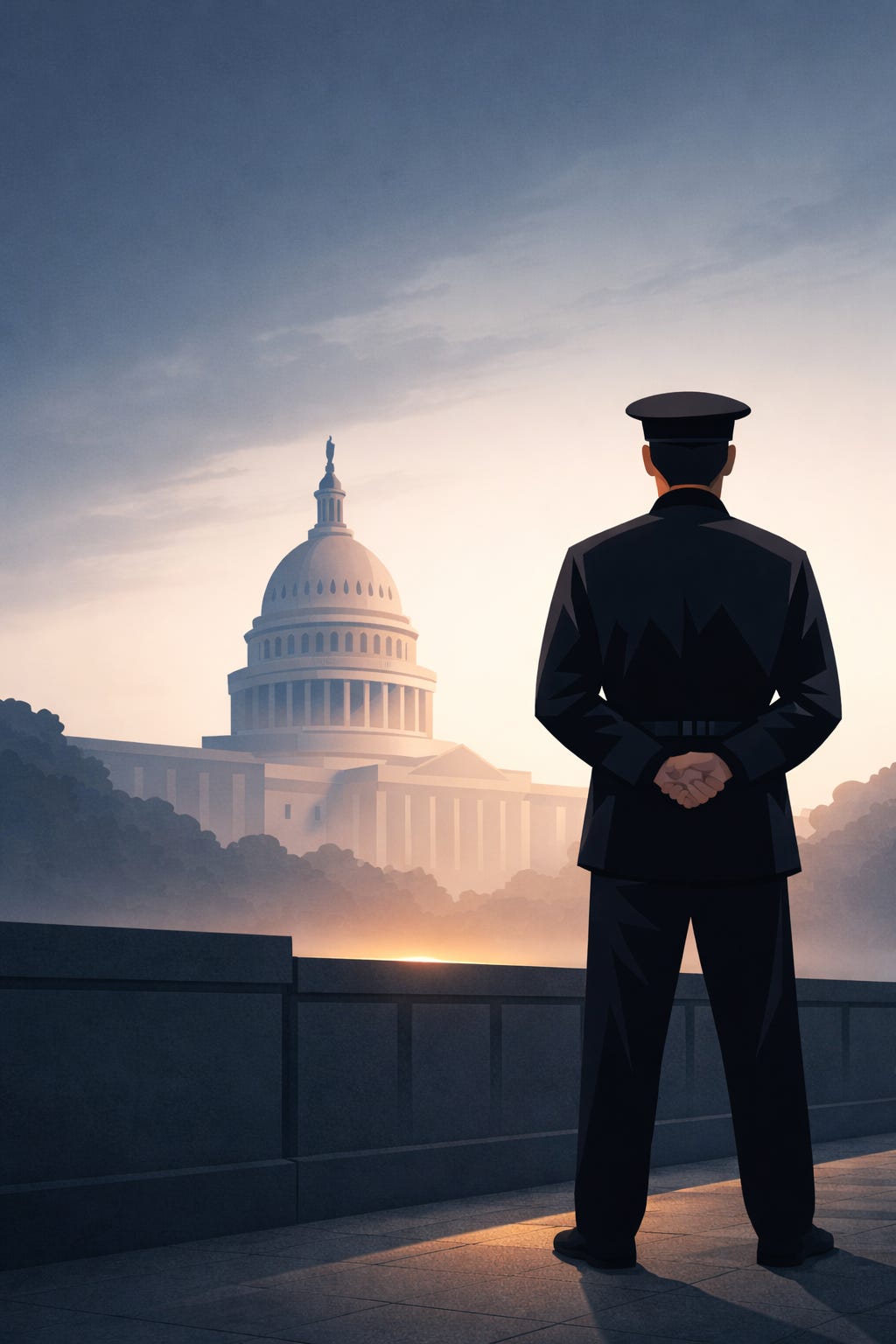
What followed, however, was something else. The War Powers Resolution did not restore clarity so much as it normalized ambiguity. Presidents learned how to comply with its procedures without conceding authority, while Congress learned how to receive notice without accepting responsibility. Flexibility was preserved, confrontation avoided, and the constitutional question left unanswered.
This did not happen because anyone forgot the Constitution. It happened because ambiguity is useful.
The Problem Hamilton Didn’t Live to See
Hamilton assumed that authority and responsibility would move together. If the government acted, someone would be held accountable for the action. If force was used, the decision would be traceable and contestable. Capacity mattered, but accountability mattered just as much.
Modern war powers show what happens when that assumption breaks down. Decisions are made under claims of necessity, justifications follow later, and debate unfolds without resolution. Action moves forward while ownership disperses, and the constitutional question is deferred rather than answered.
War is the hardest test of constitutional design because it compresses time and raises stakes simultaneously. When force is on the table, delay has consequences, but so does evasion. A system that cannot clearly assign responsibility in that moment is not merely inefficient; it is fundamentally flawed.
Why Congress Passed the War Powers Resolution
The War Powers Resolution was not born of cowardice, but of shock. Vietnam exposed how easily a conflict could expand without sustained congressional consent and how difficult it was to reclaim authority once momentum took hold. Congress was not seeking to command troops or dictate strategy, but to recover its place at the moment of decision itself, when authorization still carried real constitutional weight.
The Resolution was designed to force that reckoning. Either Congress would authorize the use of force, or military action would end. The point was not paralysis, but responsibility: a system in which someone would have to say yes or no and live with the consequences.
That intent matters because it explains how the system later went wrong. The failure was not moral or ideological, but structural, rooted in an arrangement that preserved participation without requiring decision and allowed influence to persist without ownership.
What the War Powers Resolution Actually Requires
On paper, the War Powers Resolution appears straightforward, requiring presidents to notify Congress within forty-eight hours of introducing armed forces into hostilities and to withdraw those forces within sixty to ninety days absent authorization. What it does not do is compel a decision. The statute contains no enforcement mechanism, offers no clear definition of “hostilities,” and relies on political will rather than institutional force.
Those omissions were not accidental. Congress sought restraint without constant confrontation and, in doing so, created a framework in which responsibility could persist procedurally while dissolving substantively over time.
How Ambiguity Became the Feature
The War Powers Resolution did not fail because it was ignored. It failed because it was absorbed into practice. Over time, its procedures became familiar enough to follow without ever confronting its premise.
Presidents learned how to comply formally while preserving discretion. Notifications were filed, reports submitted, deadlines acknowledged and then reinterpreted. Military actions were framed as limited or short of “hostilities,” a term vague enough to accommodate almost any use of force. Consultation continued, but the location of the decision did not meaningfully shift.
Congress adjusted in parallel. Receiving notice proved easier than granting authorization and far less costly. Hearings and statements replaced votes, allowing members to influence debate without accepting ownership of outcomes. Participation remained visible, but decision quietly receded.
As this pattern repeated, it hardened into expectation. Presidents acted first, confident that procedural compliance would blunt resistance, while Congress responded later, satisfied that notification preserved institutional relevance without binding it to consequences. Each branch could point to the Resolution as evidence that norms were intact, even as authority itself grew increasingly difficult to locate.
The lingering force of the 2002 Authorization for Use of Military Force reflects the same dynamic from a different direction. Congress did authorize the use of force, but it did so once and then largely declined to revisit that decision as circumstances changed. What began as a context-specific grant of authority became a standing justification, cited long after its original rationale had faded. Authorization remained on the books, but responsibility did not renew itself. Action continued, while the decision that enabled it receded further into the past.
This ambiguity was not accidental. It was functional. For the executive, it preserved speed without the vulnerability of explicit authorization. For Congress, it preserved influence without the burden of repeated ownership. For both, it reduced the risk of open confrontation, even as the constitutional question at the center of war powers remained unresolved.
The result was a system that appeared restrained on paper but operated permissively in practice. Force could be used quickly, accountability deferred, and the distinction between action and authorization steadily blurred. The Resolution came to function less as a guardrail than as a ritual, signaling concern without compelling decision.
The Incentives Nobody Likes to Admit
That this arrangement persists is not mysterious. It endures because it aligns neatly with incentives on both sides of the constitutional divide, rewarding avoidance while preserving the appearance of engagement.
For presidents, ambiguity is attractive precisely because clarity brings constraint. Formal authorization fixes responsibility and narrows room to maneuver if conditions change, while action taken beneath the War Powers framework allows speed without concentrated political risk. Success accrues to leadership. Failure disperses.
Congress operates under parallel pressures. Voting to authorize force requires members to take positions that will be remembered, judged, and potentially punished, while declining to vote preserves flexibility. Oversight and consultation fill the space where consent once stood, allowing influence to persist without full ownership of the consequences.
Electoral reality reinforces the equilibrium. Wars rarely command sustained public attention unless costs rise sharply, and ambiguity allows both branches to operate in the space between urgency and indifference. Safeguards appear intact, process appears functional, and responsibility remains indistinct.
Over time, these habits harden into expectation. Presidential initiative comes to feel normal, congressional hesitation routine, and what was designed to constrain the use of force quietly reshapes itself around convenience.
War Powers as the Ultimate Stress Test
No constitutional question tests the alignment between authority and responsibility more severely than the use of force. War exposes every weakness in institutional design, and a system that cannot assign responsibility clearly under those conditions cannot plausibly claim to be functioning as intended.
This is the failure Hamilton warned against. A government charged with national defense must be able to act, but that capacity was never meant to operate untethered from responsibility. When the link between the two breaks, restraint does not disappear outright. It remains visible on paper, but it loses its force in practice.
In the modern arrangement, presidents act under claims of necessity while Congress responds with consultation and criticism, carefully avoiding authorization or refusal. Capacity exists. Restraint exists. What is missing is the moment when responsibility clearly attaches, leaving a system that can move decisively but struggles to account for its own decisions.
What Constitutional Seriousness Requires

The War Powers Resolution was an attempt to restore balance after failure. Its weakness was not that it demanded too much, but that it demanded too little. By allowing participation without decision, restraint without enforcement, and flexibility without clarity, it created an arrangement that gradually became normal, not because it worked particularly well, but because it was comfortable.
Constitutional seriousness requires something more demanding. Responsibility cannot be shared indefinitely without thinning into obscurity. If presidents believe the use of force is necessary, they must be willing to seek authorization and accept the limits that follow. If Congress believes force is unjustified or misused, it must be willing to refuse consent and accept the consequences of restraint. Process can facilitate judgment, but it cannot replace it indefinitely.
The central failure, then, is not that the War Powers Resolution proved unable to restrain action. It is that it allowed restraint itself to become optional. And once restraint becomes optional in matters of war, it rarely remains mandatory anywhere else for long.