


In 1787, Americans confronted a question that had challenged political thinkers for centuries. Could republican government survive across a large and diverse nation, or did liberty depend on keeping the republic small?
James Madison and the Anti-Federalist writer known as Brutus offered sharply different answers. The Constitution adopted one of them. American history would spend the next two centuries testing both.
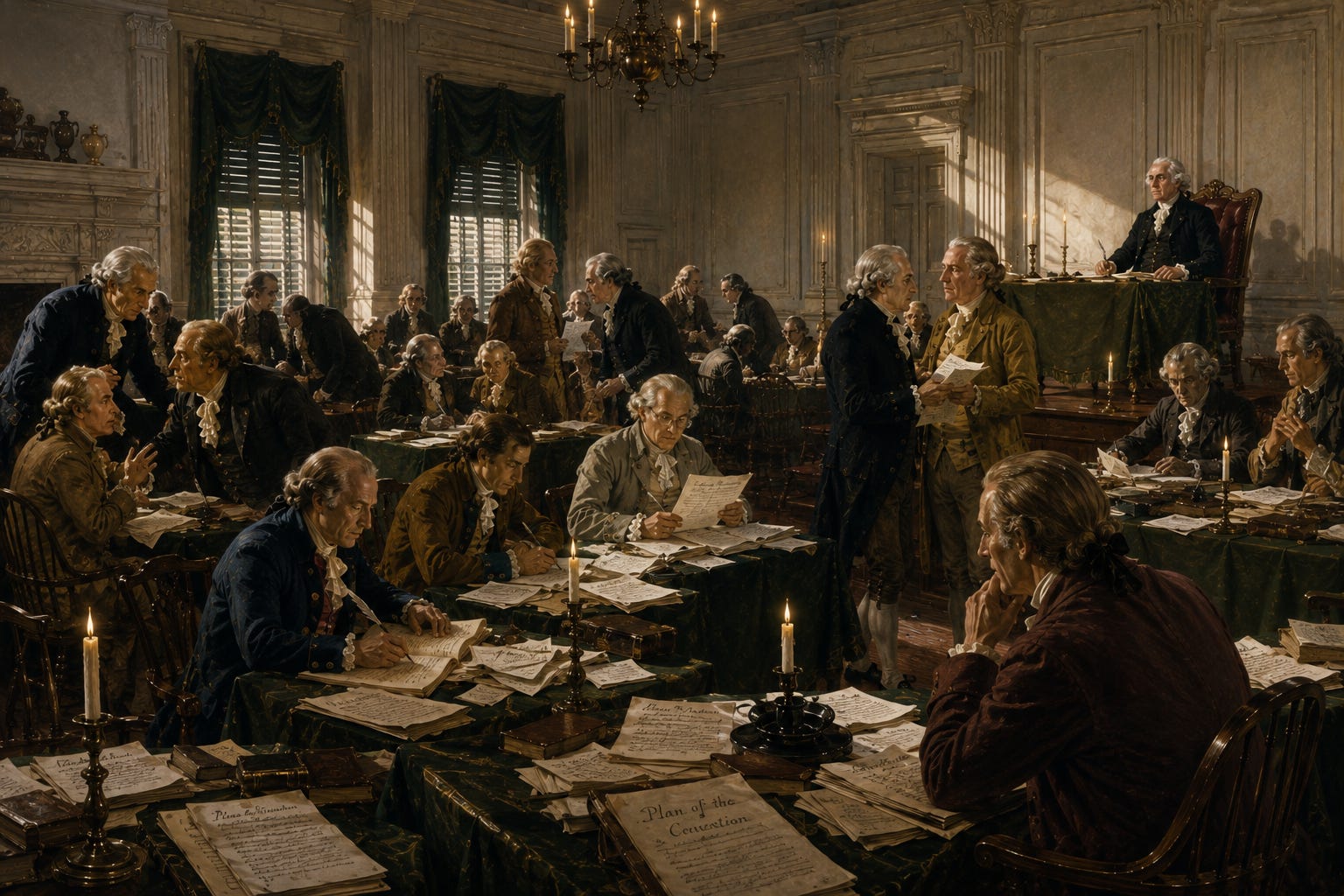
Two Cases for Liberty
The question itself was hardly new. From the ancient world through the Enlightenment, political thinkers generally assumed that republics worked only on a small scale. Citizens who knew one another were more likely to recognize a common good, hold public officials accountable, and resist the concentration of power. The larger and more diverse a republic became, they believed, the weaker those civic bonds would grow, until self-government itself began to fail.
Brutus accepted that traditional view. “In a republic, the manners, sentiments, and interests of the people should be similar,” he wrote. A nation stretching from New Hampshire to Georgia contained too many competing interests, in his view, to remain genuinely representative.
Distance posed another danger. “The representatives of the people cannot, as they now do, mix with the people,” Brutus warned. In a larger republic, public officials would know less about the lives and opinions of their constituents. The states would gradually lose influence as national authority grew, leaving political power farther from those it was meant to serve.1
Madison did not dismiss the concern. He had watched the Revolution divide Americans into Patriots and Loyalists. He had witnessed the failures of the Articles of Confederation and seen Shays’ Rebellion expose the fragility of the young republic. He agreed that faction threatened self-government. Where he differed with Brutus was over the cure.

In a small republic, Madison argued, citizens moved by the same passion or interest could quickly gain enough power to impose their will on others. He defined a faction not simply as a political group, but as one driven by an interest or passion “adverse to the rights of other citizens.” Free people would disagree and organize. The danger arose when one group gained enough power to place its interests above the rights of others.
Nor did Madison believe faction could be eliminated without destroying the freedom that produced it. “Liberty is to faction what air is to fire,” he wrote. People would develop different interests and naturally organize around them. A free society could not prevent that without ceasing to be free, so its challenge was to control faction’s effects.
His answer reversed one of the oldest assumptions in political thought. “Extend the sphere,” Madison urged. A larger nation would contain more competing interests and ambitions, making an oppressive majority harder to assemble. The diversity Brutus regarded as a threat could become a safeguard.2
The wider sphere was only part of the design. In Federalist No. 51, Madison described authority divided between the states and the national government, then divided again among separate branches. He called this arrangement a “double security” for the rights of the people. Representation would provide another filter. Elected officials were expected to exercise judgment, not simply carry the passions of the moment into government.3
Brutus and Madison therefore offered different protections for liberty. Brutus trusted government kept close to the people, while Madison trusted a larger constitutional system to prevent any one interest from dominating. Ratification chose Madison’s design, but it could not tell Americans whether that design would work.
The Republic Responds
When the Constitution went into effect in 1789, Madison’s theory moved from paper into practice. The First Congress created the first executive departments and established the federal judiciary. It also sent twelve proposed amendments to the states. Ten were ratified by 1791 as the Bill of Rights. Another, limiting when congressional pay increases could take effect, waited 203 years before becoming the Twenty-Seventh Amendment in 1992.4
Organized political opposition soon complicated the picture. Within a few years, Hamilton and Jefferson had built rival coalitions around profoundly different visions of the republic. Newspapers became openly partisan, with Federalists warning that Jefferson would invite anarchy and Republicans portraying Hamilton’s allies as enemies of republican government.5
Madison was not simply observing this development; he helped create it. The author who had argued that a large republic would disperse political interests became one of the architects of a national opposition movement. That did not invalidate his theory, but it showed how quickly political leaders could gather the varied interests of an extended republic into durable coalitions.
The election of 1800 placed the new system under its first great strain. Jefferson defeated the Federalist incumbent John Adams, but the Electoral College produced a tie between Jefferson and his running mate, Aaron Burr. The House of Representatives needed thirty-six ballots to resolve the contest.
The crisis exposed a serious weakness in the Constitution’s original design. Still, the dispute was settled through the constitutional process. Jefferson’s inauguration and the Democratic-Republican takeover of Congress marked the first peaceful transfer of national power between political parties in American history.6
Madison’s confidence survived its first major test, though not quite in the way he might have expected. The transfer occurred through organized political parties, a form of national coordination that Federalist No. 10 did not fully explore. The Constitution proved able to accommodate political practices that reached beyond the argument he had made in 1787.
When the Coalitions Broke
The decades after 1800 appeared to strengthen Madison’s case. The United States expanded westward, admitted new states, and became more economically complex than either Madison or Brutus had known. Its major political parties joined voters across regions and interests, giving the constitutional system a measure of stability.
Democrats and Whigs remained national parties because each depended on support from both North and South. That structure did not resolve the conflict over slavery, but it kept sectional loyalty from becoming the only organizing force in American politics.
That structure began to fail as slavery moved from one issue among many to the question that reorganized American politics. The Kansas-Nebraska Act of 1854 did not create sectional conflict, and the Whig Party was already fragile. But by repealing the Missouri Compromise restriction and allowing settlers to determine the status of slavery in the new territories, it accelerated the collapse of the coalition structure that had helped contain the dispute.
Violence followed in Kansas. The remaining Whig coalition disintegrated, and the Republican Party emerged in opposition to the expansion of slavery. The Democratic Party also fractured along sectional lines as the Civil War approached.7
The breakdown reached beyond party politics. Madison had expected different interests to cross one another, making a durable majority faction harder to form. By the late 1850s, slavery was drawing those interests into rival sectional blocs. Northern and southern voters increasingly saw the opposing section not as a political competitor, but as a threat to their future.
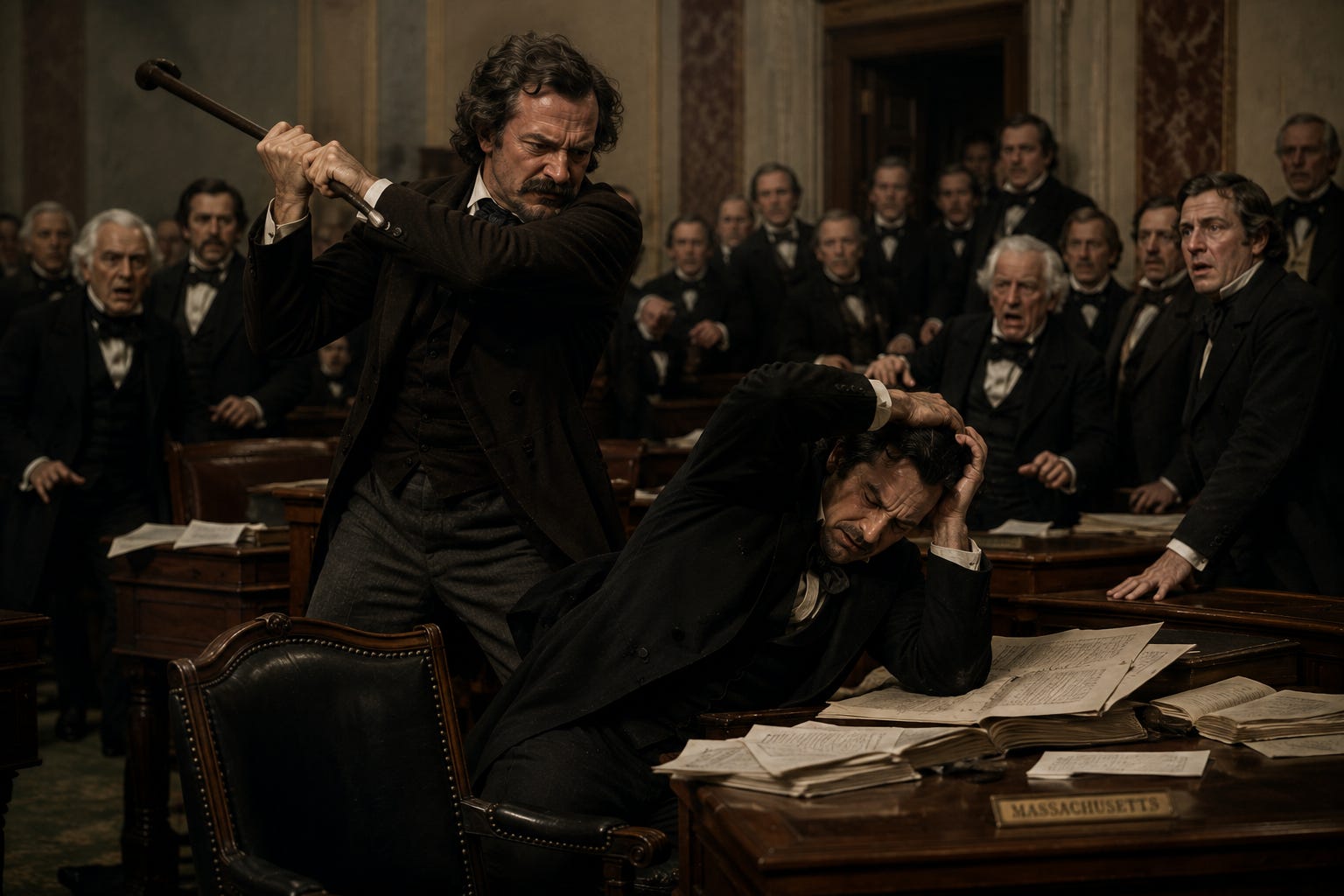
Congress itself became another arena for the conflict. On 22 May 1856, Representative Preston Brooks entered the Senate chamber and beat Senator Charles Sumner unconscious. Three days earlier, Sumner had delivered “The Crime Against Kansas,” an antislavery speech condemning the violence in the territory and attacking several of slavery’s defenders in the Senate.8
Secession and civil war gave tremendous force to Brutus’s warning that a vast republic could become too divided to govern itself. The competing interests Madison expected to restrain one another had instead been reorganized around incompatible political and moral orders.
The war did not produce a simple verdict against Madison. In his First Inaugural Address, Abraham Lincoln argued that the Union was older than the Constitution and intended to be perpetual. Because the Constitution sought to form “a more perfect Union,” unilateral secession could not lawfully make that Union less perfect. The Union therefore remained unbroken despite the ordinances of secession.9
The Union fought to preserve that order, but preservation transformed it. The war brought emancipation and greatly increased national capacity. It also raised serious constitutional questions about executive war powers and the suspension of habeas corpus.10
What the First Century Revealed
Madison described the “great object” of republican government as securing “the public good and private rights” while preserving popular rule. By 1865, the extended republic had endured, but at extraordinary cost. It had preserved the Union without resolving whether constitutional liberty would be secured equally for all Americans.11
The first century vindicated parts of both arguments. Madison’s institutions proved stronger than Brutus expected, and the large republic withstood political parties, transfers of power, territorial expansion, and civil war. Yet his confidence in crosscutting interests met a devastating limit. Once slavery absorbed those interests into rival sectional blocs, constitutional bargaining could no longer contain the conflict.
Brutus was also right that scale could strengthen national power. Preserving the Union required a broader federal authority than Americans had known before the war. His case remained incomplete, however. He could not show that a smaller republic would have protected liberty more reliably, especially for those trapped beneath a local majority.
By 1865, the Constitution had survived the crisis of the Union, but it had not answered the crisis of citizenship. The war had ended slavery and preserved the nation. The harder question was whether the extended republic could protect the rights of Americans when the governments closest to them would not.
Brutus, “Essay No. 1,” 18 October 1787.
James Madison, Federalist No. 10.
James Madison, Federalist No. 51.
United States Senate, “Senate Diaries: The First Congress”; National Archives, “The Bill of Rights: A Transcription”; National Archives, “Amendments 11–27”.
Library of Congress, “Formation of Political Parties”.
National Archives, “The House Selects a President”.
United States Senate, “The Kansas-Nebraska Act”.
United States Senate, “The Caning of Senator Charles Sumner”.
Abraham Lincoln, First Inaugural Address, 4 March 1861.
Library of Congress, Constitution Annotated, “Suspension Clause and Writ of Habeas Corpus”.
James Madison, Federalist No. 10.
Ss always, Scott, wonderful. I am curious as to just how singular Madison was in the whole faction against faction approach. Is this Madison's idea from while cloth, or was he synthesizing?
Fascinating look back at the age-old question of how to build and maintain durable models of complex human cooperation. Thank you Scott!