


There is an old joke about a New Yorker walking through a small town in Georgia when he sees a dog attacking a young boy. He jumps into action, killing the dog while saving the child. A reporter, who saw the whole thing, congratulates him and proposes the headline: “Local Man Saves Child by Killing Vicious Animal.” When the man explains that he is not a local, the reporter changes the headline to “Georgia Man Saves Child by Killing Dog.” Then he learns the man is from New York, and the headline changes again: “Yankee Kills Family Pet.”
The joke works because the event never changes. The child remains unharmed. The dog remains dead. The man still a hero. Only his origin story changes, and the judgment changes with it.
Congress shares that headline problem. Democrats retained control of the House in January 2021 when Joe Biden took office, but now their oversight was on a Democratic Administration. In the previous Congress, during Donald Trump’s final two years in office, House committees devoted much of their time to investigating the executive branch. Under Biden, the same committees slowed their oversight. Among 20 comparable committees, the median share of tracked hearings and letters devoted to executive oversight dropped from 36.9 percent during the first 18 months of the 116th Congress to 24.9 percent during the first 18 months of the 117th. Fifteen of the 20 committees did less oversight.
There are limits to the comparison because COVID disrupted congressional business and unified Democratic control gave the party a substantial legislative agenda to pursue. The pattern doesn’t begin or end with Trump or Biden. Research on House investigations from 1898 through 2014 found committees pursued executive branch oversight more aggressively when the other party controlled the White House. This does not prove that Congress simply abandons the Capitol when their own party occupies the presidency, but it does show that party shifts the incentives to use congressional power.
That matters because Madison expected personal and institutional interests reinforcing one another. He believed members of Congress would defend congressional power because doing so would also defend their place in the constitutional order. Modern parties have torn those interests apart.
The Interest of the Man
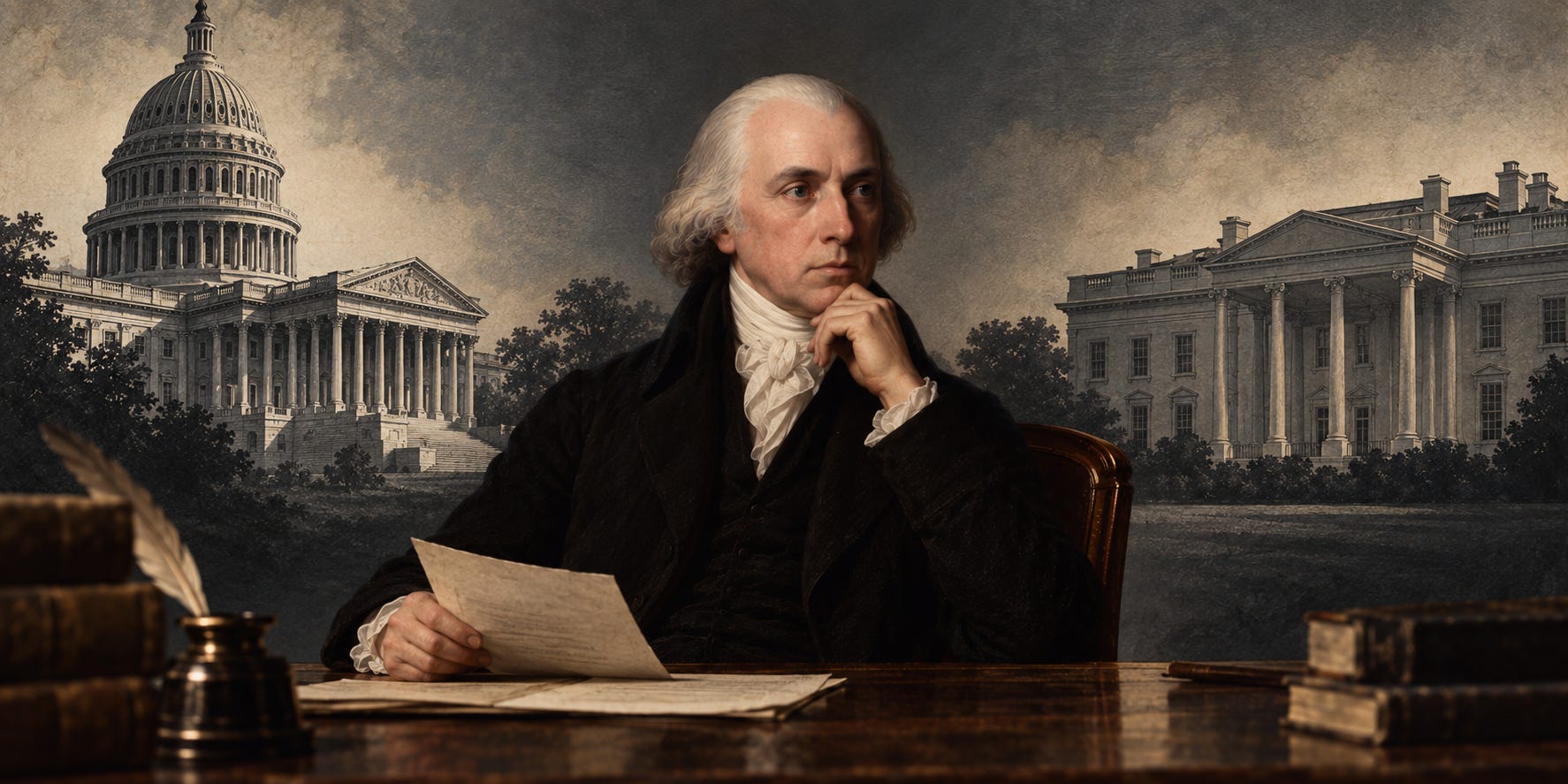
Madison argued the people occupying each branch needed the “constitutional means, and personal motives to resist encroachments by the others.” His explanation was blunt: “The interest of the man must be connected with the constitutional rights of the place.”
The formula was simple: a president would protect presidential power, while members of Congress would protect congressional power. Madison expected each branch to resist the other because the people occupying each had something to lose when another branch gained leverage. The design relied on self-interest being attached to the institution. Though presidents and members of Congress alike have been motivated by self-interest, that alone has not kept up in modern times.
Madison also understood parties would influence the system. Four years after Federalist 51, he wrote that “in every political society, parties are unavoidable,” and he soon became ironically involved in organizing opposition to the Federalists. The vulnerability in his argument is not that he did not envision parties. Instead, it’s that modern parties give legislators political interests that extend beyond the very branch lines Madison expected to generate rivalry.
A senator may care about the Senate’s authority, but if protecting it means blocking a president of his party, his institutional interest is no longer operating alone. The party can make presidential success more valuable than resisting presidential power or its failure.
When Party Changes the Incentive
Appropriations law offers an example because the underlying question is fairly constant: did the executive spend in the way Congress intended? The Government Accountability Office interprets those questions for Congress, and congressional requests have become increasingly partisan.
Previous administrations experienced more cross-party and bipartisan activity. During the Obama administration, Republicans made most of the requests, though Democrats still asked GAO to examine their own administration. Some requests were even bipartisan. Republican and bipartisan requests also continued into Trump’s first term in office.
More recently, the partisan pattern has solidified. Of the 26 congressional requests for GAO decisions on executive branch compliance with appropriations law during the Obama and Biden administrations, 18 were submitted solely by Republicans. Of the 33 requests during Trump's first administration, 27 came solely from Democrats. Under Biden, requests regarding his administration have come solely from Republicans. As of 16 July 2026, requests regarding Trump's second administration have come solely from Democrats.
This does not prove that party determines every congressional action, but it shows how strongly partisan alignment determines who questions executive compliance.
The same pattern emerges in litigation. The Republican-controlled House sued the Obama administration over Affordable Care Act payments it claimed Congress had not authorized. A few years later, the Democratic-controlled House sued the Trump administration after it redirected federal funds to the border wall. The legal questions were not identical, but both Houses asserted the same fundamental prerogative: presidents cannot spend money Congress has not authorized for that purpose.
Those cases do not show what either party would do against a president from their own party. They do show that both parties clearly use the institutional principle when it means opposing the other party.
Legal scholars Daryl Levinson and Richard Pildes identified this as the “separation of parties, not powers.” National parties create political alliances that cross the formal boundary between Congress and the presidency. Under divided government, partisan and institutional interests often reinforce one another. During unified government, they do not, because defending Congress may mean hamstringing a president whose success members of the majority party want.
Checks That Depend on Party
Members of Congress do not always yield to the partisan incentive. In 2019, 12 Republican senators joined Democrats in voting to end Trump’s national emergency declaration at the southern border, opposing a president from their own party on a question of congressional authority.
Those votes show that institutional interest has not completely disappeared. The question is how costly it becomes when it conflicts with party loyalty. Challenging an opposition president can protect Congress and help your party at the same time. Challenging your own president might sacrifice policies you support, provoke your base, or weaken a president whose success is tied to yours.
The broader oversight record reflects that difference. Congress tends to pursue executive oversight more aggressively during divided government and relax when one party controls both Congress and the White House. Its constitutional authority does not change after an election, but the political price of using it does.
That is the pressure party places on Madison’s design. The institutional incentive remains, but is less reliable when legislators have stronger political reasons to protect the president than to resist him.
What Madison Could Not Solve
We might see another test after the November elections. Democrats have a realistic chance of taking the House and, in doing so, returning Congress and the White House to divided control. If that happens, oversight of the Trump administration will almost certainly become more aggressive, and it may be justified. The interesting question will be whether the same congressional powers suddenly seem more necessary because an election changed the party holding the gavel.
Voters reinforce the same dynamic when we demand aggressive oversight of a president we oppose and dismiss similar efforts as obstruction when our party occupies the White House. The hardest test of constitutional principle is not whether we want it applied to “the other side.” It is whether we still want it applied when it blocks something we support.
If Congress and the public defend constitutional limits arbitrarily, presidents quickly learn the lesson. Some resistance will be strong when the opposition party controls Congress and much less when their own party does.
That is the same distortion at work in the old joke. A presidential power does not become more constitutional because our candidate is using it, and congressional oversight does not become obstruction because it is aimed at a president we support. The office is the same. The authority is the same. Only the party changes.
If that is enough to change our judgment, then Madison’s problem is not confined to Congress anymore. We have made constitutional limits conditional on the party in power. The facts should not change because the party does. Neither should the Constitution.