

By the time Alexander Hamilton wrote Federalist No. 31, the argument over taxation had been going on for years. The United States had emerged from the Revolution with debts it could not reliably pay and a national government that depended on the states for the money needed to meet its obligations.
The Articles of Confederation created a common treasury, but Congress could not fill it on its own. The states were expected to raise their assigned shares through their own legislatures. In theory, the arrangement preserved their independence while allowing the Union to function. In practice, it left Congress asking for money it could not compel anyone to provide.
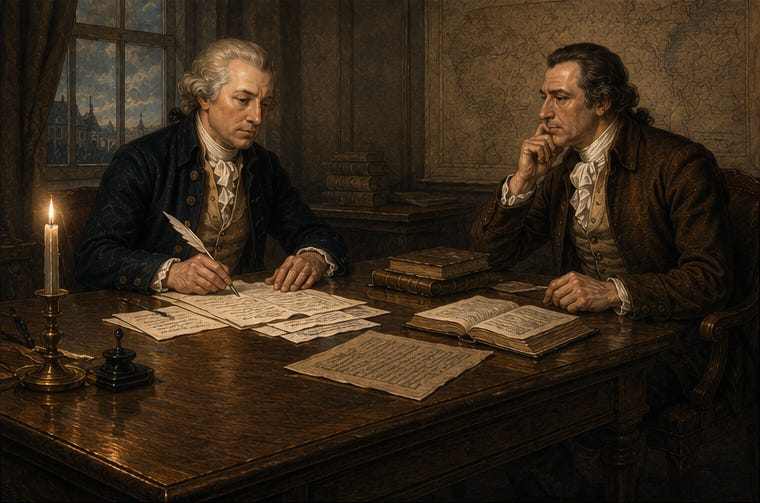
Hamilton had already described the problem in Federalist No. 15. Congress could pass resolutions, but without authority over individual citizens, those resolutions became “mere recommendations which the States observe or disregard at their option.” Congress tried to work around that weakness by proposing import duties in 1781 and again in 1783. Both efforts failed, leaving Hamilton convinced that a single state could frustrate the entire system.
By the time he reached Federalist No. 31, Hamilton believed the lesson was clear. A national government responsible for national obligations needed the authority to raise revenue directly. Since no one could predict the cost of the next war or emergency, that authority could not be confined within narrow limits established in advance. “As revenue is the essential engine” for meeting national needs, Hamilton wrote, the federal government “must of necessity be invested with an unqualified power of taxation in the ordinary modes.”
Hamilton had a strong case. A government that cannot pay its debts or provide for its defense will eventually discover that its other powers do not mean very much. But the Anti-Federalists saw a different danger inside the solution. They worried that a power granted to cure weakness would gradually change the character of the Union.
What Brutus Saw in the Taxing Power
The Anti-Federalist writer known as Brutus, widely believed to have been Robert Yates of New York, raised that question before Hamilton wrote Federalist No. 31. Yates had served as a delegate to the Constitutional Convention but left Philadelphia before the Convention completed its work. By the time the first Brutus essay appeared in the New York Journal in October 1787, he had become one of the strongest critics of the proposed Constitution.
Brutus did not treat taxation as one provision among many. He saw it as the power that would allow the rest of the federal government to grow. “The authority to lay and collect taxes is the most important of any power that can be granted,” he wrote, because it “will in process of time draw all other after it.”
That was more than an objection to taxes. Brutus was trying to understand what the new power would do to the relationship between Washington and the states. Congress would gain access to duties, imposts, excises, and direct taxation. The states would retain their authority, but they would be competing for revenue with a national government whose laws were supreme.
Brutus believed Congress should control duties on imports while the states retained greater authority over internal taxation. Hamilton rejected that distinction because he believed it would recreate the weakness the country had spent years trying to escape. Import duties might be enough in ordinary times, but a war could require much more.
The disagreement was not between people who understood the problem and people who did not. Hamilton saw the danger of giving the federal government responsibilities without the resources needed to meet them. Brutus saw the danger of giving it access to nearly every resource and trusting future generations to preserve the balance.
When the Argument Reached John Neville’s Door
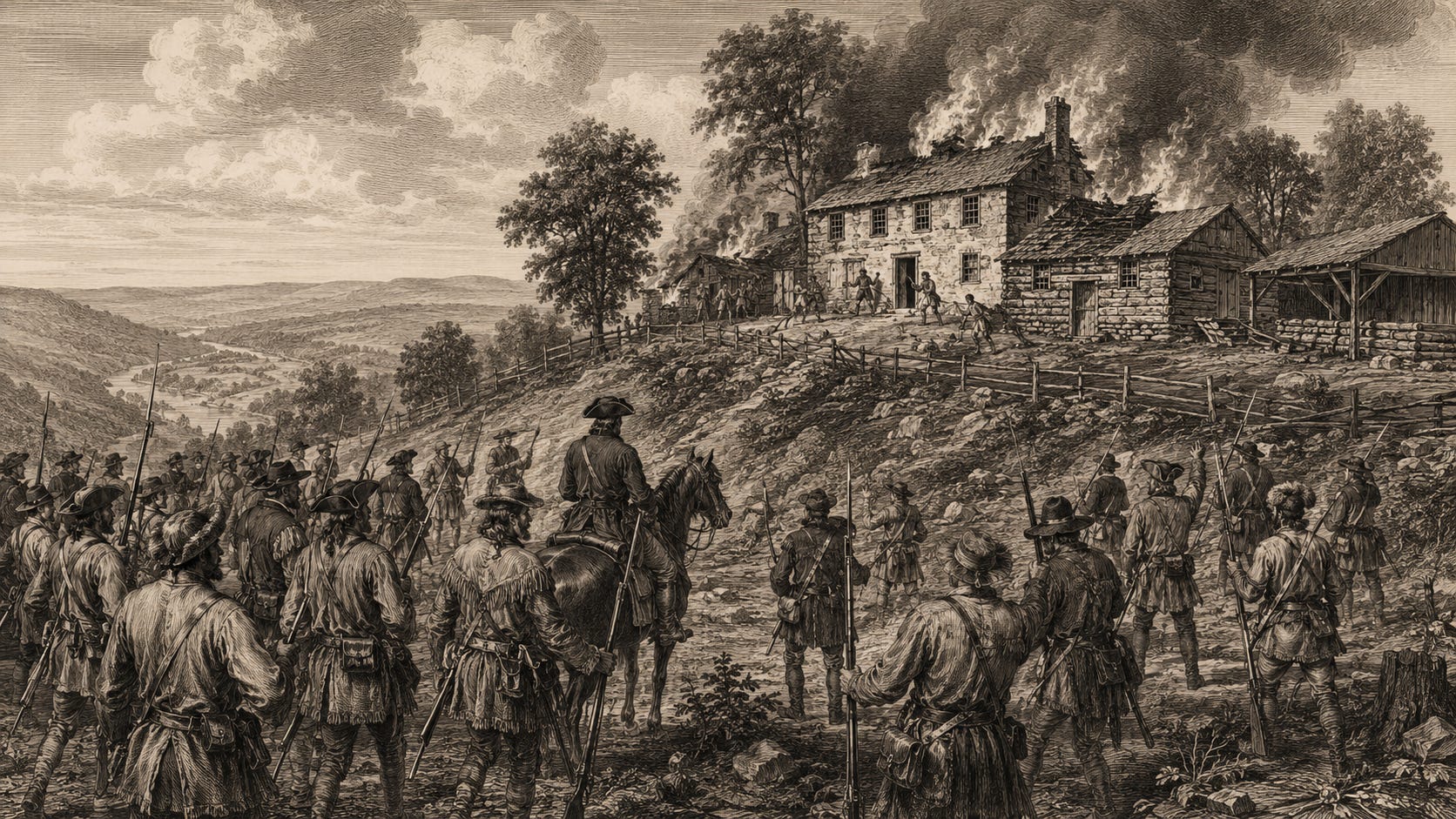
The disagreement did not remain theoretical for long. In July 1794, it arrived at the home of John Neville outside Pittsburgh. Neville was the federal tax supervisor for western Pennsylvania, charged with collecting the excise tax on distilled spirits that Congress had enacted at Hamilton’s urging. For farmers west of the mountains, whiskey was not simply a drink. It was a practical way to turn grain into something easier to transport and sell.
Resistance had been building for years. When federal officers began serving writs on distillers who refused to comply, the conflict escalated. Armed men surrounded Neville’s estate at Bower Hill and demanded the surrender of a federal marshal. Fighting broke out, and by the end, the house and outbuildings were burning.
President Washington responded by calling out a militia force of nearly 13,000 men. By the time the troops arrived, the rebellion had largely dissolved. But the episode made the stakes plain. The new federal government could do what the Confederation could not. It could levy a tax and enforce it.
Hamilton saw a government capable of governing, and he was right that a republic could not allow armed resistance to determine which laws would be obeyed. But Brutus might have seen something else. The stronger government had arrived, and the power to tax carried with it the authority and resources needed to make that power real.
From Taxation to Influence
The federal government remained relatively small for much of the nineteenth century, but the direction of travel was clear. The Sixteenth Amendment, ratified in 1913, allowed Congress to collect income tax without apportioning the burden among the states according to population. That did not create an entirely new taxing power, but it made federal revenue easier to collect at scale.
Federal authority also grew through spending. Washington developed a powerful way to shape decisions traditionally left to the states by attaching conditions to federal money. The clearest example came in the 1980s, when South Dakota still allowed 19-year-olds to purchase low-alcohol beer and Congress threatened to withhold a portion of the state’s federal highway funds unless it raised the drinking age to 21. Washington did not order the state legislature to change its law. It used money to make the alternative more expensive.
South Dakota challenged the law, and the Supreme Court upheld it in South Dakota v. Dole. Justice Sandra Day O’Connor dissented. Her concern was not that Congress could never attach conditions to federal funds. It was that highway money had become a tool for regulating a separate area of state policy. If that logic extended too far, she warned, Congress could reach “almost any area of a State’s social, political, or economic life.”
There was a serious public-safety argument for a uniform drinking age. But the case revealed how federal power had evolved. Washington did not need to eliminate the states when it could influence their decisions through money. That was the modern version of the concern Brutus raised two centuries earlier. The power to tax had become the power to spend, and the power to spend had become a way to shape decisions Washington could not always impose directly.
The Ratchet
The Anti-Federalist argument becomes more persuasive when we stop imagining the growth of government as a dramatic act of seizure. That is rarely how power accumulates. More often, it grows through decisions that appear reasonable on their own and become difficult to reverse after people begin to rely on them.
The danger is that emergency power rarely feels temporary once people have learned to live with it. What begins as a response to a particular failure becomes part of the country’s expectations, and after a while the burden shifts from justifying its creation to defending its removal.
Some of those programs have been necessary. Others corrected failures that the states were unable or unwilling to confront. There is no serious way to look at American history and conclude that every expansion of national authority was a mistake. But the cumulative effect matters. Authority moves toward Washington more easily than it moves back, and programs created for defensible reasons do not disappear simply because the circumstances that first justified them have changed.
Ronald Reagan captured the problem in his 1964 speech, A Time for Choosing: “Governments’ programs, once launched, never disappear. Actually, a government bureau is the nearest thing to eternal life we’ll ever see on this earth.” The line has lasted because it describes an institutional reality. Congress can create a program one vote at a time because each new program begins with a purpose and a constituency. Ending one is harder because every proposed reform becomes a separate fight, and each fight produces an argument for why this particular program should be spared.
Recovering Power
If power is easier to grant than to recover, restraint is not enough. The courts can police the outer boundaries, but they cannot rebuild the balance on their own. A citizen movement can create pressure, but without a process for returning authority, that pressure eventually turns into another slogan.
The best model may come from an unlikely place: the Base Realignment and Closure process, better known as BRAC. Beginning in the late twentieth century, Congress faced a problem it could not solve through ordinary politics. The country had more military installations than its post-Cold War needs, but closing a base meant that jobs, contracts, and local influence would disappear from someone’s district.
So Congress changed the process. An independent commission reviewed military installations and recommended a package of closures and realignments. The President and Congress could accept or reject the package as a whole, but they could not carve it apart one base at a time. That mattered because it prevented every local interest from defeating the larger national decision.
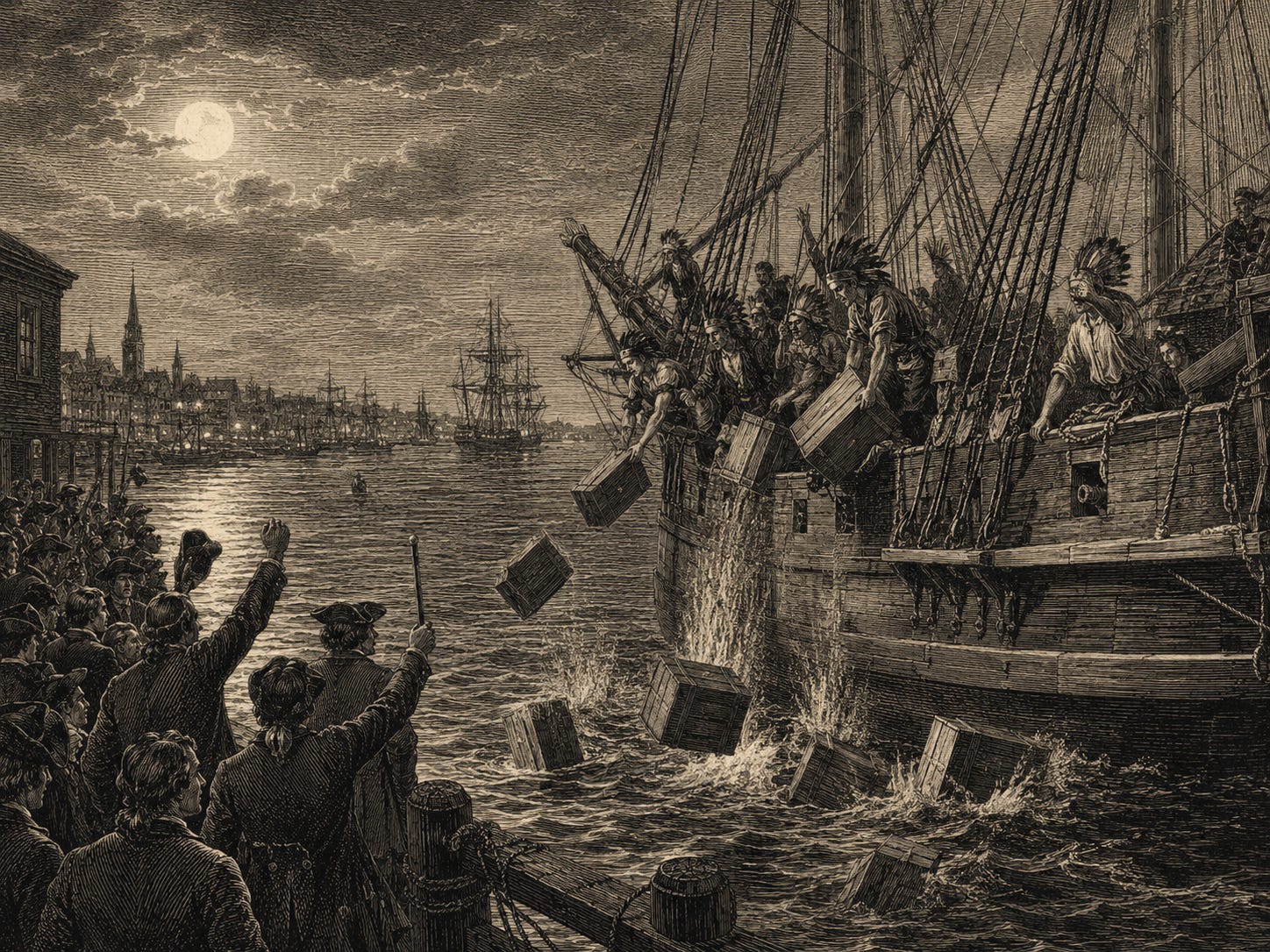
Returning authority to the states will require the same kind of discipline. Congress should create a HARBOR Commission, modeled on BRAC: Handing Authority and Responsibility Back to Our Republic. The name carries a little history. Americans once protested distant taxation by throwing tea into the Boston Harbor. HARBOR would be less theatrical, though there may still be some satisfaction in throwing a few taxes into the harbor along the way.
Its task would be easy to state and hard to execute: identify which federal responsibilities still require federal control, which should be returned to the states, and which no longer justify their existence. The recommendations would come as a single package of transfers, consolidations, and closures so Congress could not spare every favored program one fight at a time.
That structure matters because ordinary politics is built to protect the familiar. The point is not to cut for the sake of cutting. It is to force the question Congress usually avoids: where does this responsibility belong?
The debt makes that question harder to postpone. The next fiscal crisis will not arrive as a seminar on federalism. It will arrive as pressure and an emergency. In moments like that, constitutional limits are often treated less like rules of self-government than obstacles to be overcome. In the current political climate, even asking whether Washington has the authority to act can be treated as a refusal to care about the problem.
That is how constitutional government weakens. Not usually through open contempt, but through impatience. A crisis arrives, and the demand for action becomes absolute. Limits that once defined the system begin to look like excuses. Before long, anyone who insists on those limits becomes the problem.
That is why HARBOR matters. If there is no mechanism for returning power before the next crisis, the crisis itself will become the mechanism for expanding it. Hamilton was right that a government too weak to act could not survive. Brutus was right that a government accustomed to acting would not easily yield power back. The work now is to build a way back while constitutional limits still have a fighting chance.
Can’t say that I totally agree with your analysis and proposed solution, but it certainly makes more sense than DOGE and Trump’s reckless dismantling of government based on nothing more than his whim and Project 2025 outline.
HARBOR is a great idea. But I think we need to take it one step further and redesign the entire executive branch. If we started the federal government again with a blank sheet of paper, it would look very different than it does today and would certainly be more efficient and effective.