


Americans love to argue about taxes, but we rarely argue honestly about what they reveal. Most tax debates focus on who pays. Far fewer ask whether the public can still see clearly enough to understand what they are paying for. We have built a tax code that touches nearly every part of public life, yet hides behind rules few can follow without help.
Hamilton would have recognized the danger. Federalist No. 30 is usually treated as a defense of federal taxing power, but the deeper issue is accountability. A government that promises what it cannot finance is dishonest. Financing what people cannot understand creates a different problem. We all know the taxman collects, but we can no longer see him clearly.
The Cost of the Articles
When Hamilton wrote Federalist No. 30, the young nation was struggling under the Articles of Confederation. Congress could request money from the states, but it could not compel payment. Hamilton wanted a government powerful enough to function, but accountable enough to trust. The national government carried responsibilities it could not reliably support.
Hamilton saw the contradiction immediately. “Money is, with propriety, considered as the vital principle of the body politic,” he wrote, “as that which sustains its life and motion, and enables it to perform its most essential functions.” Many modern readers stop at the word “money” and assume Hamilton was talking about wealth. He was talking about capacity. Responsibilities without resources are just promises.
The problem under the Articles was not only financial weakness but confusion. Congress could blame the states, and the states could blame Congress. The public had no clear way to know who was responsible when obligations went unmet. Hamilton believed responsibility and authority were bound together. If the federal government carried national obligations, it needed the power to meet them. Only then could the public know who deserved credit when government succeeded and who deserved blame when it failed.
A Different Problem
Today, the problem has taken a different shape. Hamilton worried that the federal government lacked enough authority to raise revenue. Few would make that argument now. Washington has the power to tax, but power is no longer the issue. Clarity is.
The tax code began as a way to raise money. Over time, Congress made it carry more of the work of governing. A choice that might look costly in the budget can look less visible in the tax code, even when it still shapes behavior and shifts resources. That does not make every tax preference wrong. It does mean the public has to work harder to see what has been done.
That is where complexity becomes more than a tax problem. The more Washington hides choices inside the code, the harder it becomes to hold anyone responsible for them. Hamilton feared a government too weak to meet its financial obligations. We should fear one that forgets its obligation to the people paying the bill.
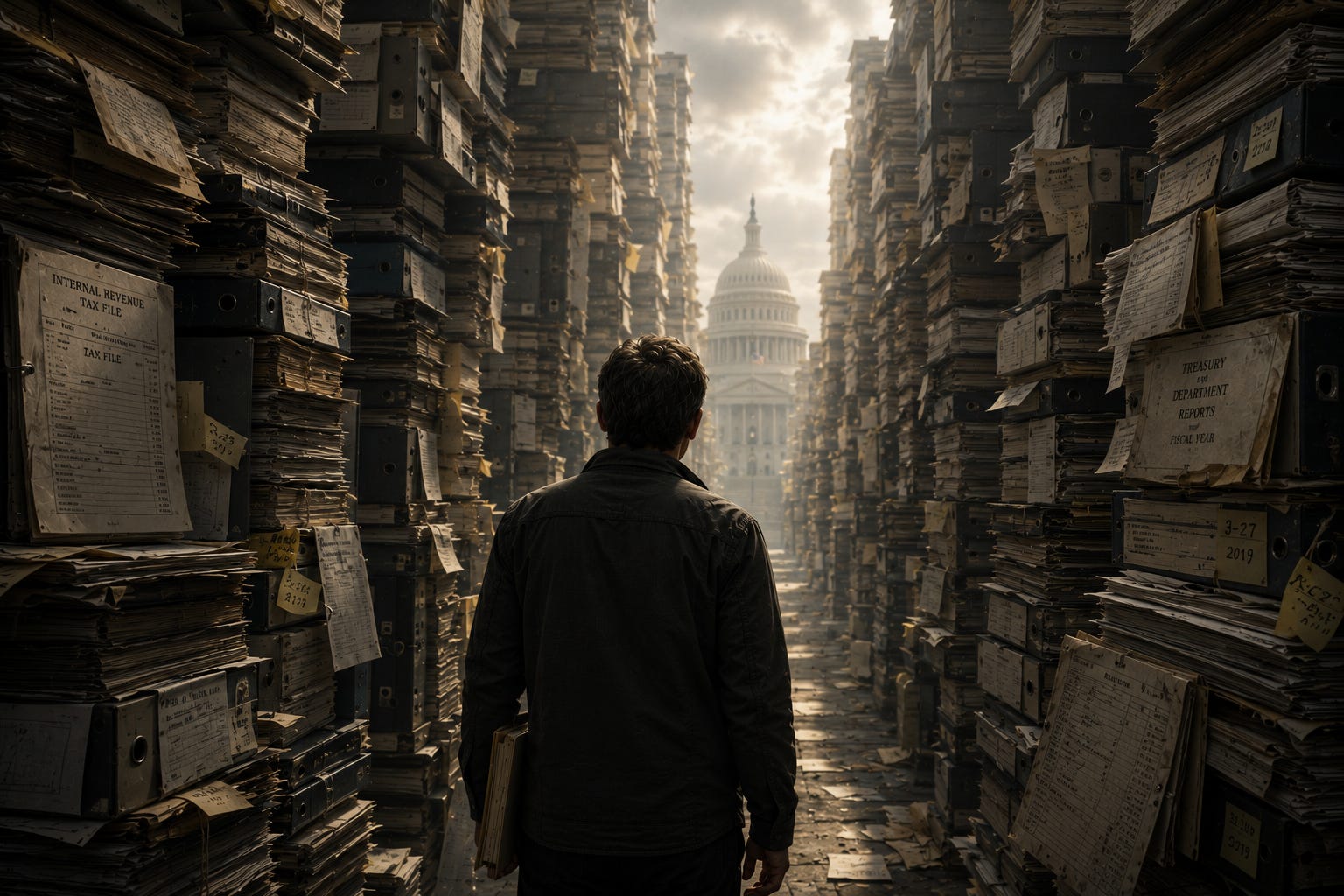
That is the danger of a tax code that becomes too hard to follow. It does not merely confuse people. It changes the relationship between the government and the governed. The people who know how the system works gain leverage. Everyone else is left to comply first and understand later.
The Transparency Deficit
Americans do not get to opt out of the tax system. We live under the code whether we understand it or not, which is why its rules should not become clear only after the bill comes due. Most people accept that taxes are necessary. What they should not have to accept is a government that sends the public a surprise bill for decisions it never got to see clearly.
That matters because taxes are not just numbers on a return. They represent a portion of someone’s life already spent earning the money. When the cost only becomes clear later, people are right to wonder whether the rules were written with them in mind.
If citizens are expected to obey the law and pay their bills, they should be able to understand the rules. If only the taxman knows the rules, taxation without representation takes on a new form.
The Game Is Not Neutral
Complexity is often defended as the unavoidable cost of governing a modern economy. There is some truth in that. A country this large will never have a tax code that fits on a postcard, and pretending otherwise does not help the argument. But complexity does not fall evenly. It favors the people who can afford to understand the rules before everyone else even knows where to look.
That is where the imbalance begins. Expertise has value, and there is nothing wrong with hiring good advice. The problem comes when the system depends so heavily on specialists that ordinary taxpayers can no longer follow the rules without them.
Most Americans are not studying the tax code in their spare time. They are trying to live their lives and make good decisions with the information they have. When the rules become too complicated for most people to follow, the public loses more than convenience. It loses confidence that the same system is working the same way for everyone.
Hamilton’s Challenge
Federalist No. 30 contains another line that deserves more attention. Hamilton argued that “a complete power… to procure a regular and adequate supply” of revenue “may be regarded as an indispensable ingredient in every constitution.” It is often read as a defense of federal taxing authority, and it is. But Hamilton was also setting a standard: if government claims responsibility, it must show the means.
That standard still matters because revenue is not only a tool of government. It is also a test of accountability. The question is not only whether Washington can collect. It is whether the people funding the system can still judge it.
This is where Hamilton’s argument turns back on modern government. He wanted a Union with enough power to meet its responsibilities, but that power was never meant to become distant from the people who fund it. Revenue should make the government function. It should not give the government shelter from accountability.
Trust Requires Light

Hamilton won the argument over federal revenue authority long ago, but the question beneath Federalist No. 30 did not disappear. The old question was whether the government had the means to act. The modern question is whether the public can still see how that power is being used.
That is where modern America has work to do. Washington can move money at a scale Hamilton could not have imagined. The problem is not that the government acts. The problem is that too much of its work now happens where the people paying for it cannot clearly see it.
Self-government asks more of us than voting. It asks us to see power clearly enough to challenge it. That becomes harder when the rules are written for people already inside the system.
Free people should never have to guess how they are governed.
Scott - you are well on your way to a book! Appreciate the series!
You write "Most people accept that taxes are necessary." Well...:
https://www.pewresearch.org/short-reads/2026/04/06/top-tax-frustrations-for-americans-feeling-that-some-wealthy-people-corporations-dont-pay-fair-share/
Wealthy Republicans, especially strongly conservative Republicans complain about taxes more than other Americans, and spend a lot of money electing federal government legislators and the president to create a tax system that favors them. This is wrong-headed. We have only to look to Western Europe and especially Scandinavia to see how modern, well-run governments ought to work: highly progressive federal income taxes, and a robust government that benefits all citizens. What we Americans pay in taxes PLUS all the things that European nations provide their citizens (higher education, health care, social welfare and a higher standard of living, etc.) is more than what Europeans pay. We're getting screwed by the fat cats and the Republicans. It's just that simple. And we've had this argument for decades - and we'll continue to argue about it, because we're a young nation and we haven't rooted out enough of the rich fat cat whiners yet.