


The Diagnosis Is Easy
Americans have never lacked confidence in their diagnoses of national decline. Every age finds proof that the republic is weakening, and ours is no exception. We can spend a great deal of time naming what feels broken, but diagnosis has a way of becoming its own substitute for action. The harder question is what might make us healthier.
That is why Federalist No. 29 deserves a better reading than it usually receives. At first glance, it can feel like one of the more technical essays in the series, focused primarily on the militia and national defense. But Hamilton is working toward a larger question that still matters: what keeps a free people free?
Hamilton’s argument rested on a simple idea. Liberty survives only when citizens remain connected to the responsibilities of self-government. Read that way, Federalist No. 29 becomes more than a technical debate about military readiness. Beneath the constitutional mechanics, Hamilton asks whether a republic can preserve freedom once its citizens grow detached from the work of preserving it.
The Fear Behind the Argument
The Anti-Federalists were not foolish to worry about military power. They had history on their side. Americans had just fought a revolution against imperial authority, and many remembered British troops not as abstract defenders of order, but as instruments of control. To people who had lived through that experience, giving the new federal government authority over the militia sounded less like efficiency and more like restoring the crown under a new name.
Hamilton understood the fear. One reason The Federalist Papers endure is that their authors rarely treated objections to the Constitution as unserious. They often thought those objections were wrong or overstated, but they understood their force. In Federalist No. 29, Hamilton was writing to citizens who feared that the very government created to protect liberty might someday command the means to destroy it.
His response was practical rather than sentimental. Hamilton argued that the federal government needed meaningful authority over the militia because common defense could not depend on scattered systems moving in different directions. A nation that could not organize its own defense would eventually discover that disorganization is not a theory of liberty. It is an invitation to danger. When he wrote that militia authority was one of the “natural incidents” of providing for the common defense, Hamilton meant that the duty to defend the nation carried with it the authority necessary to do so. If the Union had the duty to protect national survival, it needed the tools to meet that duty.
Hamilton distrusted political arrangements that depended on everyone behaving nobly at the same time. The Articles of Confederation had already shown the danger of a national government that could request and hope, but not reliably act. He wanted a republic capable of defending itself, not because he worshiped power, but because he understood that weakness could endanger liberty as surely as ambition.
The Limits of Theory
Federalist No. 29 is not a blank check for central power. Hamilton spends much of the essay explaining why the militia system would not become the nightmare his opponents imagined. He rejected the idea that the federal government could realistically turn the whole population into a constantly drilled military force. Trying to discipline the entire body of the people, he argued, would be both “mischievous” and “impracticable.” It would burden ordinary citizens, disrupt productive life, and turn civic obligation into a weight few people could reasonably sustain.
Hamilton’s answer is more restrained than the caricature usually allows. He was not imagining a country organized around permanent military readiness. He was trying to solve a practical problem: how to give the republic enough capacity to defend itself without letting defense consume the ordinary life of its citizens. His proposed “select corps” of the militia was an attempt to hold that line. It kept the people connected to the work of defense without asking every citizen to live as a part-time soldier.
That balance is the heart of the essay. Hamilton wanted the republic to be capable of defending itself without allowing defense to consume civic life. He wanted federal authority, but not a system in which the people disappeared from the equation. Properly understood, the militia was not only a military instrument. It was a reminder that the defense of a free society should remain connected to the citizens who live under it.
The Citizen Soldier and the Republic
Federalist No. 29 becomes larger and more hopeful when read as an argument about citizenship. A free people cannot treat the republic as someone else’s responsibility, push every duty upward, and then wonder why their institutions feel distant and unresponsive. Liberty depends on a living connection between citizens and the system they expect to preserve their freedom.
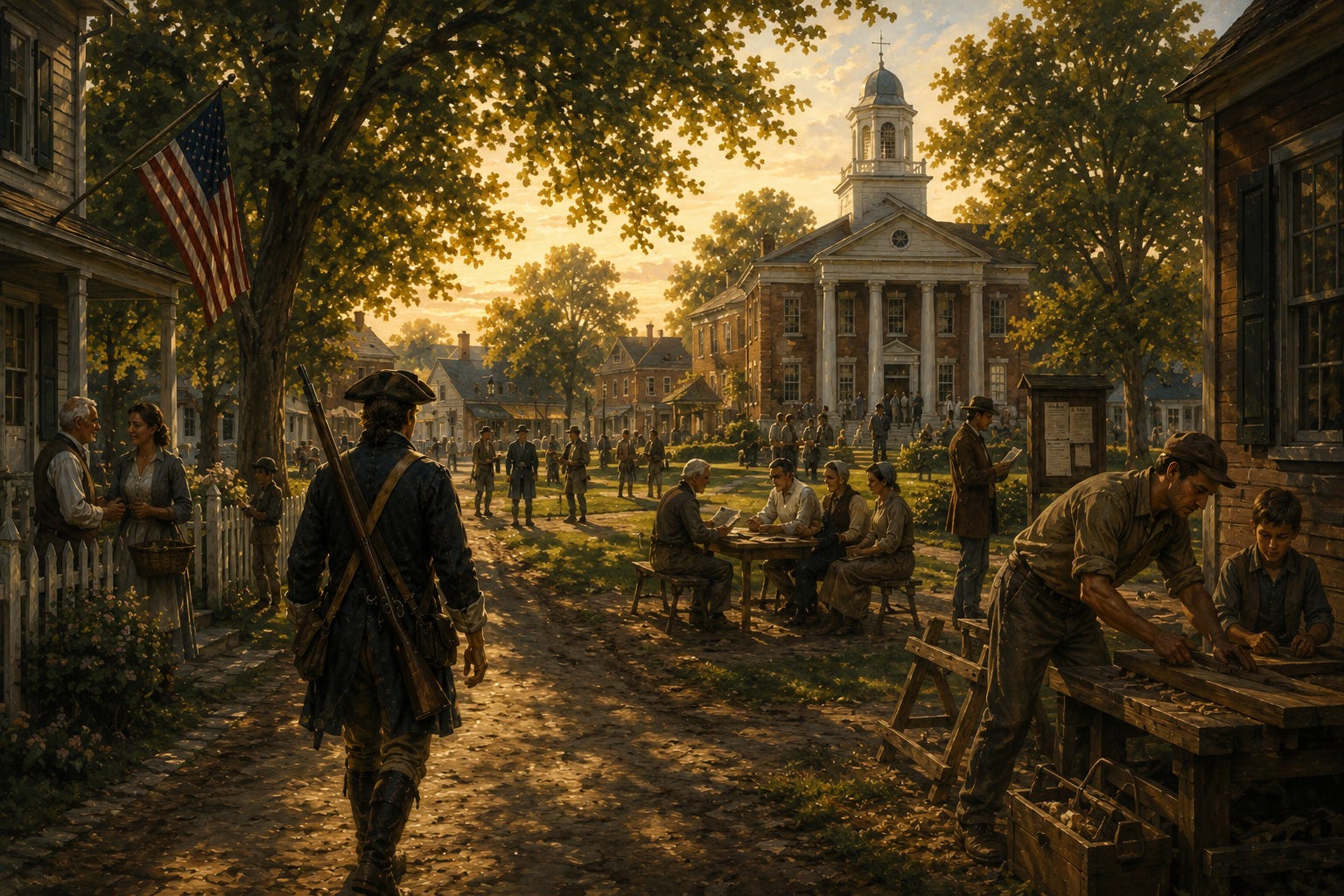
The Citizen Soldier embodies that connection. The idea is not simply that civilians may be called into military service. It is that service leaves behind the habits a republic needs long after the uniform comes off. The Citizen Soldier serves when called, then returns home to the longer work of citizenship.
That is what makes the idea hopeful without making it sentimental. Hamilton was not asking Americans to admire a cleaner past. He knew the republic had been born in argument and would live in argument. His confidence rested on something harder: the belief that free people could disagree fiercely and still accept enough obligation to keep the country from coming apart.
The Modern Habit of Outsourcing

Our problem is not that Americans lack opinions. It is that opinion has become too easy to mistake for citizenship. We can react to politics all day without accepting responsibility for it. Hamilton would have recognized the danger. A republic does not survive because people admire liberty from a distance. It survives when citizens accept personal responsibility for whether freedom endures.
The Constitution can set the framework, but it cannot supply civic will. That work belongs to the people. Federalist No. 29 reminds us that liberty cannot be handed off to others or preserved by spectatorship. The republic needs citizens who still believe freedom asks a sacrifice of them.
That is the promise inside the Citizen Soldier ideal. Service is not only what happens in uniform. It is the habit of answering when the republic calls and carrying that obligation back into ordinary life. A country that remembers that habit has not lost its way. It still knows how to find its way back.
The Hope Inside the Essay
Federalist No. 29 carries warnings, but its deeper current is constructive. Hamilton believed the American experiment could work if free people remained close enough to the responsibilities of self-government. He did not ask Americans to choose between security and liberty. He asked them to build a republic capable of preserving both.
That belief is easy to miss because modern readers often come to Hamilton through the lens of his conflicts. We remember the ambition, the financial system, the fights with Jefferson, and the fatal duel that still casts too long a shadow over his public memory. But Hamilton’s constitutional writing is animated by a stubborn faith that the republic could be made to work if its design matched human nature.
There is hope in that realism. Hamilton did not ask Americans to become angels. He asked them to build institutions suited for flawed people who still wanted to live free. That may be one of the most useful lessons for our own time. We do not need a political system that waits for Americans to become less angry or less tribal. We need civic habits strong enough to help us act responsibly anyway.
Hope, then, is not denial. It is not pretending the republic is healthier than it is or using slogans to avoid hard truths. Hope is the belief that free people still have the power to repair what has weakened and that national dysfunction does not excuse personal withdrawal. That kind of hope is harder than cynicism because it asks something of us. It asks us to do the work of freedom.
The Right Prescription
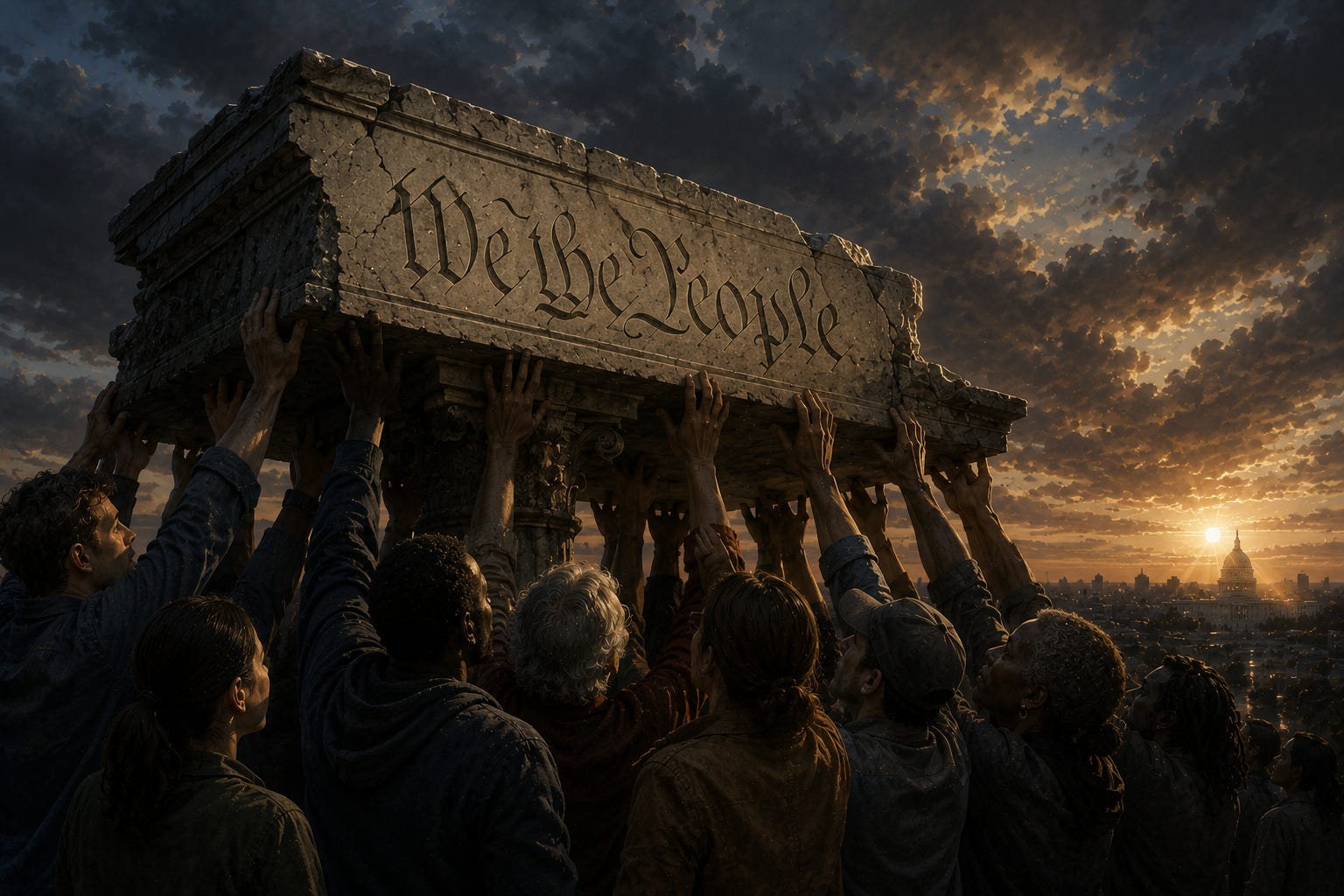
The cure for what ails us will not come from a politics built around resentment, nor will it come from protecting the powerful because they happen to wear the right party label. Citizenship requires something more honest than that. It asks us to hold elected officials accountable regardless of party and to reject the old habit of political insiders shielding their own while asking everyone else to carry the cost. A country cannot outrage its way back to health. It has to recover the habits that make self-government possible.
That is the older and better meaning of citizenship Hamilton points us toward in Federalist No. 29. The militia question belonged to his time, but the principle behind it still belongs to ours. Liberty endures only when free people remain connected to the republic and to the responsibilities of citizenship.
That is the cure: renewed citizenship, rooted in the belief that freedom still asks something of us and that Americans are still capable of answering. For a country tired of diagnosing its own decline, that may be the hope Hamilton leaves behind: the cure is still in our hands.
The modern incarnation of federalist 29 is compulsory federal service. Everyone who does not serve in the military serves for 2 years as a fed. If they're college bound, they serve after they finish all their degrees. The service can be deferred until, say 30, if people want to, as there is probably more value in people coming in mid-career when they have more skills and can get more exposure to the real workings of government. But whenever they arrive and wherever they work all the people should spend time in the system to better understand it and feel more accountable for the outcomes.
Scott: This is another great essay and it shows how Hamilton was thinking about the same questions/issues that occupied the intellectual pursuits of John W. Gardner (1912-2002) - college professor, cabinet official, advisor to five U.S. presidents, and the founder of Common Cause. Your work is overlapping with mine and would love to catch up this summer (away for the month of June). My email: msiwik@sandrunrisk.com. All the best, Mark