


A Man Returns Home
In August 1895, Wong Kim Ark returned to San Francisco after a temporary trip to China and found that the federal government would not let him reenter the country where he had been born. Officials argued that birth on American soil did not make him a citizen under the Fourteenth Amendment, and that claim eventually reached the Supreme Court. In 1898, the Court rejected the government’s position and held that a man born in the United States to non-citizen parents who were permanently domiciled here was a citizen at birth.
That story still carries weight because it reminds us that the argument over birthright citizenship did not suddenly appear in the age of cable panels and executive orders. It is an old constitutional dispute, and from the beginning it has involved more than theory. It has forced the government to answer a basic question about law and belonging: when a person stands before the state, born here, does he belong here or not? More than a century later, the Supreme Court must again confront the scope of birthright citizenship. But the part of the case that keeps drawing me back is not only the debate over text. It is the question of whether an administration that rejects the current legal understanding may try to force a new one into place through executive action when Congress has already spoken through statute, and the courts have already spoken through precedent. Once that becomes the issue, the case no longer concerns immigration policy alone, or constitutional interpretation in the abstract. It becomes a case about how the law changes and whether the country still expects major legal change to move through the institutions that test it and legitimize it.
The Question Beneath the Case
There is nothing improper about arguing that the law has taken a wrong turn. Congress can write a bad statute. Courts can misread a constitutional provision. Even a longstanding legal settlement can deserve another look if the case for rethinking it is serious enough. That is part of republican life. It is how a constitutional system stays alive rather than turning itself into a shrine to old conclusions. So the point here is not that birthright citizenship must remain forever beyond debate. The point is that the Constitution does not treat every possible route to change as equally legitimate. Some routes force scrutiny, consent, and institutional testing. Others try to achieve by executive speed what the constitutional order ordinarily requires people to earn through argument and persuasion.
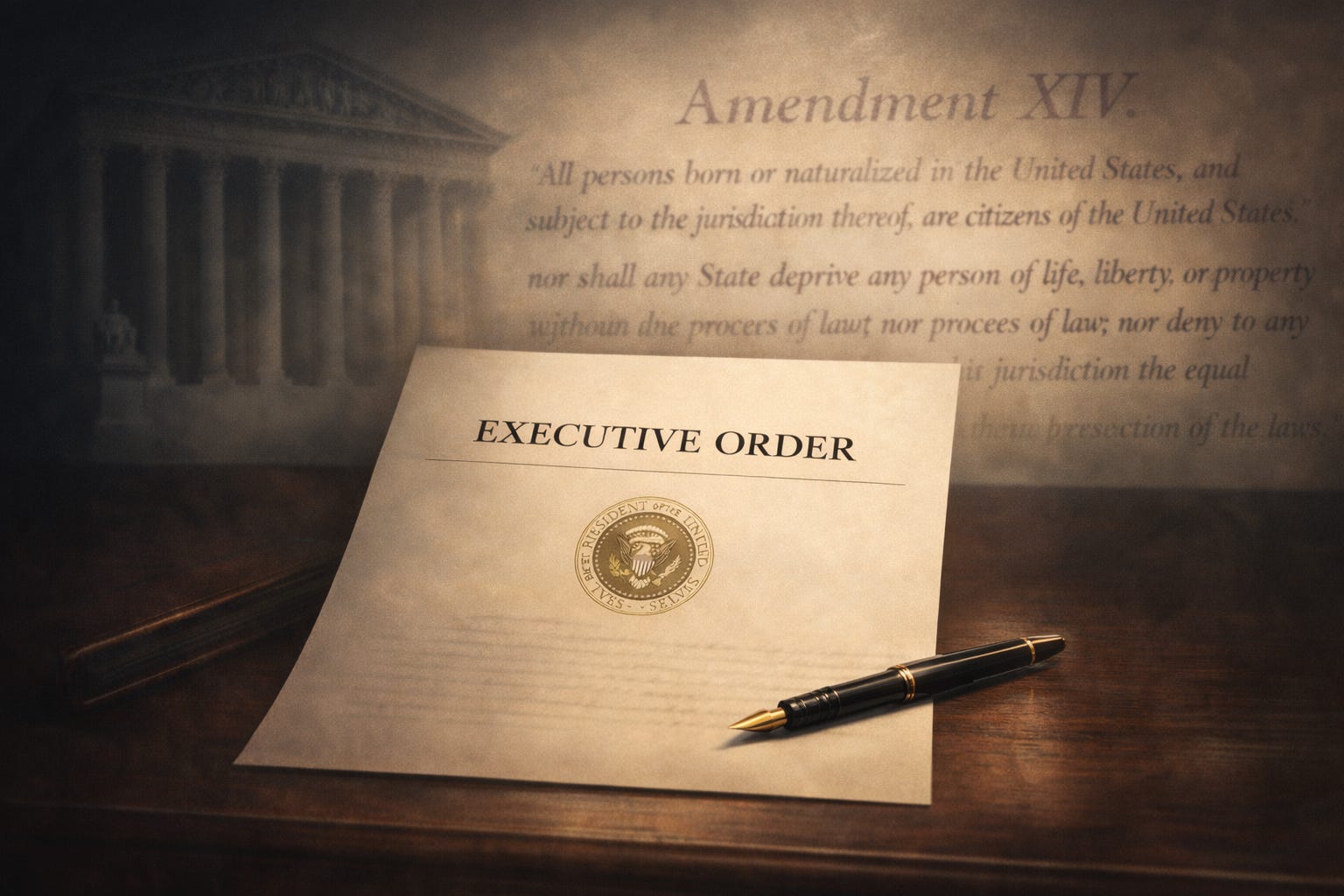
That distinction matters because of the posture of the present dispute. On January 20, 2025, President Trump signed an executive order titled “Protecting the Meaning and Value of American Citizenship,” directing the federal government not to recognize citizenship for certain children born in the United States to mothers who were unlawfully present or temporarily present, unless the father met certain citizenship or permanent-resident conditions. Lower courts blocked the order, and the Supreme Court heard arguments on April 1, 2026. What makes that sequence important is that the administration is not merely floating a constitutional theory in an academic journal or, in the ordinary course, asking the judiciary to reconsider precedent. It is asserting executive authority in an area where the governing legal order already includes constitutional text, a federal statute, and long-settled Supreme Court case law. Title 8 of the United States Code states that a person born in the United States and subject to its jurisdiction is a citizen at birth. The administration, then, is not simply offering an interpretation. It is trying to push around an existing legal structure rather than work through it.
Why Method Is Part of the Substance
That is why method matters here, and why it should matter even to people who are open to revisiting the current understanding of birthright citizenship. The Constitution does not leave the country helpless when citizens or officeholders believe that a major legal question has been wrongly settled. Congress may revise statutes. Litigants may ask the judiciary to narrow, distinguish, or overturn precedent. And if the country genuinely comes to believe that constitutional text itself should change, Article V remains available. None of those paths is quick, and none is easy, but that does not show constitutional failure. It shows that the American system requires more than executive impatience before the legal ground shifts beneath the public.
In other words, the process here does not distract from the real question. In constitutional government, process helps answer it, because it shapes how officials exercise power, how institutions build legitimacy, and what future officeholders think they can claim for themselves. When a president uses an executive order to unsettle a structure that Congress and the courts have already reinforced through statute and precedent, the lesson reaches well beyond the policy dispute at hand. He teaches the country that certainty and impatience can make the ordinary channels of legal change look optional. That habit has consequences. It encourages the public to treat the constitutional order not as a framework within which power must operate, but as a set of obstacles that the boldest branch can manage if it moves first and forces everyone else to react later.
What the Federalists Still Have to Say

This is where the Federalist frame helps, not because the eighteenth century offers easy answers to every modern question, but because it still offers clarity about structure. Hamilton argued for energy in the executive because he understood that government without vigor can become incoherent, evasive, and weak. But he did not defend executive energy in order to blur the line between enforcing the law and remaking it. He defended decisiveness in administration, accountability in office, and the capacity to act where the Constitution and the law had already entrusted action to the executive. He did not argue that a president should push aside the ordinary work of lawmaking and adjudication whenever Congress moves too slowly and the courts seem likely to resist.
Madison’s framework points in the same direction. The Constitution assumes ambition, rivalry, and institutional friction, which is precisely why it divides power rather than concentrating it. The Framers did not expect one branch to take the lead on every urgent question while the others scrambled to catch up. They wanted difficult matters to pass through more than one center of authority so that law, especially on questions of enduring importance, would carry more legitimacy than the will of a single officeholder. Viewed through that lens, the birthright citizenship case is not simply another policy clash. It reflects a broader trend in modern governance, in which presidents of both parties increasingly cite congressional paralysis, legal complexity, and political urgency as reasons to expand executive initiative. The script now sounds so familiar that people mistake it for common sense: Congress will not act, the issue is too important to wait, and the courts can sort it out later. But that is not really a theory of constitutional government. It is a habit of executive impatience that has grown easier to defend only because the rest of the system has grown too accustomed to it.
This Is Not an Argument for Freezing the Law
None of this requires anyone to pretend that the present legal understanding of birthright citizenship lies beyond challenge. It does not. People who believe that Wong Kim Ark should be read narrowly, or that modern assumptions about citizenship have drifted away from the original meaning of the Fourteenth Amendment, have every right to make those arguments. They can bring them to court. They can make them in scholarship, in Congress, and in public debate. There is nothing un-American about pressing for legal change. On the contrary, a healthy republic depends on the ability to argue for legal change within the constitutional order itself.
What does not follow, though, is that executive action may stand in for that larger constitutional labor. An administration may challenge precedent, but it should not act as though an executive order can perform the work that belongs to Congress, the judiciary, or the amendment process. To my mind, that is the stronger argument in this case because it avoids the lazy mistake of treating precedent as sacred and change as illegitimate. The issue is not whether change may happen. The issue is whether a president may announce a narrower constitutional view, instruct the bureaucracy to enforce it, and leave the rest of the system to absorb the shock. On a question as consequential as citizenship, that is very hard to defend. The Court may yet choose to narrow or revisit existing doctrine, but that is a different thing altogether from allowing the executive branch to behave as though that work has already been done.
The Better Standard
A better standard would begin with a simple but demanding premise. If Americans want to revisit birthright citizenship, they should do so openly and lawfully, through the institutions that give lasting change its legitimacy. They should make their argument in court and ask the judges to reconsider the doctrine. They should make the argument in Congress wherever Congress has room to act. And if they truly believe the constitutional text has been wrongly understood at the deepest level, they should make the harder case for amendment. That path is slower, less dramatic, and much less satisfying for leaders who want immediate victories. But constitutional government was never designed to guarantee quick wins for the side most persuaded of its own righteousness. It was designed to ensure that lasting change would be tested by institutions broad enough to legitimize it and sturdy enough to slow it down.
That is also why executive shortcuts do so much damage over time. Their effect does not stop with a single policy or administration. They teach the public to think that constitutional order is optional whenever the issue is urgent enough and the president is determined enough. Once that mindset takes hold, it does not stay boxed inside immigration law. It reappears wherever a future administration decides that legislation is too slow, the courts too uncertain, or public persuasion too burdensome. And every time it reappears, the same claim returns with it: the matter is too important to wait, so the executive must act. A republic can survive episodes of that reasoning. What it cannot do, at least not without cost, is turn that reasoning into a governing style.
Closing Thought

The story of Wong Kim Ark still matters because it reminds us how much is at stake when the government treats citizenship as something it can narrow first and justify later. But the larger issue in the present case is whether the country still believes that constitutional ends must be pursued through constitutional means. That concern is not abstract, and it is not merely procedural. It goes to the heart of how modern presidents understand power and how Congress has too often allowed itself to become a spectator, condemning executive overreach in theory while tolerating it whenever the overreach comes from the right political team. The result is a political culture that rewards motion, mocks restraint, and slowly teaches the public to treat the ordinary constitutional route as unusual simply because it is slower and more demanding.
That is a bad bargain for everyone. A republic cannot preserve its balance if each branch defends the Constitution only when it is losing. On a question as weighty as citizenship, that should be clear enough. If birthright citizenship is important enough to revisit, then it is important enough to revisit honestly through the courts, through Congress, and, if the country is prepared for it, through the amendment process. What should concern us is not only the answer the Court eventually gives, but whether we have become so accustomed to executive shortcuts that the ordinary constitutional route now feels exceptional. If that happens, the deeper loss will not be confined to this case. It will be felt across the whole structure of self-government.
You're right, but I suspect the ending of the EO excess will not happen until Congress deigns to fulfill its role
Scott - an excellent piece. You've, appropriately, separate the questions of birthright citizenship from that of executive orders. While my personal opinion is that the citizenship question is settled law and has been raised simply to stir up racist anger, the way in which each successive president has attempted to re-write the law through their EOs is an insult to the citizenry and the constitution. Fortunately the courts are correcting some of the overreach of the current administration, but not going far enough.