


Introduction
By the end of the Civil War, the United States had preserved the Union but left one of the Constitution’s most difficult questions unresolved. Four million people were suddenly liberated from slavery, but the Constitution offered no clear answer to what that freedom meant.1 Nearly a century after independence, the country finally confronted the question of American citizenship at a national level. More importantly, if those rights were denied, who had the duty to protect them?
Leading up to the war, citizens' legal rights largely depended on their state of residence. Though the federal government exercised its authority at the national level, it did little to directly protect citizens against the states. Emancipation introduced a new conflict: freedom meant little if states could still deny ordinary citizens their rights.
Madison described America’s republic as a “double security” to the rights of the people.2 The state and national governments would serve as a check on one another, giving citizens, in theory, more than one protection of their rights. Reconstruction, instead, exposed a limit when the government closest to the people was the source of oppression.
The constitutional response came in the form of three constitutional amendments adopted over five years.3 The Thirteenth Amendment abolished slavery, but freedom alone did not immediately settle which rights accompanied it. The Fourteenth Amendment clearly established citizenship and prohibited states from denying due process or equal protection under the law. Finally, the Fifteenth Amendment barred racial discrimination in voting.
Together, the Reconstruction Amendments did more than repair the Union. They changed the dynamic of our constitutional rights. While the Bill of Rights was designed to restrain the federal government, Reconstruction established a federal role to protect our rights against state denial. The Civil War had settled slavery and secession through force, but it had not settled what citizenship would mean afterward.
A Second Founding
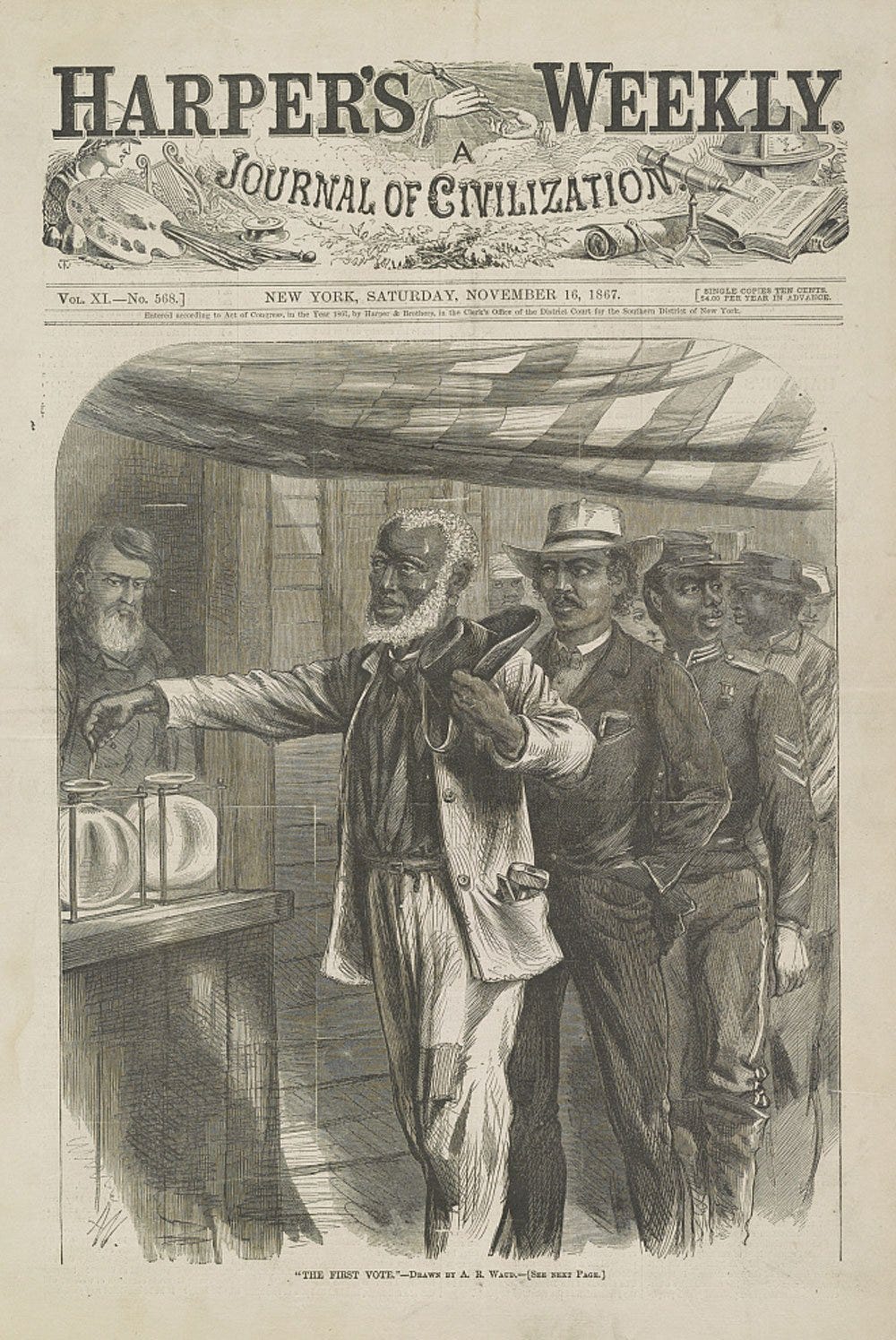
During Reconstruction, a new constitutional order spread across the South. Congress required most former Confederate states to adopt new constitutions and ratify the Fourteenth Amendment as conditions of full reentry into the Union. Black men who had until recently not been considered citizens were now voting on those constitutions, serving on juries, and entering public office.4 In 1870, Joseph Rainey of South Carolina and Hiram Rhodes Revels of Mississippi became the first Black men to serve in the U.S. House and U.S. Senate respectively.
Reconstruction also changed what southern state governments felt obliged to provide. Public education, which had largely been limited across the South, became one example. South Carolina’s 1868 constitution required public schools to be open to children “without regard to race or color,” an effort to address the social and civic conditions slavery had created.5 Less than thirty years later, Ben Tillman would lead the political effort to replace that Reconstruction constitution and restrict the political rights established under it.
New federal power gave the new constitutional order more practical force. On the military side, the Army protected both voters and Reconstruction governments, while the Freedmen’s Bureau helped former slaves transition to freedom. White supremacist violence posed a threat to that progress, and Congress enacted the Enforcement Acts to give federal authorities greater power to protect voting rights and prosecute political violence. Those efforts weakened groups like the Ku Klux Klan and gave the new amendments some practical force. This would prove to be a temporary solution to a much deeper challenge.6
When Enforcement Failed
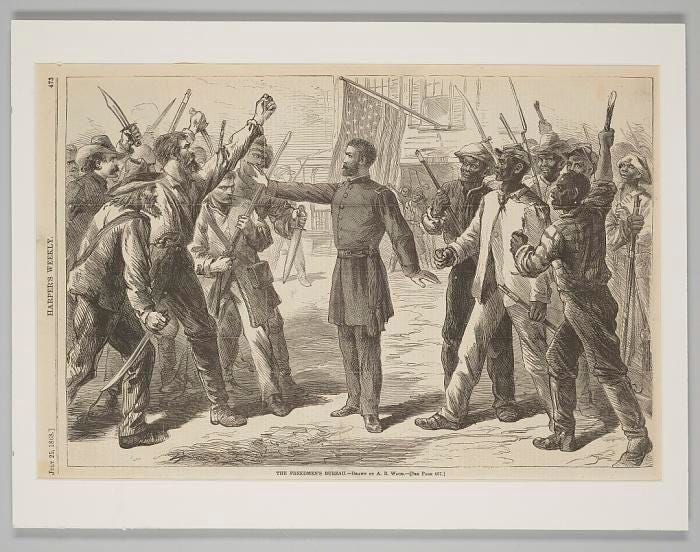
The rise of Reconstruction also brought the rise of groups like the Ku Klux Klan, which used violence and intimidation to suppress Black political participation in an attempt to restore the pre-Civil War political order. Though federal intervention succeeded in countering some of that resistance, the commitment to do so was difficult to sustain over time. Republican unity fractured, economic concerns grew, and Reconstruction increasingly gave way to sectional reconciliation.
The Supreme Court started to narrow Congress’ Reconstruction reforms as well. In The Slaughter-House Cases and United States v. Cruikshank, the Court read the Fourteenth Amendment more narrowly than many Republicans had hoped, limiting the federal government’s ability to act. The Court agreed on national citizenship, but not on how far federal power could go to defend it.7
By 1877, political support for Reconstruction had largely disappeared, and the post-war federal presence in the South had withdrawn. Those critical amendments remained, but as troops withdrew, many Southern states began dismantling much of the progress gained during Reconstruction.
The Long Delay
The retreat from Reconstruction revealed the difference between changing the Constitution and enforcing it. South Carolina offers a clear example of how Reconstruction was undone. Its 1868 constitution opened public schools to children “without regard to race or color.” Less than thirty years later, Ben Tillman helped lead a convention to replace that constitution. He said the goal was “to so restrict the suffrage and circumscribe it, that this infamy can never come about again.” Through constitutional change, Reconstruction expanded citizenship, but its opponents later used constitutional change to restrict it.
The contradiction could hardly have been clearer. The Constitution recognized national citizenship and promised equal protection, yet millions of citizens remained subject to governments organized to deny both. The amendments had not disappeared, but they offered little protection when those responsible for enforcing them chose not to act.
This history makes it difficult to say that the constitutional system simply corrected itself. The Constitution supplied tools, but it could not compel anyone to use them. The Constitution provided another avenue for protection, but citizens still had to push the federal government to act.
The Republic Responds
The civil rights movement succeeded in part by forcing racial discrimination into the national consciousness. Activists challenged discriminatory laws in the federal courts, while exposing violence far beyond the South. Birmingham and Selma became national symbols of the denial of constitutional rights.
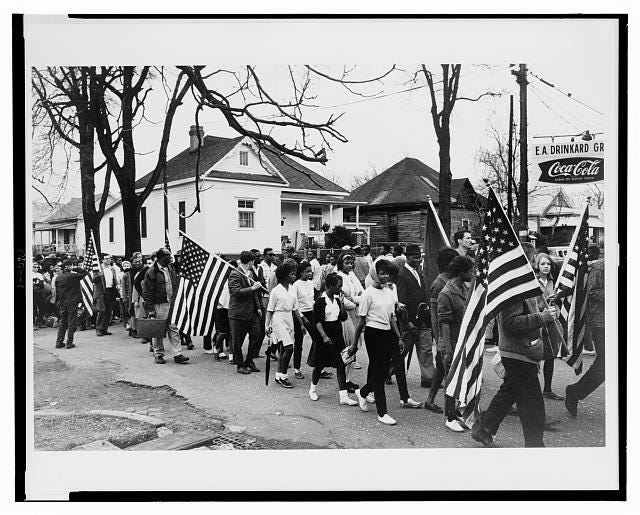
That changed the political equation at the federal level. Brown v. Board of Education opened one route for federal intervention, while the Civil Rights Act of 1964 and Voting Rights Act of 1965 gave the federal government power to act when states would not.8
Civil rights activists used public opinion across the country and federal power to challenge state and local governments that refused to protect their rights. Madison had argued that divided authority could help protect liberty. Reconstruction and the civil rights movement showed that the same structure could also give citizens somewhere else to turn when their own governments denied them equal protection.
What Reconstruction Changed
Reconstruction changed more than the rights written into the Constitution. It changed the relationship between citizenship and federalism. Before the Civil War, the constitutional order largely assumed that states would protect the ordinary rights of their own citizens. Reconstruction changed that assumption by recognizing that the state itself could be the problem.
The Fourteenth and Fifteenth Amendments gave the federal government a new role when states denied those rights. That was the deeper shift. Federalism was no longer only about dividing power. It also created a way to challenge abuses of power closer to home.
Washington had argued that constitutional defects should be corrected through amendment, and Reconstruction followed that path.9 But the amendments also exposed their own limit. They could change the Constitution, but they could not make anyone enforce it.
Reconstruction showed that the danger to liberty did not always come from a distant federal government. It could come from much closer to home, and when it did, federal power might be the only effective check. That was a possibility neither Madison nor Brutus had fully imagined, and one the country would spend the next century struggling to resolve.
National Park Service, “History & Culture,” Reconstruction Era National Historical Park.
James Madison, Federalist No. 51, Library of Congress.
Library of Congress, “Reconstruction: A Resource Guide”; National Archives, “Black Americans and the Vote”.
South Carolina Department of Archives and History, “Reconstruction Exhibit: 1868 Constitution”; Lowcountry Digital History Initiative, College of Charleston, “Origins of Public Education in South Carolina”.
National Archives, “Laws and Court Cases”; “The Freedmen’s Bureau”.
Congress.gov, Constitution Annotated, “Privileges or Immunities of Citizens and the Slaughter-House Cases”; “Who Congress May Regulate”.
National Archives, “Brown v. Board of Education (1954)”; “Civil Rights Act (1964)”; “Voting Rights Act (1965)”.
George Washington, “Washington’s Farewell Address, 1796,” George Washington’s Mount Vernon, 17 September 1796.