


“What Right Had They?”
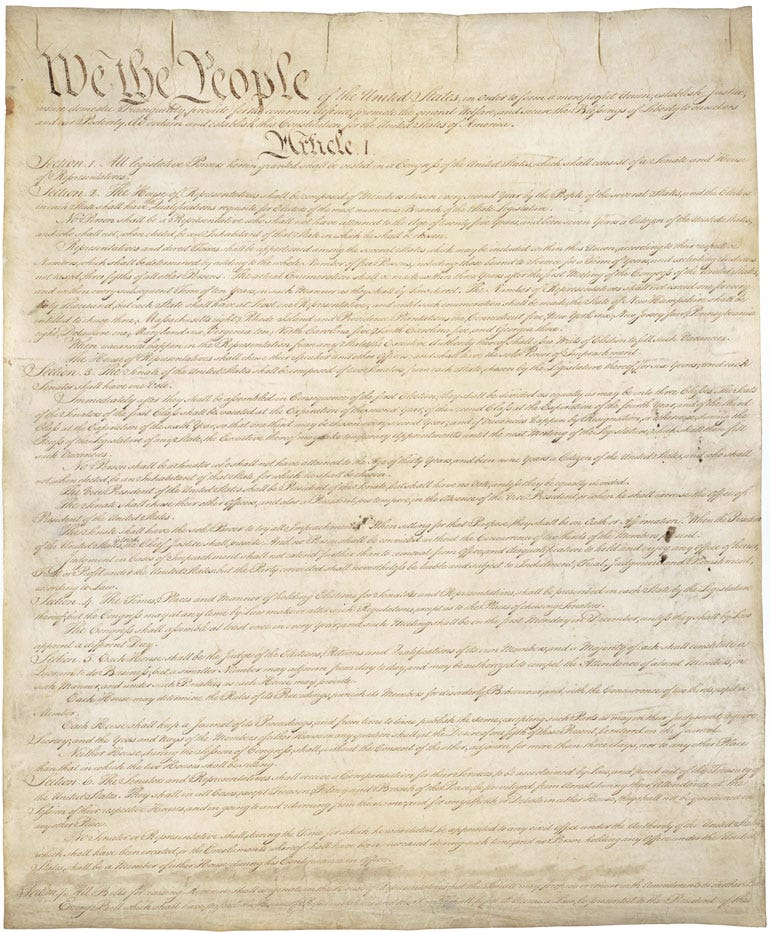
Patrick Henry posed that question to the Virginia ratifying convention on 4 June 1788. He wanted to know why the Constitutional Convention spoke in the name of “We, the people” instead of “We, the states.”
To Henry, those words signaled a fundamental change in the constitutional order. The Articles of Confederation had declared that “Each state retains its sovereignty, freedom and independence” and described the Union as a “league of friendship.” Under the Articles, Congress relied on the states to raise revenue and carry out its decisions. The states were central to the function and, more often, dysfunction of the Confederation.
“We the People” made a more radical claim than a stronger central government. The proposed Constitution would replace a confederation dependent on its member states with a federal government that governed the citizens directly. While the states would retain their governments and authority, they would no longer control the national government.
Henry recognized what was at stake. “If the states be not the agents of this compact, it must be one great, consolidated, national government, of the people of all the states.” He questioned whether the delegates even had the authority to propose such a change and feared that a national government would eventually erase the states. The next day, he returned to those three words: “The question turns, Sir, on that poor little thing, the expression, We, the people, instead of the States of America.”
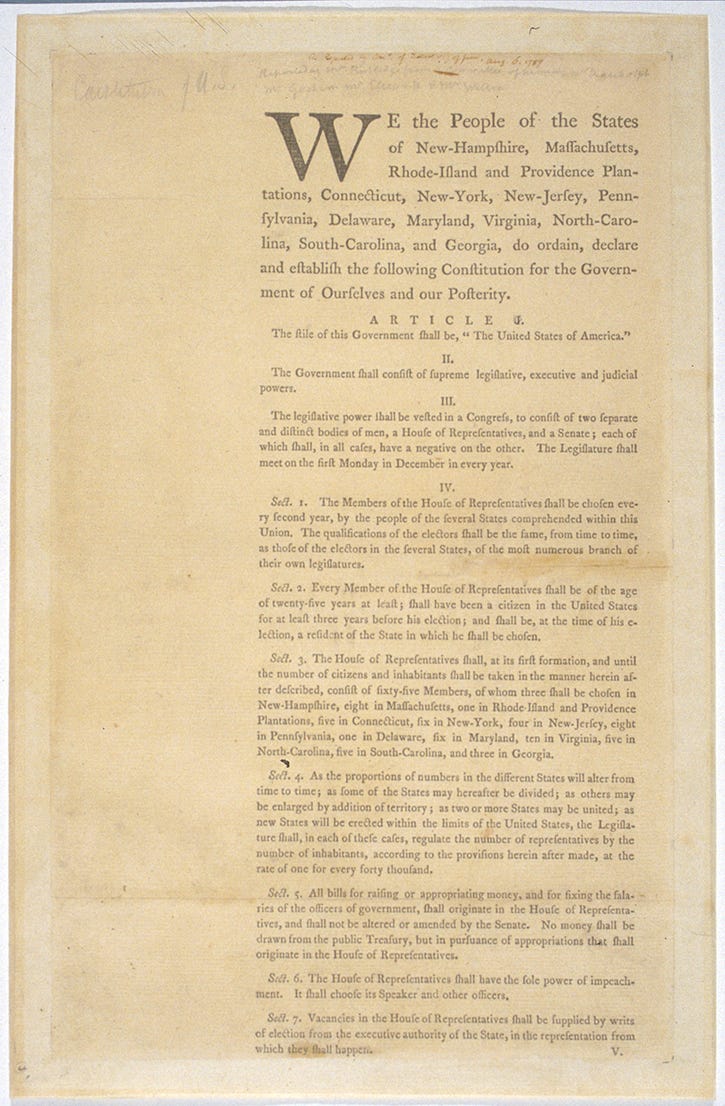
To understand the root of his concern, we have to return to the Constitutional Convention. On 6 August 1787, the Committee of Detail presented a draft beginning, “We the People of the States of New-Hampshire, Massachusetts…” and naming all thirteen states. By September, the Committee of Style had replaced that list with “We the People of the United States.” The surviving Convention records offer no insight into the revision, but the proposed Constitution already reflected the change expressed in those words.
“Who But the People?”
Edmund Pendleton answered Henry the next day by asking, “Who but the people can delegate powers? Who but the people have a right to form Government?”
Pendelton rejected the premise that the states had some parallel authority to the people themselves. State governments drew their powers from the very people who could also empower a federal government. Though the Philadelphia Convention proposed a Constitution, only the people could give it force.
James Wilson made the same argument during Pennsylvania’s ratification debate. He compared governmental powers to streams flowing from a common source, then stated the principle plainly: “In THIS CONSTITUTION, all authority is derived from the PEOPLE.”
Article XIII of the Articales of Confederation required Congress and every state legislature to approve any change. The proposed Constitution placed ratifcation in the hands of conventions elected for that purpose, rather than state legislatures. Under Article VII of the proposed Constitution, nine states could establish the new government. Any state legislature could oppose the Constitution and still watch its own state ratify it.
The Convention proposed not only a different government, but how it would be governed. Yet ratification still took place within the states. Virginians would ratify in Virginia, New Yorkers in New York. So who exactly were “We the People”: one American people, or the people of thirteen states acting separately?
“A Composition of Both”
Madison agreed that the people gave the Constitution its authority, but he did not treat them as one national electorate. In Federalist No. 39, he wrote, “The act, therefore, establishing the Constitution, will not be a NATIONAL, but a FEDERAL act.”
“Each State, in ratifying the Constitution, is considered as a sovereign body, independent of all others, and only to be bound by its own voluntary act.” No national vote could force a state into the new Union. Rhode Island proved the point, remaining outside even after the federal government began operating. It did not ratify the Constitution until 29 May 1790, more than a year after George Washington took office.
Madison preferred ratification by conventions of the people rather than by state legislatures. His argument was constitutional: a legislature should not be able to remake the constitution from which its own authority came. Nathaniel Gorham made the political case more bluntly: “Men chosen by the people for the particular purpose, will discuss the subject more candidly than members of the Legislature who are to lose the power which is to be given up to the Genl. Govt.”
The Constitution created a difficult duality: federal because the people acted within states, but national because the government had direct power over the people. The states retained their own constitutional authority and the federal government received enumerated powers. Americans would live under two governments exercising authority over the same people, neither with unlimited power. Madison concluded: “The proposed Constitution, therefore, is, in strictness, neither a national nor a federal Constitution, but a composition of both.”
The argument did not end with ratification. Several states pressed for amendments that would make the limits on federal power clear. The Tenth Amendment declared: “The powers not delegated to the United States by the Constitution, nor prohibited by it to the States, are reserved to the States respectively, or to the people.”
It did not, however, restore the language of the Articles of Confederation, which had declared powers not “expressly delegated to the United States, in Congress assembled” to be reserved. The Tenth Amendment replaced “expressly” with nothing. In 1789, Thomas Tudor Tucker proposed adding it to the Constitution, but Madison argued that government could not function without implied powers. The House voted it down, and even to this day, implied powers is central to many debates about federal expansion.
The Tenth Amendment preserved the powers of the states in the Union, but did not expressly provide a right of secession. Madison made a distinction between a treaty, which could be dissolved when one party failed to observe its terms, and a constitution established by the people. “In the case of a union of people under one Constitution,” he wrote, “the nature of the pact has always been understood to exclude such an interpretation.”
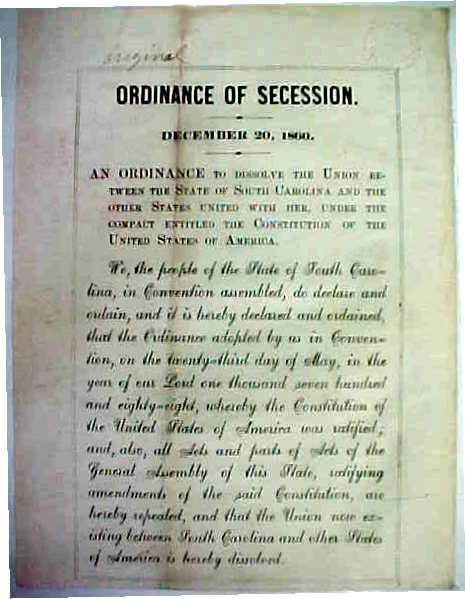
Decades later, South Carolina started what would become a major test of the issue. On 20 December 1860, South Carolina’s convention voted to repeal its ratification of the Constitution of 1788 and declared the Union dissolved. Four days later, the convention argued that secession was necessary to preserve slavery, as northern states had violated the constitutional compact by obstructing the return of escaped human property. Lincoln denied any right to secession. The Constitution had been ratified by “We the People of the United States.” South Carolina’s ordinance of secession appealed to “We, the People of the State of South Carolina.”