


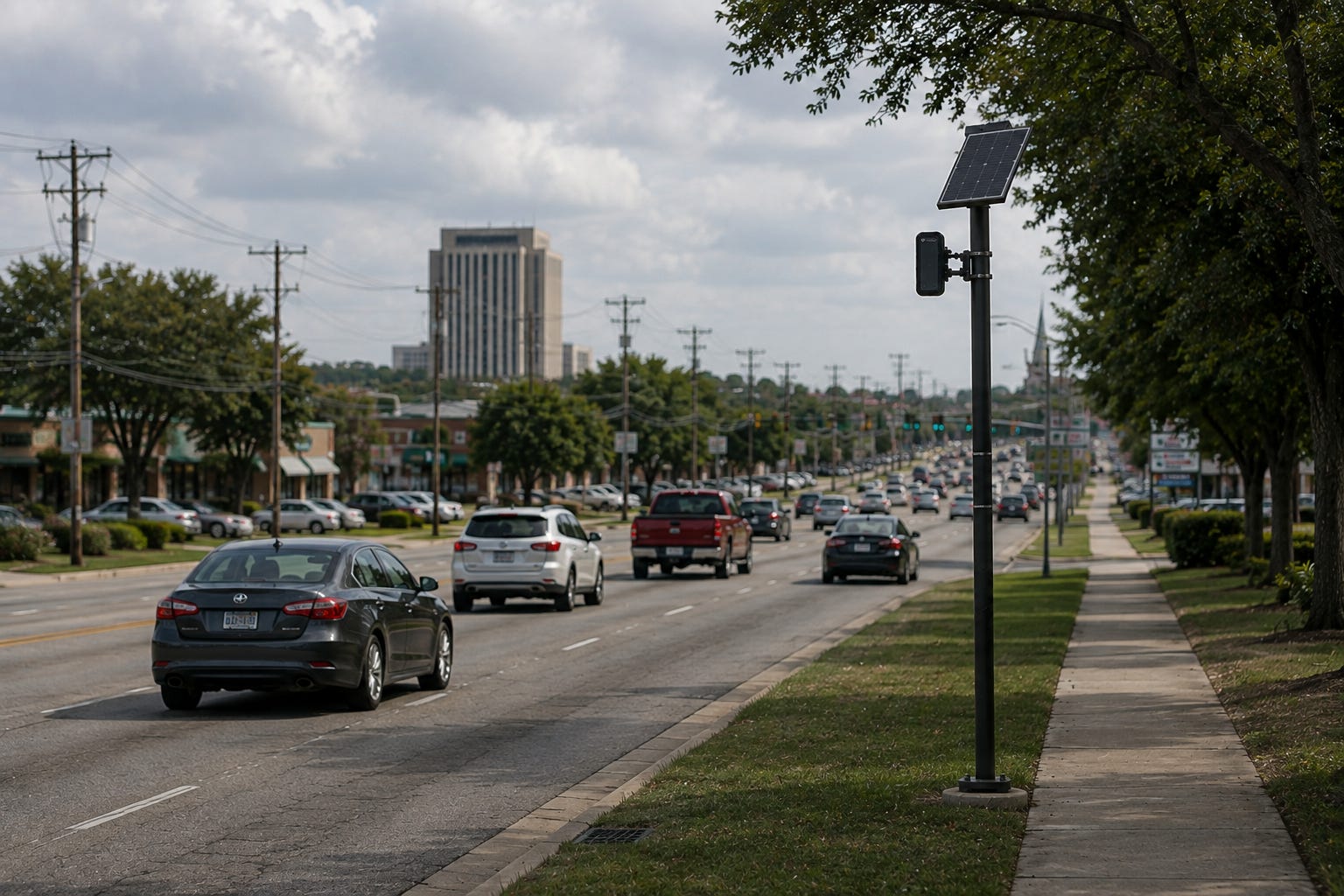
In 2023, Texas legislators voted unanimously to raise car insurance rates by $1 per year to combat catalytic converter theft. The bill made no mention of ALPRs; lawmakers later told The Texas Tribune that they had not come up in discussions of how the money would be spent. The Tribune has since learned that the Motor Vehicle Crime Prevention Authority has allowed at least $30 million of that rate increase to be used on nearly 3,200 Flock cameras. The chairman of the authority had hoped in 2023 to “cover the entire state” with Flock cameras.1
Texas Governor Greg Abbott recently ordered state agencies to stop funding the deployment of Flock cameras in light of increasing reports of abuse and public concern. More than 1,200 cameras had been deployed for the Department of Public Safety under a three-year, $15.9 million agreement, with thousands more backed by grants to local departments.2 Texas had built a surveillance state without the legislature quite realizing it.
Noel Pichardo had the same experience in Pawtucket, Rhode Island. Pichardo was a police officer in 2023 and thought that an earlier effort to bring Flock cameras to Pawtucket had stalled. Pichardo later learned that the city had signed a two-year, $128,000 deal for 20 cameras and treated it as an administrative decision. Pichardo began to notice them around town and asked, “Wait a minute. When did we make this decision to put these up?”3
Cities all the time buy this kind of gear, and you’re not going to expect a city council vote over a software license or a printer. Flock is something else. It allows the government to hold on to massive amounts of information about people suspected of nothing and connected to no particular investigation. That is a surveillance policy, and one that needs to be in the open and discussed.
Why Flock?
Flock is handy for police. In June 2026, the Kenosha County Sheriff’s Office used Flock data combined with other evidence to identify those involved after a shooting at the Bluebird Motel in Somers. Four people were taken into custody.4 When you’re dealing with serious crimes and time is of the essence, efficiency like that is important.
You can look up a license plate in public view without a warrant. Flock changes that by allowing police to store and later retrieve vehicle sightings before they have any indication that the driver might be relevant to an investigation. Information about vehicles police are looking for is stored in a much larger database of people suspected of nothing.
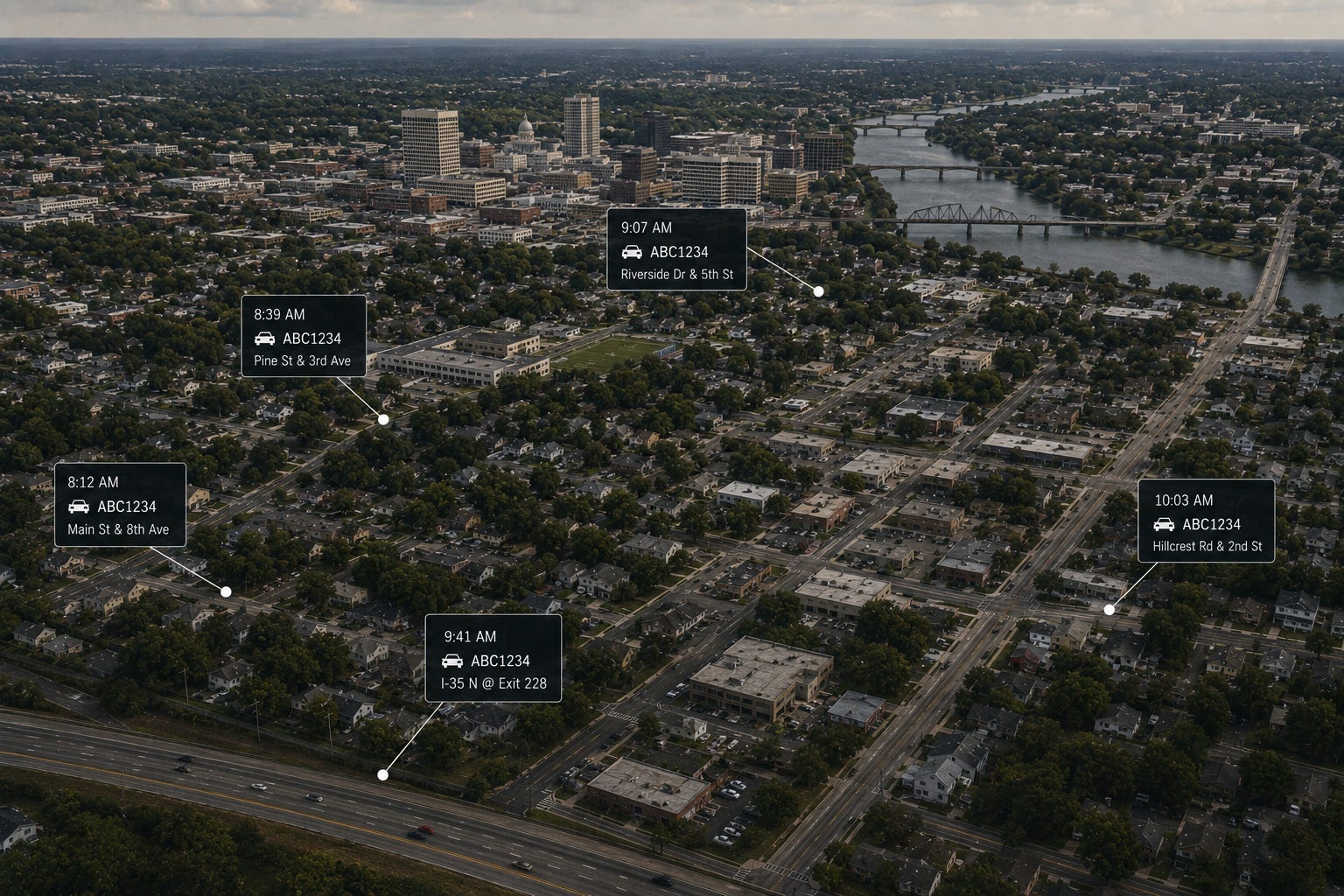
Police can query that data and start building a picture of where a given car has been. That may be enormously helpful in a serious investigation. But does that mean we want the government holding on to that much information about the rest of us?
The Washington Post has reported on at least 50 law enforcement officers charged with or accused of misusing license plate reader systems, 90 percent of which involved Flock.5 In Wisconsin, Milwaukee police officer Josue Ayala was charged with repeatedly using Flock for personal reasons.6 These officers didn’t hack the system. They had access, and they used it.
An audit might reveal that an officer abused the database, but the officer already has the information. The person being watched might not know the search took place, much less have an opportunity to challenge it.
The government’s experience with Section 215 of the PATRIOT Act is instructive. After 9/11, the government bulk collected metadata on phone calls because they believed that more access might prevent another terrorist attack. The bipartisan Privacy and Civil Liberties Oversight Board subsequently found that the program had only narrow value, and Congress scaled it back.7 Surveillance powers are easy to expand when the benefits are clear, and the costs aren’t. They’re much harder to scale back once the government starts relying on them.
The Fourth and Fifth Amendments were written with an inherent distrust of government power. The Founding Fathers had seen the government search, seize, and deprive people of liberty with broad brushstrokes. Their solution was to require the government to follow rules before it could intrude on our rights. Flock is handy, but that doesn’t mean we get to circumvent the process.
In 1755, Ben Franklin noted that “Those who would give up essential Liberty, to purchase a little temporary Safety, deserve neither Liberty nor Safety.”8 James Madison later wrote about representative government in Federalist No. 51: “You must first enable the government to control the governed; and in the next place oblige it to control itself.”9
If communities decide that Flock is useful enough to keep, the constraints on that power should be in place before police use it to gather information on people suspected of nothing.
Checking the Government
The Supreme Court has not yet ruled on how the Fourth Amendment applies to a technology like Flock. Its location-tracking cases suggest that some tracking on public roads may be okay, while, more broadly, sweeping digital records of a person’s movements are constitutionally distinct.10 Flock falls somewhere between those cases.
This summer, the Court issued a ruling in Chatrie v. United States that taking a person’s Google Location History constituted a Fourth Amendment search requiring a warrant. The case has been sent back to the Fourth Circuit to determine whether the warrant satisfied constitutional requirements.11 Chatrie doesn’t answer the Flock question. But the government shouldn’t get to exercise the surveillance power enabled by technology while we all wait years for another case to reach the Court.
Virginia has already set guardrails around the use of automated license plate readers. Its law generally requires information to be deleted after 21 days, restricts how and with whom it can be used or shared, and requires public reporting.12 Wisconsin lawmakers considered different approaches during the 2025–26 legislative session, but neither became law.13
Flock has also adjusted some of its policies in response to criticism, recommending a seven-day retention period and requiring more documentation around searches.14 Those protections rely heavily on the person at the keyboard and on whether someone actually reviews their work.
An internal investigation in Alpharetta, Georgia found that officer Dustin Bozzo allegedly looked up a former lover’s license plate 56 times and another officer’s plate 29 times. When asked for a reason, he frequently chose “Wanted Person” or “Traffic Infraction,” options he later said were simply “just a quick keystroke.”15 Requiring a reason offers little protection if nobody actually reviews the search.
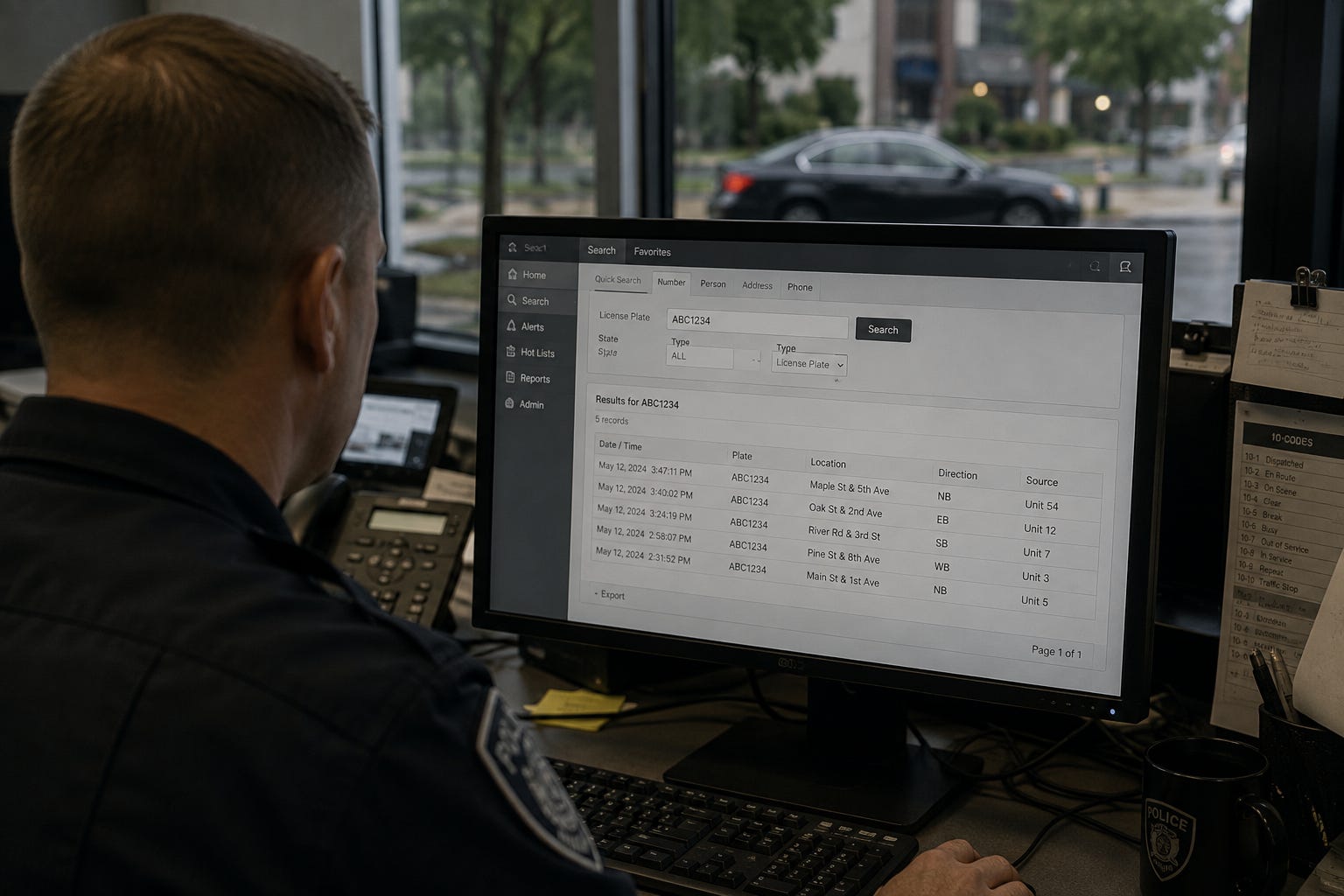
The ACLU of Massachusetts recently published a toolkit for defense attorneys to use to force disclosure of surveillance technology used by police departments. WIRED reported that defendants and sometimes even prosecutors may not be aware that a particular surveillance technology was used.[16] A defendant who doesn’t know how police found them can’t challenge it, and a judge won’t know whether the government crossed a constitutional line.
If the government wants a searchable database of the movements of people overwhelmingly suspected of nothing, it should explain why it needs that power before it deploys it widely. Citizens need enough information about how the system is being used to know whether those limits are being observed.
Some places might want Flock, but with guardrails. Others might not want that much power. Either is more defensible than letting the technology proliferate unseen until police rely on it and every proposed constraint sounds like taking away an essential tool of law enforcement.
Pichardo asked the right question: “When did we make this decision to put these up?” The answer isn’t after the cameras have been watching.
If police want databases that let them track civilians’ everyday movements, that power should be authorized by elected officials with clear boundaries the public can see and understand. The government doesn’t get to build the surveillance system, give police carte blanche access to it, and then ask us to trust them to behave going forward.
Ayden Runnels and Alex Ford, “Lawmakers Added $1 to Texans’ Car Insurance Policies. That Money Paid for Thousands of Flock Cameras,” The Texas Tribune, 28 August 2026.
Ayden Runnels, “Gov. Abbott Blocks State Agencies from Spending Money on Flock Cameras,” The Texas Tribune, 28 August 2026.
Dhruv Mehrotra, “The Cop Who Took On Flock,” WIRED, 18 August 2026.
Kenosha County Sheriff’s Office, “Four Arrested in Bluebird Motel Shooting,” 10 June 2026.
Drew Harwell, Douglas MacMillan, and Aaron Schaffer, “How Rogue Officers Turned a Nationwide Camera Network into a Tool for Stalking,” The Washington Post, 2 August 2026.
State of Wisconsin v. Josue Ayala, Criminal Complaint, Milwaukee County Circuit Court, 24 February 2026.
Privacy and Civil Liberties Oversight Board, Report on the Telephone Records Program Conducted under Section 215 of the USA PATRIOT Act (Washington, DC: PCLOB, 23 January 2014).
Benjamin Franklin et al., “Pennsylvania Assembly: Reply to the Governor,” 11 November 1755, in The Papers of Benjamin Franklin, vol. 6, Founders Online, National Archives.
James Madison, “Federalist No. 51,” The Federalist, 6 February 1788. Library of Congress
United States v. Knotts, 460 U.S. 276 (1983); United States v. Jones, 565 U.S. 400 (2012); Carpenter v. United States, 585 U.S. 296 (2018).
Chatrie v. United States, No. 25-112, 609 U.S. ___ (2026), certiorari to the United States Court of Appeals for the Fourth Circuit, argued 27 April 2026, decided 29 June 2026, vacating and remanding 136 F.4th 100.
Va. Code Ann. § 2.2-5517.
Wisconsin Legislature, 2025 Assembly Bill 300; Wisconsin Legislature, 2025 Assembly Bill 576.
Garrett Langley, “Flock Updates Privacy, Accountability, Security, and Transparency Safeguards,” Flock Safety, 13 August 2026.
Caroline Haskins, “A Georgia Cop Used Flock to Track 2 Other Cops: His Ex and Her Friend,” WIRED, 27 August 2026.