


The American Experiment is a new occasional series about how Americans have argued over the meaning of the republic they inherited. These essays begin with the sources themselves and ask how Americans have understood the promise and demands of self-government across time.
Every Fourth of July, we return to the Declaration of Independence, or at least to the lines most Americans know best.
“We hold these truths to be self-evident…”
That sentence deserves its place in our civic memory. It gave Americans a standard the country would spend generations trying to meet. Later generations would use it to challenge the nation, often more forcefully than the founders themselves had imagined.
But the Declaration was not written only to announce a principle. It was written to defend a decision.
The men who approved it were not writing from the safety of victory. They were speaking for a cause that could still fail. The colonies had been fighting Britain for more than a year, but independence remained a step many Americans had not yet accepted. Before Congress could ask the world to recognize a new nation, it had to explain why separation was justified. That argument had been building for years, but most of it had not begun as an argument for independence.
Before Independence

The Declaration did not appear out of nowhere. By the summer of 1776, the colonies had been arguing with Great Britain for more than a decade, and most of that argument had not been about independence.
For years, colonial leaders insisted they remained loyal subjects of the Crown. Their quarrel was not with British government itself, but with a government they believed had violated the rights British subjects were supposed to possess. They were not yet asking to leave the empire. They were asking the empire to honor its own principles.
Even after fighting broke out at Lexington and Concord, many Americans still hoped the breach could be repaired. By July 1776, Congress no longer believed that was possible. The Declaration gave that conclusion its public form. After years of arguing that British authority had violated British rights, Congress now had to explain why those violations justified leaving the empire altogether.
The Burden of Persuasion
By July 1776, Congress had already decided that the colonies would separate from Great Britain. The remarkable thing about the Declaration is not the decision itself, but what the delegates chose to do next.
Before speaking of equality or natural rights, and before listing a single grievance against the king, they paused to explain why they believed they owed the world an explanation.
“When in the Course of human events…” the Declaration begins, “a decent respect to the opinions of mankind requires that they should declare the causes which impel them to the separation.”
Those are not the words of people who believed conviction alone settled the matter. The famous principles that follow are the beginning of a case Congress believed had to be made before independence could be defended.
Raising the Standard
The opening of the Declaration invites its readers to hear the case. The next paragraph tells them how to judge it. Jefferson begins with a thought that feels almost out of place: “Prudence, indeed, will dictate that Governments long established should not be changed for light and transient causes…”
Those words slow the document down just when we expect it to gather speed. Jefferson does not ask his readers to begin with the colonies’ grievances. He asks them to begin with the weight of the decision itself. Governments are not to be discarded because they disappoint us, nor is every injustice enough to justify revolution.
Only after establishing that principle does he turn to the conduct of George III. The grievances that follow are not simply a catalog of complaints. They are Congress’s answer to the standard Jefferson has already set. If long-established governments should not be changed for “light and transient causes,” then Congress had to show that Britain’s abuses were neither light nor transient. The Declaration is asking whether separation had finally become not a choice but a necessity.
The Citizen Appears
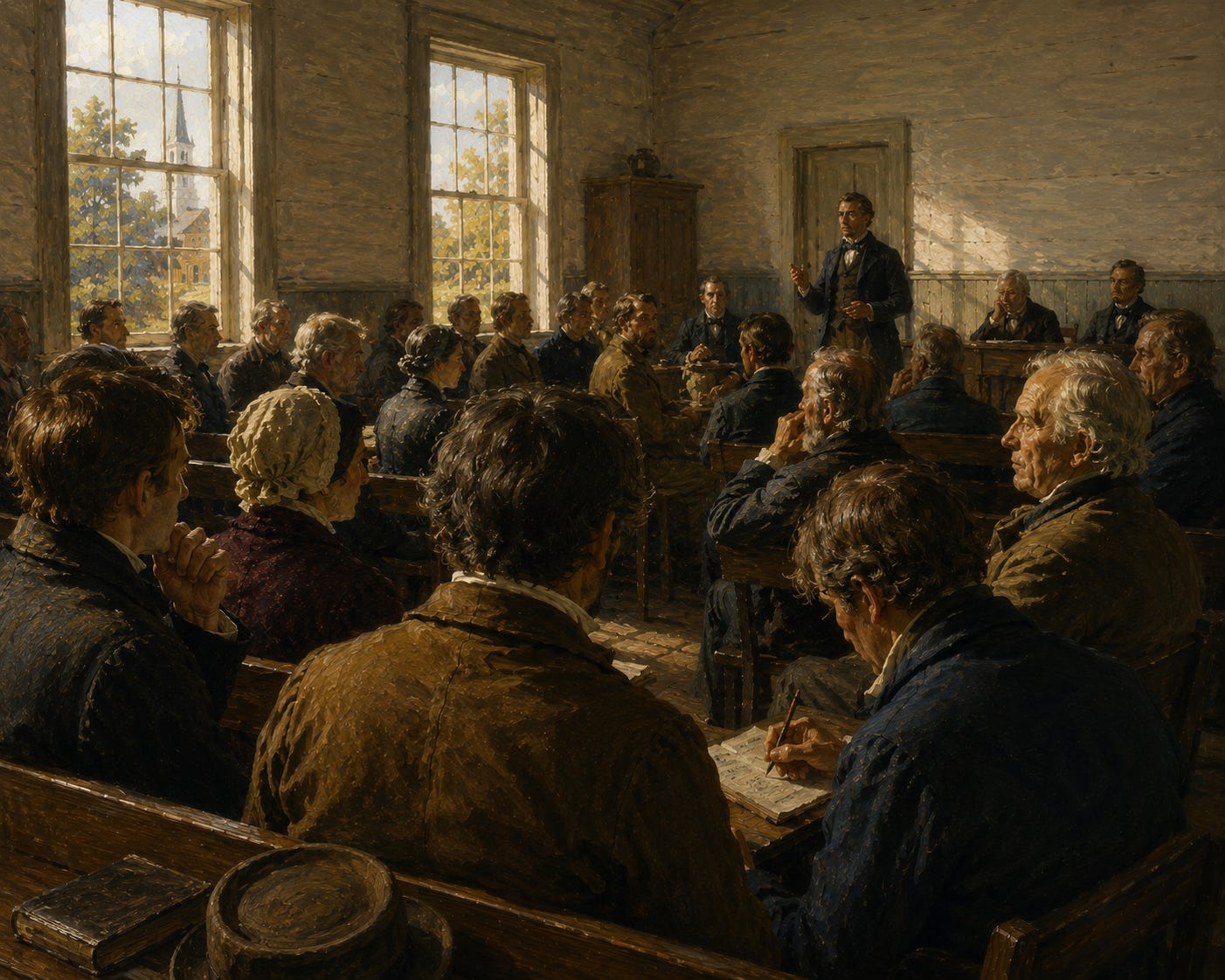
By the time Jefferson writes that governments derive “their just powers from the consent of the governed,” Congress has already presented its case and left the judgment to its readers.
That is easy to overlook because we know how the story ends. The delegates did not. They could not assume agreement, much less demand it. The Declaration had to persuade its readers. It treated them not as subjects receiving an order, but as people capable of judging whether the case had been made.
Consent of the governed is usually read as a statement about the source of political authority. It is that, but it also says something about the people themselves. A government can rest on consent only if citizens are capable of judgment. The Declaration does not merely claim that power comes from the people. It assumes the people can decide whether power has been used justly.
An Unfinished Experiment
The Declaration declared that governments derive “their just powers from the consent of the governed,” but it left a question that would follow the republic from the beginning: who counted among the governed?
The question appeared almost as soon as independence did. Abigail Adams saw the problem before the Declaration was approved.
“We will not hold ourselves bound by any Laws in which we have no voice, or Representation.”
She was not rejecting the Revolution. She was asking whether its principles would be applied as broadly as its language suggested.
Nearly a century later, Frederick Douglass returned to the same question from the perspective of a man born into slavery.
“What, to the American slave, is your Fourth of July?”
Douglass did not argue that the Declaration was wrong. He argued that the nation had failed to live under the principle it had already proclaimed.
Abraham Lincoln answered that challenge by returning to the Declaration itself. At Gettysburg, he reached past the Constitution to the nation’s first principle.
“Conceived in Liberty, and dedicated to the proposition that all men are created equal.”
For Lincoln, the Civil War was a test of whether the proposition announced in 1776 could endure.
A century after emancipation, Martin Luther King Jr. stood at the Lincoln Memorial and described the Declaration as a promise still waiting to be honored.
“A promissory note to which every American was to fall heir.”
King was making the same argument Abigail Adams had made before the republic was born. The question was not whether the principle had power. The question was whether Americans would extend it to the people still waiting to be included.
That is where the Declaration becomes harder to live with than to quote. It gave Americans a way to defend independence, then left behind a principle that did not stay where the founding generation tried to leave it. It moved outward, slowly and unevenly, carried by people who could read the words and see themselves missing from them.
That does not make the Declaration weaker. It makes our obligation clearer. If we claim its principles as an inheritance, we also inherit the work of upholding them.
What Comes Next

The sentence we remember still deserves its place, but the Declaration is deeper than its most famous line. Its strength lies not only in the fact that it declared independence. It gave Americans a standard for what they should become.
We have never fully lived up to that standard, but we have never stopped returning to it. Americans have fought wars over it, amended the Constitution for it, and unsettled old arrangements because of it. That history should not make us cynical about the promise. It should remind us how much Americans have been willing to do when the country has fallen short of its own principles.
That is the inheritance the Declaration leaves us: not perfection, and not surrender, but the work of drawing the republic closer to the promise it made at the beginning. We are not the first Americans asked to do that work, and we will not be the last. But for now, it is ours.