


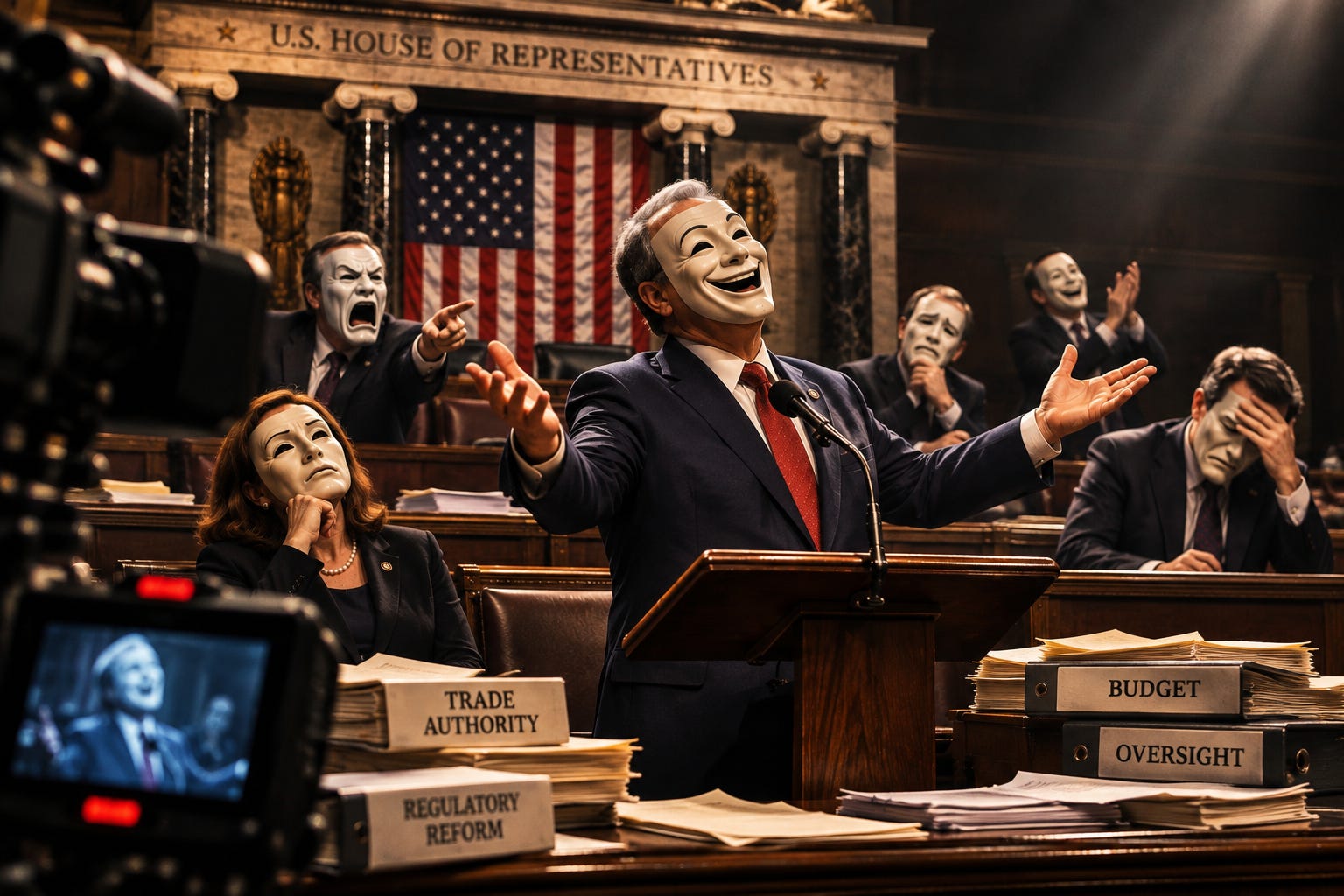
On May 10, 1984, Representative Robert Walker took to the House floor to criticize the House Democratic leadership. Not surprisingly, most members had already left the floor because the day’s legislative business had concluded. Viewers watching C-SPAN had no idea, because the House cameras showed only Walker in full tirade at the microphone.
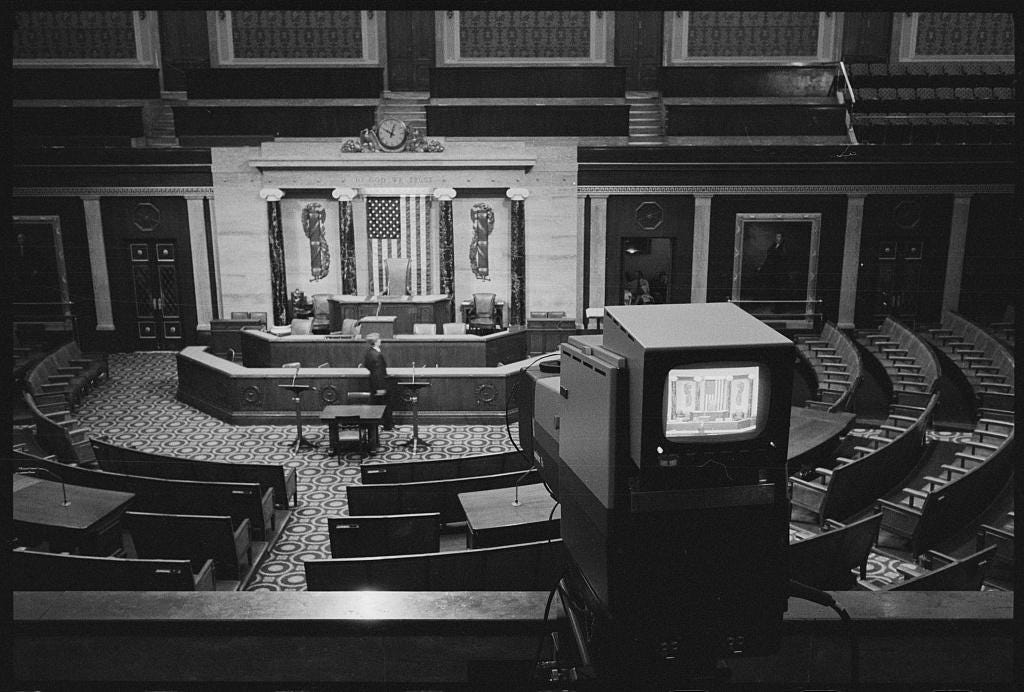
Speaker Tip O’Neill had grown tired of Republicans using special-order speeches, scheduled after the legislative day was over, to attack Democrats who weren’t there to respond. He decided to return the favor by exposing the scene. While Walker spoke, the cameras panned across rows of empty seats. Someone handed him a note telling him what was happening, and Walker wasn’t amused. "It is my understanding," he declared in shocked tones, "that . . . the cameras are panning this chamber, demonstrating that there is no one here in the chamber to listen to these remarks."
Five days later, the partisan fight erupted when Newt Gingrich confronted O’Neill on the House floor. O’Neill responded, “My personal opinion is this. You deliberately stood in that well before an empty House and challenged these people. And you challenge their Americanism. And it's the lowest thing that I've ever seen in my 32 years in Congress.”
Trent Lott demanded the Speaker’s words be taken down, and the chair ruled O’Neill’s statement out of order. What began as a dispute over how Congress appeared on television had become a televised fight over congressional behavior. The public responded.
For the first time, the curtain had been pulled back on televised congressional business. "Our callers have just been going crazy about it," offered C-SPAN’s Susan Swain. In the intervening four decades, Congress lost its shame for performative politics and the public has come to reward it.
There Ought to Be a Law
James Madison worried about Congress for different reasons. In Federalist No. 62, he warned that “the facility and excess of law-making seem to be the diseases to which our governments are most liable.” Madison wanted a Senate that would slow things down enough to consider whether legislation was wise. He feared the passion of the moment would lead Congress to legislation without deliberation.
A familiar response to almost every outrage has become: “There ought to be a law.” While that might be true, the existence of a problem doesn’t necessarily require Washington to solve it. Madison understood that passing legislation wasn’t an accomplishment if there was no discernment in accomplishing it.
Members of Congress have become notorious for introducing legislation to solve a problem, even if there’s little chance it will become law. What’s harder is explaining why legislation might be unnecessary, especially if their constituents demand action. For some reason, Americans have become too willing to reward politicians that promise solutions, even if they don’t make sense.
The Performance Becomes the Product
C-SPAN brought congressional proceedings into American homes. Four decades later, members have become broadcasters themselves, hosting podcasts and playing to social-media audiences. Committee hearings have become platforms for content intended to attract more attention than the legislation before the committee.
Members of Congress should communicate directly with their constituents, but not with the scripting of a reality show. Creating confrontation generates thousands of views but accomplishes little, while negotiating legislative compromises gets no attention and creates greater political risks. The danger is that members begin believing that building an audience is the work they were elected to do.
Congress has become adept at playing the part. Unfortunately, its members aren’t good at method acting. At least then, they would commit to the role.
But the performance is convincing, even when it’s hollow. Congress announces it’s solved the public’s problem, passes legislation outsourcing most decisions to the executive branch, then holds “main event” hearings to criticize how things have gone wrong. Members bask in the spotlight while someone else makes the difficult choices. When the results create a new crisis, the political theater begins again. The political circle of life.
Outsourcing Judgment
In Federalist No. 51, Madison wrote, “In republican government, the legislative authority necessarily predominates.” He understood the human condition and the need for safeguards against the concentration of power. “The remedy for this inconveniency is to divide the legislature into different branches,” he wrote, “and to render them, by different modes of election and different principles of action….” The result was a House of Representatives, chosen by the people every two years, and a Senate whose members were chosen by state legislatures for six-year terms. Now, more than two centuries later, the question is: What exactly happened to the legislative authority Madison assumed would predominate?
An obvious example is the tariff fiasco of the last two years. Article I, Section 8 of the Constitution grants Congress the power to impose tariffs. Yet, over the years, Congress has adopted a policy of simply handing a great deal of tariff authority to the president.
In 2025, President Trump invoked the International Emergency Economic Powers Act to impose sweeping tariffs on his so-called “Liberation Day.” In February 2026, the Supreme Court ruled the law did not authorize those tariffs. But consider the economic damage already imposed. Roughly $166 billion in tariffs had been collected from the consumers, and the U.S. government refunded it to the middlemen that collected it.
Yet the Court did not rule on whether Congress should delegate its constitutional responsibilities to the executive branch. They simply interpreted Congress's intent in the legislation, not whether Congress should have delegated its authority in the first place.
While the courts can determine the limits of presidential power, they cannot make trade policy for Congress. Congress could effectively take back the power it has granted, but that is easier said than done. As Justice Gorsuch noted in his opinion, “Once this Court reads a doubtful statute as granting the executive branch a given power, that power may prove almost impossible for Congress to retrieve. Any President keen on his own authority (and, again, what President isn’t?) will have a strong incentive to veto legislation aimed at returning the power to Congress.”
He added in a pitch for the major questions doctrine, “And without doctrines like major questions, our system of separated powers and checks-and-balances threatens to give way to the continual and permanent accretion of power in the hands of one man. That is no recipe for a republic.”
These are not debates that should take place in the rulings of the Supreme Court, but in the halls of Congress. For too long, lawmakers have added layers to the executive branch and the administrative state to seemingly make more time for hearings about using such power. Meanwhile, taking it back will take work, not necessarily something recent Congresses have been up for. And this is the first challenge to the incoming Congress: Take back your constitutional duties.
Making Congress Accountable Again
The incoming Congress has work to do to reclaim its power. This majority cannot come in on a wave of dissatisfaction over how the current president exercises power and leave the status quo intact. The new majority will face plenty of demands, but reclaiming congressional authority must be a priority from day one.
Voter frustration is crystal clear. In the 2026 midterms, 77 percent of voters disapproved of Congress’s performance, and 72 percent said Congress wasn’t doing enough to check presidential power. They are no longer content with theatrical hearings and politicians chasing airtime on podcasts and cable news.
Voters have some responsibility here because, too often, they prefer politicians who talk tough over those who get things done. In too many cases, politicians know they get punished for things that get done rather than for complaining about the process. So it shouldn’t really be a surprise when Congress can’t get things done.


The 1974 elections brought a wave of reformers to Washington in the aftermath of Watergate. They challenged established leadership and changed how Congress operated. The incoming Congress has a mandate to bring that sort of change again, but history tells us that won’t last forever. Democrats have an opportunity to reclaim congressional authority while a Republican occupies the White House. But will they fight just as hard to protect that authority when a Democrat returns? Very few members of Congress are above partisanship, and that makes Congress a dangerous place when one party controls both the executive and legislative branches.
The incoming Congress has two doors: the first is to attack Trump and the administration for the amusement of the vocally frustrated, or the second is to make Congress predominate in the way Madison envisioned. The first will produce headlines, while the second will restore the constitutional order of things. If Democrats refuse to place limits on presidential power while all eyes are on 2028, they won’t have changed Congress. They’ll simply be the new cast performing the same show.