

In October 1798, Matthew Lyon, a Democratic-Republican congressman from Vermont, stood trial for criticizing President John Adams. Lyon wrote a letter promising to support a president who served the public interest, but not one with “a continual grasp for power, in an unbounded thirst for ridiculous pomp, foolish adulation, and selfish avarice.”
He also warned against removing “men of real merit” from public office for no reason other than their “independency of sentiment.” Although he wrote the letter before the Sedition Act became law, he did not publish it until after. Federal prosecutors treated it as an attack on Adams.
Lyon defended himself in court, and the Sedition Act allowed him to prove his published statements were true. In a sensational twist, Lyon questioned the judge in the case, Supreme Court Justice William Paterson.
Paterson had dined with Adams at his house in Philadelphia, and Lyon asked if he had seen the president’s “ridiculous pomp and parade.” Paterson answered that he had seen “a great deal of plainness and simplicity.” Lyon persisted, asking Paterson if the president’s establishment equaled or exceeded the modest tavern in Rutland where Paterson was then living. A report in a Republican newspaper said that Paterson merely sat silent and smoked his cigar.
The jury convicted Lyon in about an hour. He was ordered to pay a fine of 1000 and spend four months in jail. His constituents re-elected him while he was serving his sentence.
Less than seven years earlier, the states ratified the First Amendment, declaring that “Congress shall make no law respecting an establishment of religion, or prohibiting the free exercise thereof; or abridging the freedom of speech, or of the press….” But the same generation that fought to win those rights made a law to send political dissenters to jail.
A Law to Protect the Government
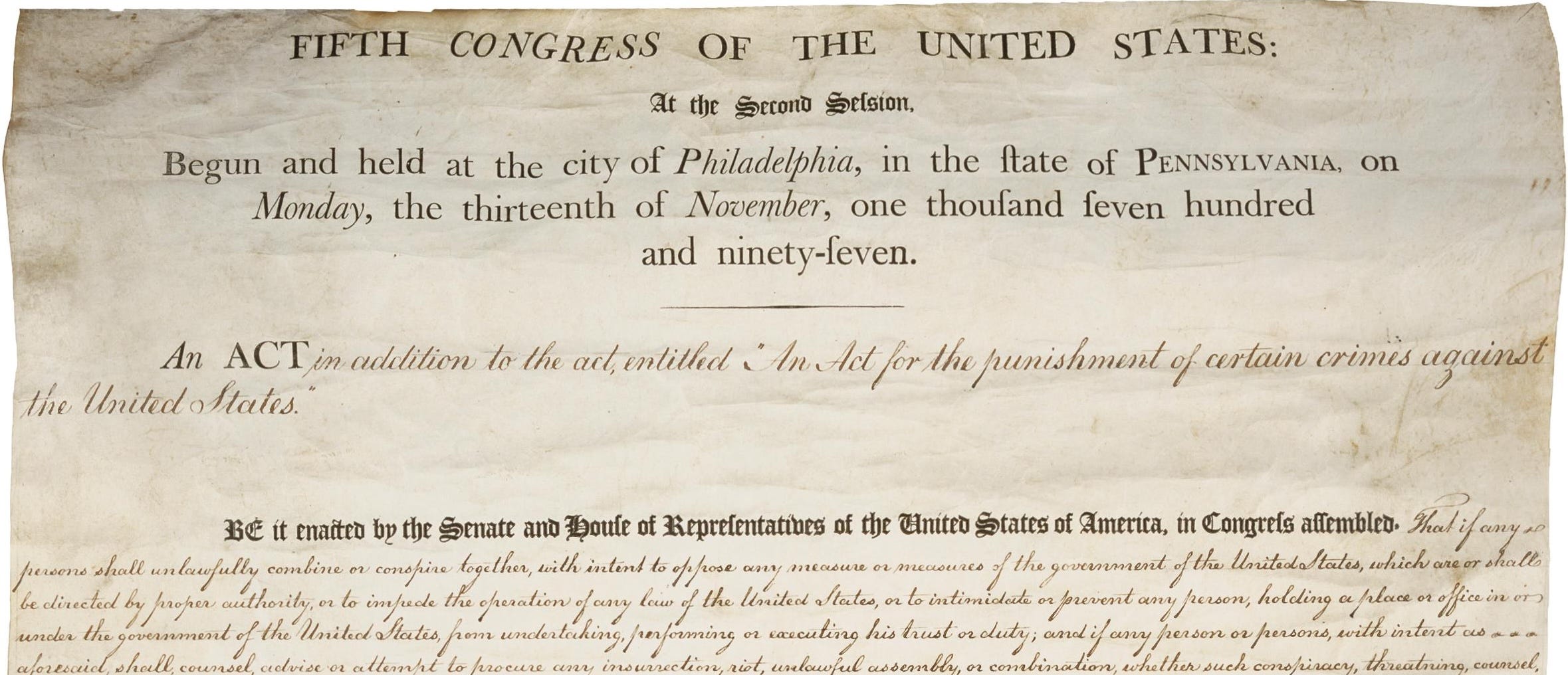
In 1798, the young republic was at undeclared war with France at sea, and the French Revolution was a controversial topic in America. The newspapers of the day were powerful tools in the burgeoning feud between the two political factions, the Federalists and Democratic-Republicans. Though many modern Americans believe media bias is a new phenomenon, many papers openly sided with one party or the other and criticized the opposition.
Federalists believed critical reporting eroded public confidence in the newly formed government. False accusations circulated freely, and newspaper editors often treated political opponents as enemies rather than fellow citizens. As a response, the Federalist-controlled Congress passed the Sedition Act of 1798, making certain “false, scandalous and malicious” writings against the federal government, Congress, or the president punishable by fines and imprisonment.
Coincidentally, the Act did not extend to Adams’s leading political opponent, Vice President Thomas Jefferson. Many supporters argued the Act was constitutional. They cited English common law, which held that freedom of the press prohibited censorship before publication but did not prevent punishment afterward. The Act also allowed defendants to prove their statements were true; supporters believed this improved on traditional English libel law.
The truth defense didn’t work in cases of political judgment. How was Matthew Lyon to prove that Adams was overly ambitious when you could document a president’s deeds, but never prove his motives except by interpretation?
James Madison refuted the Federalists’ arguments in his Report of 1800. He argued that the English understanding of a free press could not simply be transferred to our republic where legislative power was limited by a written Constitution. Punishing someone after publication discouraged criticism just as effectively as censorship in the first place.
Madison had made the point very clear in Congress in 1794: “the censorial power is in the people over the government, and not in the government over the people.” The Sedition Act reversed that relationship, allowing federal officials to prosecute citizens for criticizing their government. This was the very foundation of our Founding and our Republic.
Jefferson’s Turn
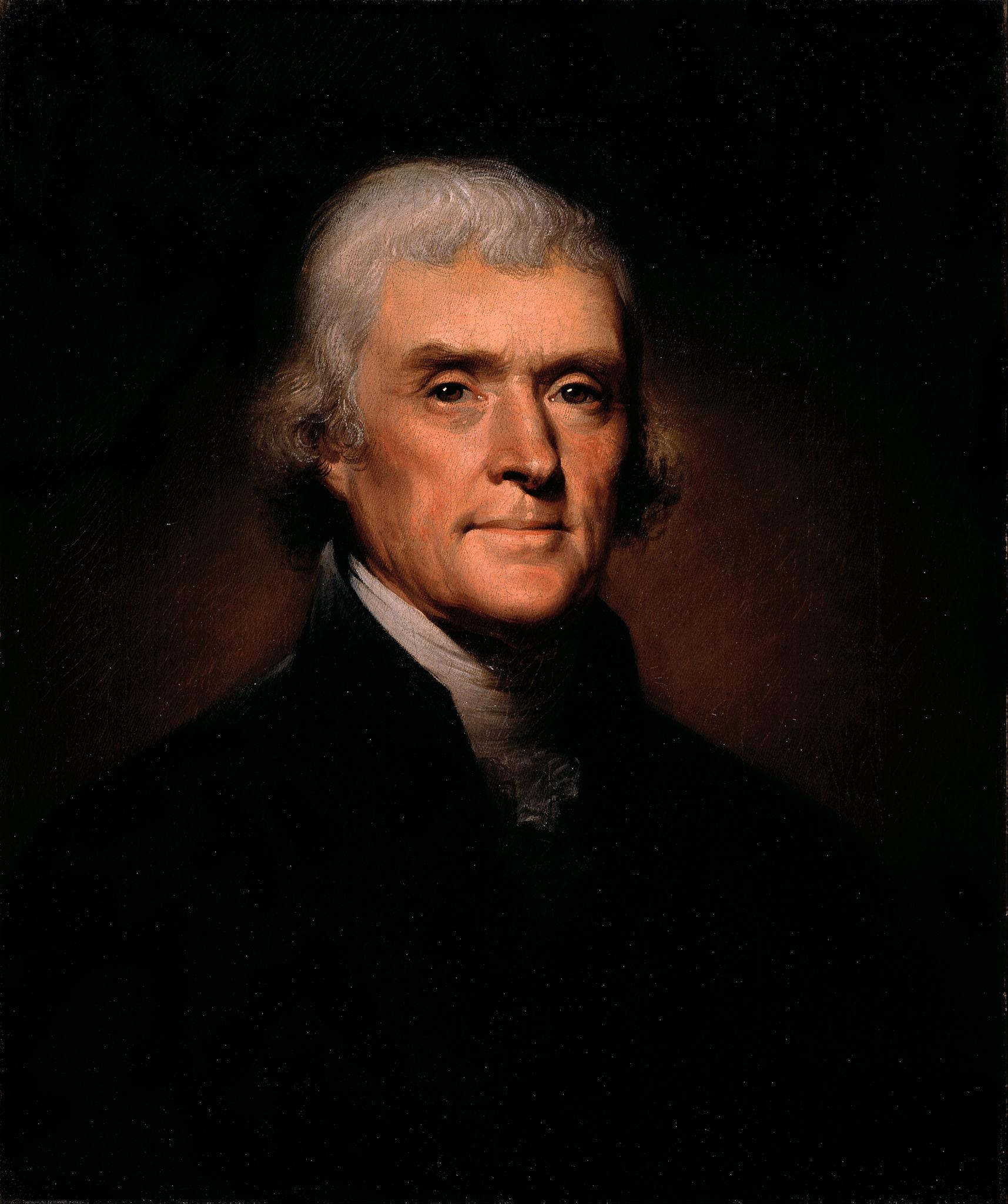
Public opposition to the Alien and Sedition Acts helped turn the election of 1800 into a defeat for the Federalists. Jefferson succeeded Adams to the presidency and pardoned those convicted under the federal law; the Sedition Act expired on 3 March 1801, as the law provided. Though Jefferson’s Inaugural speech offered a unifying theme for the political factions, he privately struggled with that idea.
On 19 February 1803, President Jefferson responded to Pennsylvania Governor Thomas McKean, who had suggested prosecuting Federalist newspaper editors. Jefferson insisted that his reply remain “entirely confidential.” He accused the Federalists of first attempting to silence the press through “their gag-law,” then destroying its credibility through relentless falsehoods. His proposed remedy was “a few prosecutions of the most prominent offenders” under state libel laws.
Jefferson opposed a general crusade likely to amount to persecution. He referred instead to a newspaper he thought deserved prosecution. Such examples in other states would “place the whole band more on their guard.” Jefferson remained opposed to federal restrictions on the press, but as president he urged state authorities to prosecute hostile editors.
In New York that same year, prosecutors secured a criminal-libel conviction against Harry Croswell, a Federalist printer in Hudson, for publishing allegations against Jefferson. Alexander Hamilton argued Croswell’s case before the state’s highest court in 1804, insisting that truth should be admissible as a defense. The judges divided evenly and left the legal question unresolved. In 1805, the New York legislature permitted truth as a defense in libel cases when the publication was made with good motives and justifiable ends.
In June 1807, a young man, John Norvell, asked Jefferson how a newspaper should be conducted to serve the public good. Jefferson replied that he could give him “only true facts & sound principles”; he doubted if any person would subscribe to his paper. It was not just the personal and partisan attacks that had become part of the landscape of American journalism that troubled him. He felt the newspapers had become so untrustworthy that they were impeding the people’s ability to know the truth. Jefferson believed a corrupted press corrupted by falsehood was as dangerous to the nation as government censorship. He added, “Nothing can now be believed which is seen in a newspaper. Truth itself becomes suspicious by being put into that polluted vehicle.”
Jefferson's stature makes his willingness to encourage prosecutions of political critics more troubling, not less. His actions show how the presidency tempts even those who defended liberty to use government power against their opponents. The constitutional safeguards of our republic exist because freedom cannot depend on the judgment or restraint of whoever holds the presidency.
The Politics of “Fake News”
In September 2026, Gallup reported only 33 percent of Americans had a great deal or fair amount of confidence in mass media to report the news “fully, accurately, and fairly.” Though confidence has improved from the previous year’s record low of 28 percent, it remains sharply divided on partisan lines.
President Donald Trump has repeatedly claimed that major news outlets publish biased or false reporting, making “fake news” a fixture of American political discourse. Although his confrontations with the press are newsworthy, his claims echo among his supporters, but skepticism about the news media goes far beyond his base.
That’s not to say some of that skepticism isn’t earned. In a rush to report, news organizations can make mistakes. In other cases, political opinion masquerades as reporting, giving the public good reason to question their credibility. Defending a free press does not require defending everything it publishes.
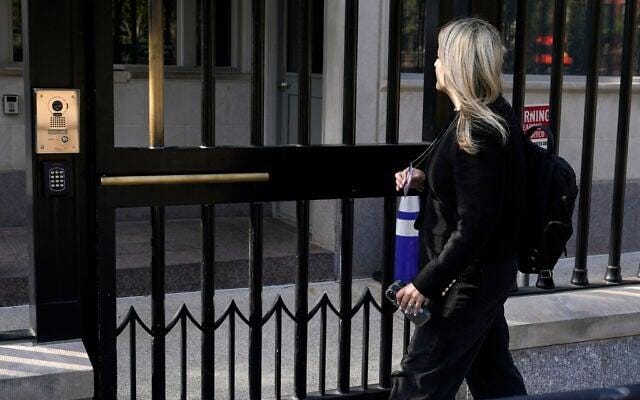
On 18 September 2026, Trump banned CNN, MS NOW, and Politico from the White House, accusing the outlets of publishing false and misleading coverage. The administration later argued that some stories disclosed sensitive or classified information and that the president was acting under his broad national security authority.
Federal judge Timothy Kelly issued a preliminary injunction on 13 October, allowing the outlets to continue to have access while the case proceeded. In his ruling, Kelly said the ban likely infringed their constitutional rights because it effectively punished them for reporting what the president didn’t like while denying them due process.
Kelly also noted that “no one should read this decision as suggesting that President Trump’s complaints are meritless.” The government could address genuine national security threats, but Kelly found “no evidence in the record to explain or justify the ‘ban’ from a national security perspective.”
There’s no comparison between a prison cell in 1798 and a White House press credential in 2026. The weight of the action is familiar: political leaders unable to bear public criticism using the weight of government to punish them.
The Supreme Court’s 1964 decision in New York Times Co. v. Sullivan looked to the Sedition Act when it ruled on how much public officials could claim in damages for criticizing them. “Although the Sedition Act was never tested in this Court,” Justice William Brennan wrote, “the attack upon its validity has carried the day in the court of history.” The Court ruled that fair discussion must be allowed to include honest mistakes, even when the discussion maligned public figures. We take these constitutional freedoms for granted, but it took nearly 200 years to get there.
Adams signed a law that jailed his political critics. Jefferson opposed the law, but urged state officials to prosecute newspapers that criticized his administration. They disagreed on the constitutional approach; both were too willing to use government force to punish critics. This is more ironic and less forgivable because these men were among our country’s Founders. Even though they knew the dangers of concentrated power, they seemingly embraced it when it fit their ends.
The federal government Adams and Jefferson led was far smaller than the one we know today. Neither man could have imagined the powers of the modern presidency, and the consequences of misuse reach far beyond anything possible in the early republic. The dispute over White House access reminds us that a president does not need to imprison critics to impose government power over the press. As executive power grows, so does the danger of political retaliation. We should demand stronger restraint on that power, and never place greater faith in the judgment of those who use it.
The press is accountable to the public for getting facts wrong. Americans are free to debate its reporting and lose faith, just like presidents are free to disagree. But no president has the right to use government power to punish criticism of his administration. The First Amendment establishes a clear boundary because the government cannot be trusted to judge criticism aimed at it. In a republic, the people have the right to hold those in power accountable, and no president has the authority to weaken that.