


Editor’s Note
This essay is intended to be read alongside The Federalists Reloaded | No. 21: A More Perfect Union and its companion piece, The Price of Union (which will follow this piece). Together, these essays examine not only Hamilton’s critique of the Articles of Confederation but also his deeper effort to move Americans from confederacy to nationhood.
A government ill executed, whatever it may be in theory, must be, in practice, a bad government. — Alexander Hamilton, Federalist No. 70
The Risk Hamilton Saw Most Clearly
Alexander Hamilton understood that the greatest danger facing the early American republic was not ambition, disagreement, or even corruption, but the far quieter possibility that independence would settle into habit without ever maturing into nationhood. In Federalist No. 21, he argued relentlessly for replacing a loose confederacy with a government capable of acting, enforcing, and sustaining itself, because he believed fragility, not tyranny, posed the greatest long-term threat to the American experiment. What Hamilton did not fully confront was that institutional strength alone could never complete the work he had begun, because building a nation requires more than capacity. It requires belief, obligation, and a shared sense of ownership that no constitutional structure can generate on its own.
Hamilton won the fight over structure. The Constitution replaced requests with authority and aspiration with execution, giving the federal government the power to tax directly, enforce its laws, and preserve internal order in ways the Articles of Confederation never allowed. Those changes mattered, and they worked. The republic did not fracture under the pressures that had nearly undone it in the 1780s, and Hamilton was vindicated in his insistence that a nation incapable of acting could not survive for long.
Identity Did Not Settle with Structure
What did not resolve as cleanly as Hamilton expected was the question of national identity. He assumed that once Americans experienced a functioning national government, loyalty would deepen, faction would soften, and shared systems would gradually produce shared purpose. That assumption underestimated how quickly people retreat into narrower identities when obligation feels uneven, abstract, or imposed rather than mutual, and it overestimated the ability of institutions to generate trust simply by operating efficiently. Political structure can stabilize a republic and prevent it from collapsing, but it cannot, by itself, persuade citizens that they belong to one another.
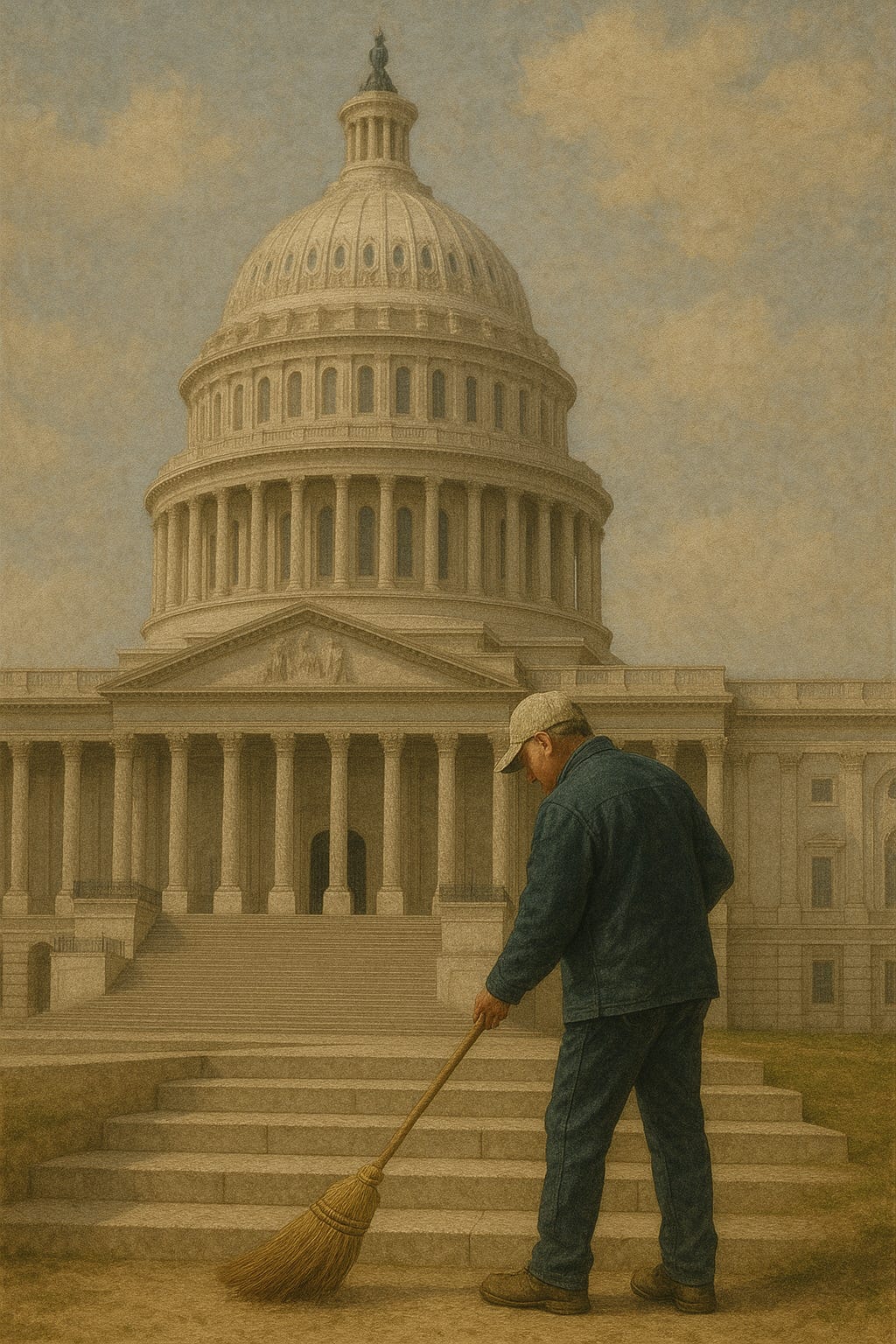
The modern United States makes this tension difficult to ignore. The federal government now possesses far more capacity than Hamilton could have imagined, reaching directly into taxation, regulation, national defense, and nearly every domain of civic life. By eighteenth-century standards, the system works remarkably well. Yet the sense of collective belonging Hamilton believed would follow effective governance remains fragile, frequently eclipsed by partisan, regional, and cultural loyalties that feel more immediate and emotionally real.
Legitimacy, Not Power
Hamilton’s unfinished business is not about power or reach, but about legitimacy. A national government can compel compliance through law and enforcement. Yet, legitimacy depends on whether citizens believe obligation runs in both directions, that sacrifice is shared, and that institutions serve a common good rather than a rotating set of winners. Hamilton believed shared responsibility would naturally produce shared identity. Still, he did not anticipate how easily responsibility would come to be experienced less as participation and more as extraction once trust in institutions weakened.
This is where Hamilton’s optimism collided with reality. He designed a government capable of decisive action and assumed civic culture would reinforce the habits of citizenship necessary to sustain it over time. Madison, by contrast, treated ambition, faction, and rivalry as permanent features of political life and accordingly designed safeguards. History suggests Madison had the clearer understanding of human nature, but Hamilton supplied the only institutional framework strong enough to keep those forces from tearing the republic apart entirely.
The Shape of Modern Fragmentation
Hamilton also underestimated how aggressively identity competes in a large, pluralistic republic. Citizens are never defined by a single allegiance, but belong simultaneously to parties, regions, professions, communities, and causes, all of which can eclipse national identity when it feels distant, procedural, or performative. In such moments, fragmentation rarely announces itself through open rebellion. Instead, it emerges through disengagement, cynicism, and the slow erosion of civic trust, producing a quieter but no less dangerous form of disintegration.
Hamilton’s unfinished business is therefore not institutional reform but cultural maintenance. The framework he helped build still functions, but its durability depends on citizens who understand responsibility as a condition of freedom rather than an infringement upon it, on leaders who treat national institutions as instruments of common purpose rather than tools of factional advantage, and on a civic culture willing to accept that belonging requires contribution and restraint rather than mere expression.
Still Unfinished
A more perfect union was never intended as a final destination. It was meant as a direction that demands constant renewal rather than reverence. Hamilton pushed the country decisively away from confederacy and toward nationhood. The remaining work belongs to every generation that inherits the system he helped create and must decide whether it is still worth sustaining.
Hamilton’s unfinished business is not about what the government can do or how much power it can exercise. It is about whether citizens still believe they belong to one another strongly enough to accept obligation, restraint, and shared responsibility as the price of self-government.
Hamilton built a government capable of holding together a republic, but he never pretended that structure alone would make Americans a people. What he assumed, perhaps too optimistically, was that shared institutions would cultivate shared responsibility, and that responsibility would mature into belonging over time. History suggests that the assumption deserves closer scrutiny. A union can endure on paper long after the habits that sustain it begin to weaken. If Hamilton’s unfinished business was creating a nation strong enough to survive, the question that follows is harder and more uncomfortable: what does that survival demand of the citizens who inherit it? That is the price of union.
Keep going Scott! Hamilton was right about the norms and institutions that were needed going forward. What he could not anticipate is how the pace of societal change caused by information technology affects the stability and improvement of those norms and institutions. The work to build durable networks of cooperation never ceases.