


When Hamilton opened Federalist No. 1, he did not begin with the details of the Constitution. He began with the stakes of the choice.
Americans had declared that rights came before political authority. They had fought a war on that principle and won. But winning independence did not prove that self-government could endure. The harder test came next: whether a free people could create a republic strong enough to protect liberty without surrendering the principle that made liberty possible.
That question does not feel as radical to us as it did in 1787. Most people lived under authority they had not chosen. The American claim rejected one of the oldest assumptions of rule: power began above the people. The Revolution rested on a different premise. Power began with the people.
The Problem the Revolution Created
The Declaration gave that claim its clearest form: governments derive “their just powers from the consent of the governed.” But a principle declared in revolution still had to become a working republic.
Federalist No. 1 forced Americans to face the problem the Revolution had left behind. If rights came first, the new republic had to be judged by whether it secured them. But if the Union remained too weak to act, liberty would rest on promises the country could not reliably keep.
That was the harder work after independence. Americans had rejected a king. Now they had to decide whether they could build a Union capable of governing while still remaining answerable to the people. The Revolution had proved that Americans could resist illegitimate power. It had not yet proved that they could create legitimate power strong enough to last.
The Failure of a Weak Union

Hamilton wrote after what he called “an unequivocal experience of the inefficacy of the subsisting federal government.” The wording is formal, but the problem was practical. The Articles of Confederation had left the Union too weak to act reliably as a nation.
The Articles described the Union as a “firm league of friendship” among the states. The phrase carried hope, but it also revealed the weakness of the arrangement. The states had joined together, yet the national government still depended on them to make common decisions real. Congress could request money, but it could not reliably collect it. National promises depended on state cooperation.
The Revolution had left the country in debt and dependent on public credit. If the Union could not meet its obligations, it could not easily command trust at home or respect abroad. This was more than an accounting problem. A republic that could not pay what it owed would struggle to prove that independence had produced a durable nation.
The same weakness appeared in trade. Because Congress lacked power to regulate commerce among the states, local interests could pull against national ones. Treaties created a similar problem. Congress could make agreements with foreign powers, but it often could not make the states honor them.
The Articles also left national policy without reliable enforcement. There was no separate executive to carry out the laws, and no national judiciary to settle disputes under national law. Congress could act in the name of the United States, but too often it lacked the tools to make that action meaningful.
This is why Hamilton did not open with a list of constitutional provisions. The United States had won independence, but the Union still lacked dependable authority to make national decisions real. Hamilton was not defending power for its own sake. He was arguing that liberty could not survive if the republic meant to protect it was too weak to act.
Reflection and Choice
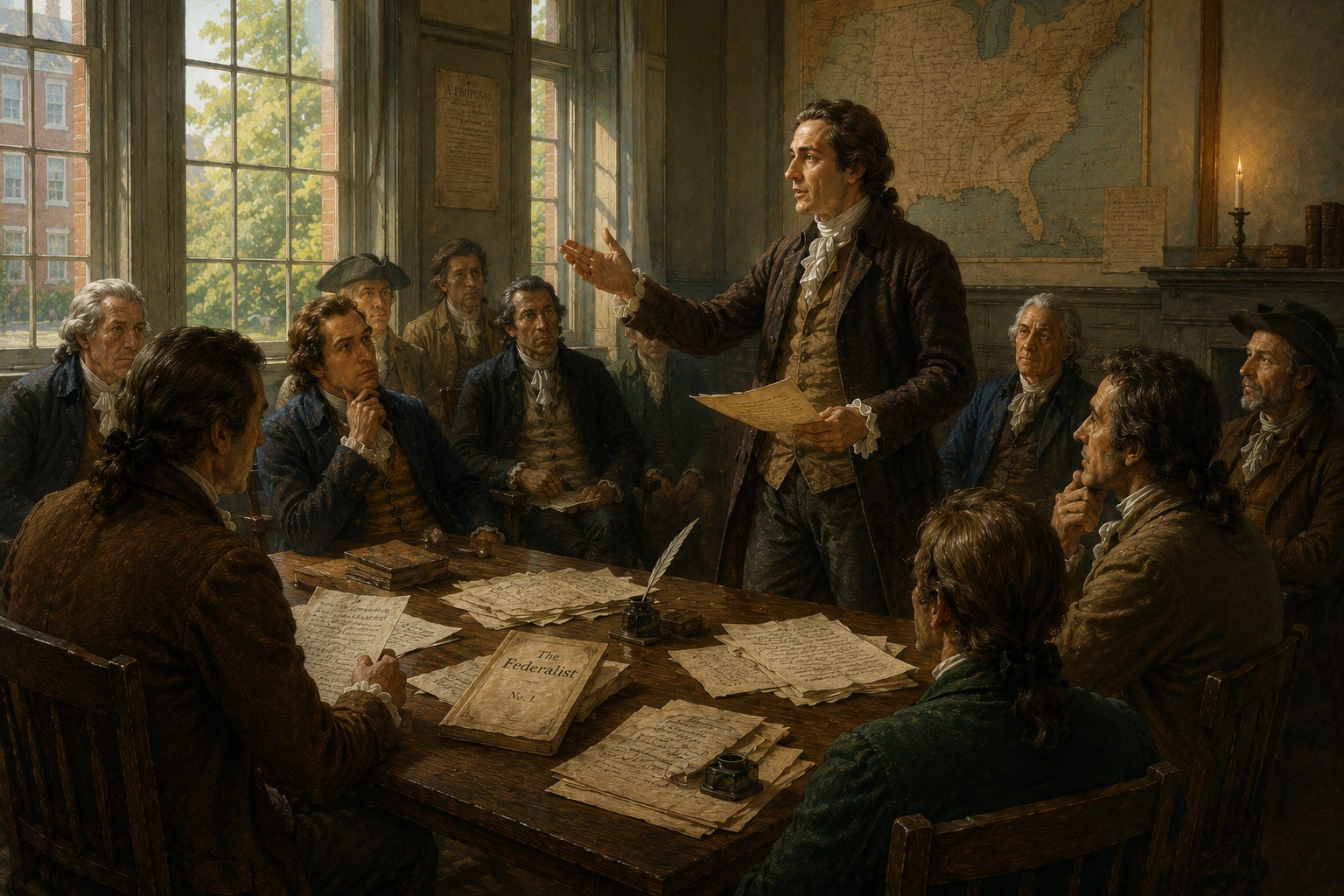
Hamilton framed ratification as a test of public judgment. Americans had the chance, he wrote, to decide whether societies could establish good government through “reflection and choice,” or whether they would remain dependent on “accident and force.”
That line names the stakes cleanly, but Hamilton did not assume the debate would rise naturally to the level of the moment. The proposed Constitution touched state power, local influence, and sincere fears about national authority. A debate that consequential was bound to draw out ambition as well as principle.
Hamilton did not ask Americans to approve the Constitution out of loyalty or habit. He hoped their choice would be guided by “a judicious estimate of our true interests.” Then he admitted that this was “more ardently to be wished than seriously to be expected.” That is not cynicism. It is realism about republican politics.
Federalist No. 1 is often remembered for its confidence in reasoned choice, but it is just as clear-eyed about what can distort that choice. Hamilton warned that ambition, personal resentment, and party spirit could shape arguments on both sides. He also warned that men who begin as demagogues can end as tyrants.
That warning belongs at the center of the essay. If the people were the source of legitimate authority, then the people also had to judge arguments made in their name. Self-government required more than a love of liberty. It required citizens to ask whether an argument served the public good or merely claimed to.
Hamilton trusted the people enough to make an argument to them, but he did not flatter them. He treated citizens as capable of judgment, not immune from passion. That is the tension running through Federalist No. 1. Americans could govern themselves, but only if they could think seriously about what self-government required.
Power Worth Trusting
The Constitution did not answer weakness by making power unlimited. It gave the Union more authority, then tried to keep that authority bound to the people.
Under the Articles, Congress could ask the states for support. Under the Constitution, Congress could tax and regulate commerce. Laws would no longer depend on state cooperation alone, because a president would be responsible for carrying them out. National disputes could also be heard in national courts. These were not small changes. They gave the Union tools the Articles had withheld.
But the point was not simply to move power from the states to the center. The point was to make national authority capable of acting while still keeping it republican. The Constitution placed power in institutions that depended on the people and then divided that power so no single part could claim the whole. The Union would be stronger, but it would still answer to the people who had created it.
Hamilton did not ask Americans to stop fearing power. Fear of power was part of the Revolution’s inheritance. But he asked them to see that weakness had dangers too. A government too strong could threaten liberty. One too weak could fail to protect it.
That was the balance Federalist No. 1 asked Americans to consider. The choice was not between liberty and authority. The choice was whether liberty could survive without authority strong enough to defend it.
The Test
Self-government was more than a principle to admire. It was a responsibility. Americans had claimed the right to choose their government, but now they had to decide whether the country they created could survive under a system that lacked the authority to govern. Hamilton believed they were capable of making that judgment, but he did not treat their success as automatic.
That is what makes Federalist No. 1 more than an introduction to the Constitution. Hamilton was asking Americans to face the next demand of the Revolution. It was not enough to reject power that ruled without consent. They had to decide whether they could create power that still answered to consent.
That question gave the ratification debate its deeper meaning. Americans had already shown that they loved liberty enough to fight for it. Hamilton wanted to know whether they understood liberty well enough to build a government capable of protecting it.
He did not offer that belief as praise. He treated it as something Americans still had to prove.