

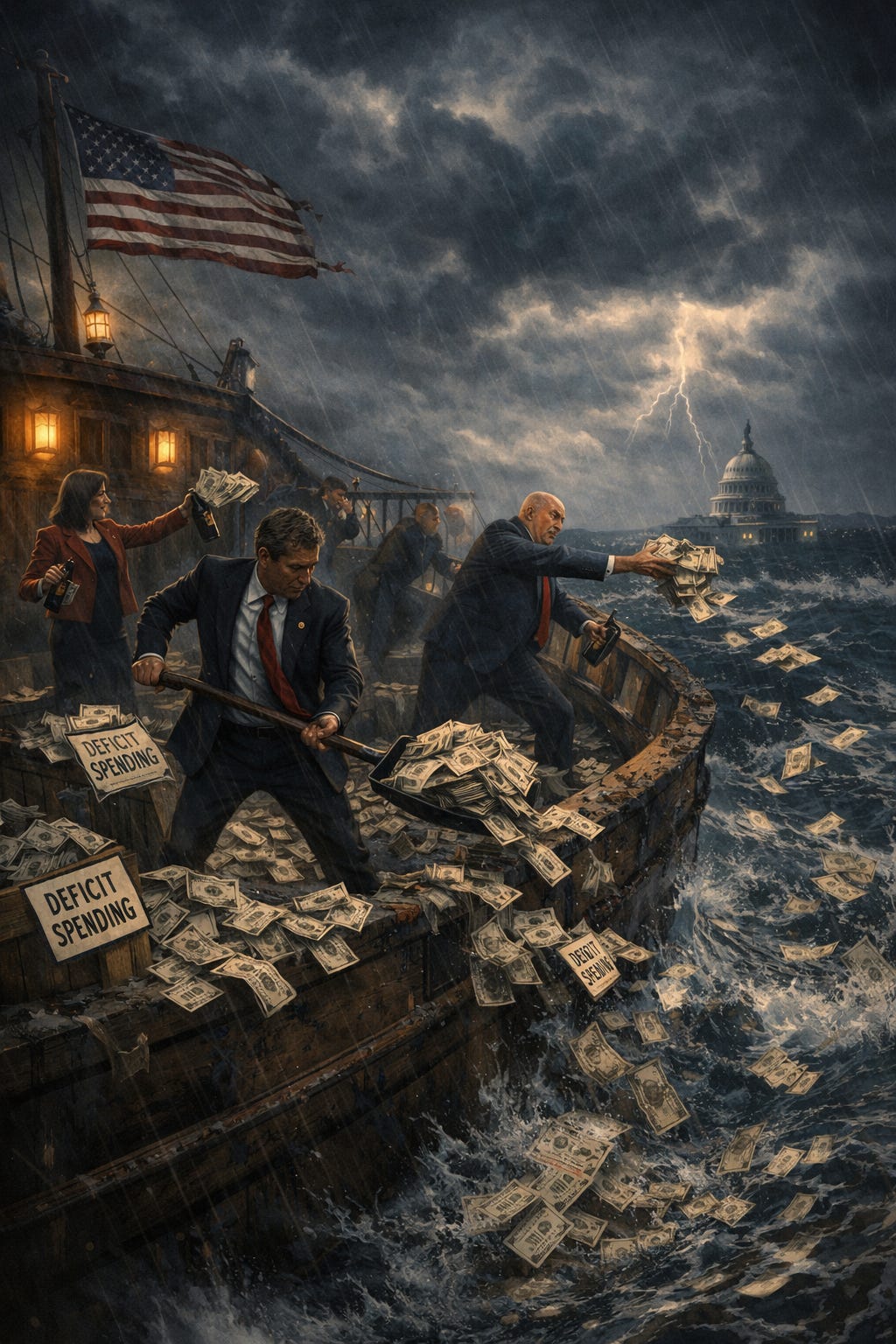
Spending Like Drunken Sailors
Last week, the federal debt crossed $39 trillion, and Congress is not even close to slowing down. U.S. Department of the Treasury data put total public debt just above that mark on March 19, 2026. The jump from $38 trillion to $39 trillion took about five months, after the move from $37 trillion to $38 trillion took about two months. This should force a serious national debate. Instead, it barely got noticed in the noise of Washington.
Congress will happily burn days on nominations, investigations, and whatever new outrage can fill an afternoon of cable news. But when the conversation turns to the cost of its own decisions, you can hear crickets in the swamps of the Capitol. Most members of Congress couldn’t tell you what the government should stop doing, which promises they cannot keep, or what taxpayers and future generations can actually bear. Reinforcing the old saying that Washington is 68 square miles surrounded by reality.
Each new trillion shows up faster than the last, while members of Congress play their role in the professional wrestling drama. In Washington, a freeze is a cut, and a real cut is an act of war. Then members go home and brag about spending that shows up in the district or state. The theater is so old that hardly anyone in town seems to notice it anymore.
Reagan saw this years ago. In “A Time for Choosing,” he said, “No government ever voluntarily reduces itself in size,” then added the line that still lands because it is still true: “a government bureau is the nearest thing to eternal life we’ll ever see on this earth.” That quote from 1964 rings even truer more than six decades later. Temporary solutions become permanent expenses without debate.
That is also why gimmicks thrive. Caps, triggers, delayed savings, rosy ten-year projections, and promises that the pain starts later. None of that is cosplay discipline. By the time the trick is exposed, the debt is even higher.
How does fiscal discipline work in Washington? Something like this:
A man comes home from work, out of breath, and drops into a chair at the kitchen table.
His wife asks, “What happened to you?”
He grins and says, “I skipped the bus and ran behind it all the way home. Saved myself $2.50.”
She looks at him and says, “That’s nothing. Tomorrow run behind a taxi and save $15.”
You, too, are now a Washington budget expert.
Fiscal Pride Before the Fall
The United States does not need a dramatic collapse to get itself into trouble. It just needs to get comfortable with habits that slowly box it in. A government promises more than it is willing to pay for. Borrowing is the easiest route, because it feels like a victimless crime. No one pays more today, no one loses a pet program, and they’ll be out of office before the bill comes due.
Interest is where this stops sounding abstract. Debt service is money already committed before Congress makes a single new decision, and that is the deeper problem. Debt does not just crowd out other priorities. It narrows self-government itself because a republic is supposed to debate real choices in real time. But a government buried in debt enters every debate with fewer real options and too much of the future already spoken for.
Sooner or later, debt becomes more than a number. It begins to limit what the government can do, especially when a crisis hits, and real choices have to be made. Great powers can carry debt for a long time. But it’s time for Congress to admit it has an addiction and begin the road to recovery.
Hamilton Understood Credit and the Danger
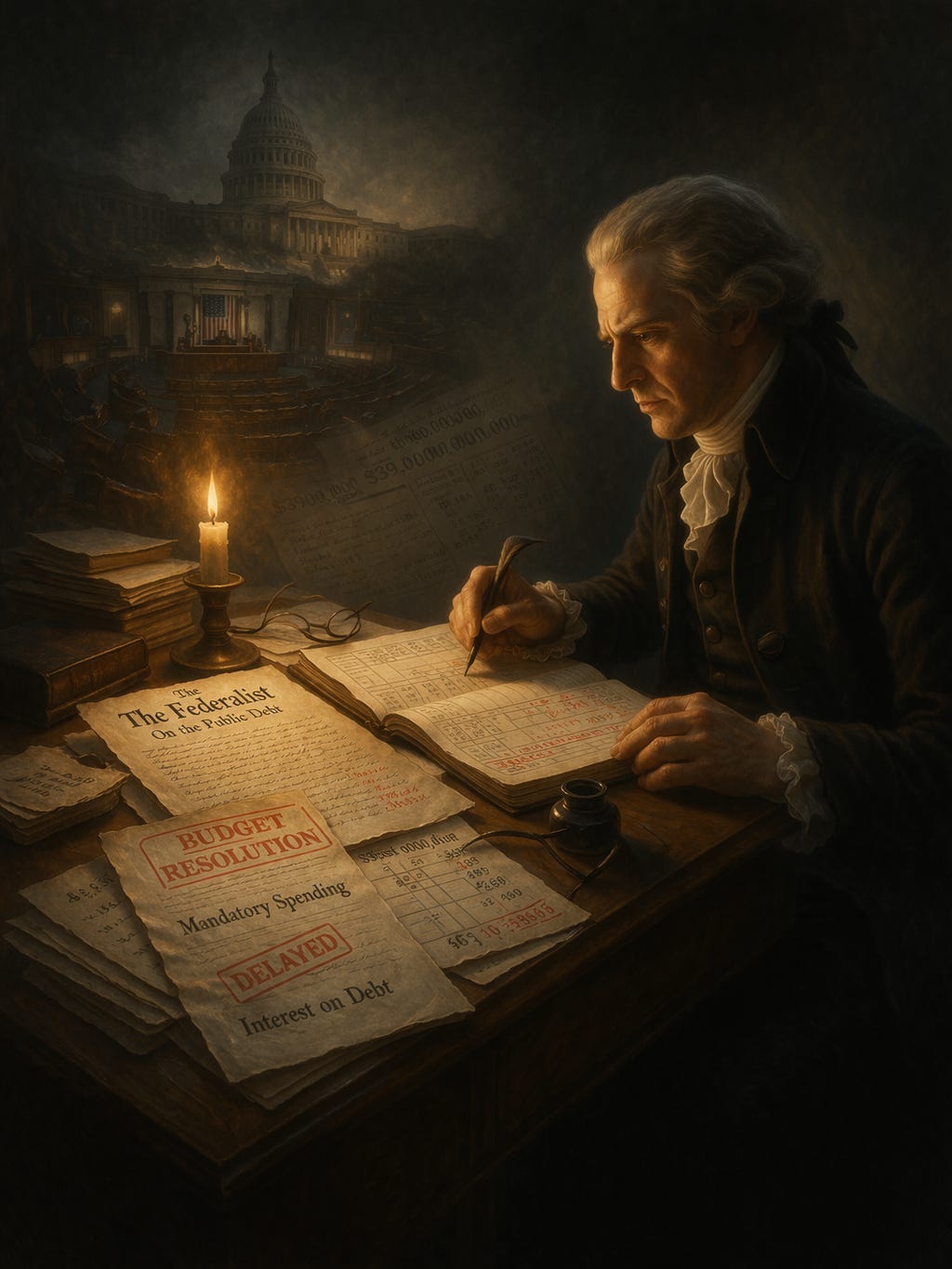
Hamilton was not hostile to public credit. He understood that a serious country needs the ability to raise money and respond to danger. In Federalist 15, he asked, “Is public credit an indispensable resource in time of public danger?” In Federalist 30, he wrote that “Money is, with propriety, considered as the vital principle of the body politic.” And in Federalist 34, he argued that government must have the “CAPACITY to provide for future contingencies as they may happen.” He understood a simple point Congress often prefers to forget: a republic cannot defend itself on good intentions alone.
But that was never his whole argument. Hamilton did not praise credit, so politicians could treat borrowing like a permanent escape hatch. He also insisted that the government needed “a regular and adequate supply” of revenue, and warned that without it, the government would “sink into a fatal atrophy, and, in a short course of time, perish.” He warned too of “the destruction of public credit at the very moment that it was becoming essential to the public safety.” In plain English, credit only works when it rests on something real: revenue, trust, and a government willing to level with the public about what it can actually afford. Congress prefers the half of Hamilton that justifies borrowing and skips the half that demands discipline.
And Hamilton was writing with a warning already in view. The Federalist Papers appeared in 1787 and 1788 as France was sinking deeper into the fiscal crisis that helped trigger the Revolution. That matters because debt becomes more than just a financial problem when a government can no longer make its promises, taxes, and political order align. At that point, the budget is no longer just a ledger. It becomes a test of whether the government can still level with the public.
What $39 Trillion Tells Us
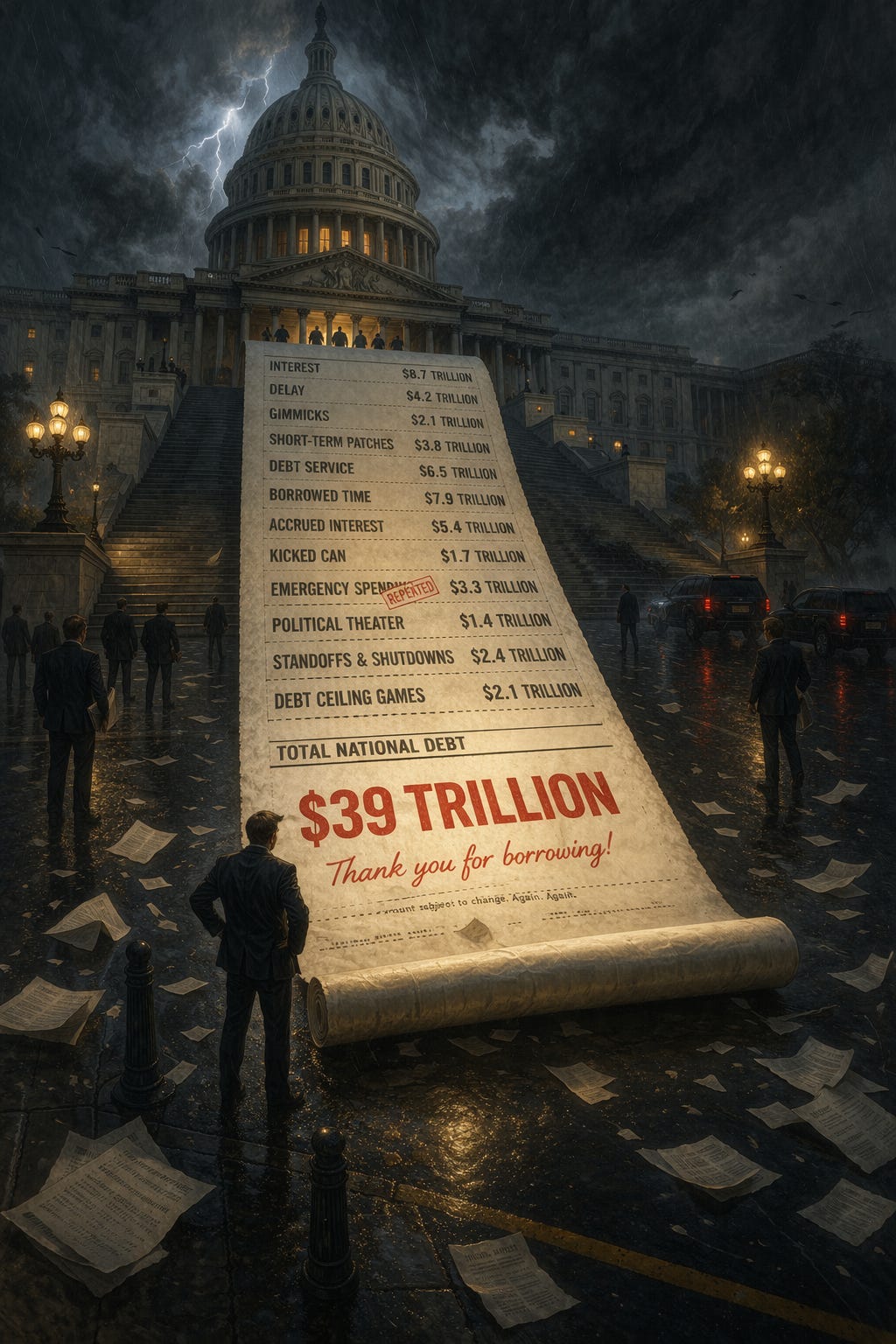
That is the real problem in Washington. The issue is not simply that Congress spends too much, though it does. It is that the system itself is built to protect spending, postpone consequences, and make serious restraint look politically absurd. Growth is treated as the baseline, while any real effort to slow it is framed as cruelty or retreat. Gimmicks are packaged as reform, temporary measures become permanent fixtures, and both parties keep finding ways to postpone the reckoning. Republicans campaign as budget hawks and then govern as if the bill will come due on somebody else’s watch. Democrats defend spending growth as though arithmetic were a partisan attack. The language changes, but the dodge stays the same. In both parties, the next election still seems to matter more than the next generation.
That is why $39 trillion matters. Not because round numbers have some mystical significance, but because this one puts the habit in plain view. Congress still wants applause for the promises, credit for the spending, and distance from the cost. It will fight over almost anything except the spending patterns that created the mess in the first place. And it keeps relying on the same evasions, calling a freeze a cut, dressing up gimmicks as reform, and treating delay as though it were a governing strategy.
Debt is not the whole problem, but it is the clearest sign of it. It shows what happens when a political system chooses avoidance over restraint and delay over honesty. That is the warning inside the number.
When does this end? Have started to look at the work of John W. Gardner and his seminal piece, “Self Renewal” (1963).