



A Revolution Without Independence
Americans began their Revolution before they decided they wanted independence. By the summer of 1775, they had fought British troops from Lexington and Concord to Bunker Hill. George Washington commanded a new Continental Army outside Boston, and men had already died fighting the king’s forces. Yet Congress was still asking the king for help.
The Olive Branch Petition called George III the colonists’ “Most Gracious Sovereign” and asked him to restore peace and protect their rights.1 Americans were fighting his army while appealing to him as their protector.
Many colonists believed Parliament had violated their rights but still hoped the relationship with Britain could be repaired. Separation would be treason, bringing economic upheaval and war against one of the world’s strongest empires. When Common Sense appeared, reconciliation and independence were still competing possibilities. Americans had learned to resist British authority, but they had not yet decided to leave it.
For years, newspapers and sermons had carried arguments about taxation and representation, along with broader questions about natural rights and the limits of parliamentary power. Legislatures petitioned London while local committees organized resistance at home. Much of the debate, however, concerned the rights of colonists within the British Empire. It explained why Parliament was wrong without making the case that America should leave.
Building a movement required more than exposing British misconduct. The case for separation had to reach beyond legislative chambers and lawyers’ offices, and people had to understand it well enough to make it their own. By January 1776, the colonies needed an argument that could move Americans from resistance to independence.
An Argument That Could Travel
Paine had arrived in Philadelphia little more than a year earlier and held no political office. Common Sense was not addressed to Congress, colonial legislators, or learned gentlemen. It was “addressed to the inhabitants of America.” The first edition appeared anonymously, credited only to “an Englishman.”2
By calling the pamphlet Common Sense, Paine suggested that readers were equipped to judge the question before them. “A long habit of not thinking a thing wrong,” he wrote, “gives it a superficial appearance of being right.” Custom could not justify an institution simply because people had grown accustomed to it.
Paine reduced the imperial relationship to an image that required no lesson in constitutional theory: “There is something very absurd, in supposing a continent to be perpetually governed by an island.”3 He also removed the king from the role many colonists still hoped he might play. George III was not standing apart from Parliament, waiting to restore colonial rights. He was part of the system they were resisting.
Paine also made a practical case, arguing that independence would allow the colonies to seek foreign alliances and take responsibility for their own defense. Instead of asking how the imperial relationship might be repaired, he asked what America might gain by ending it.
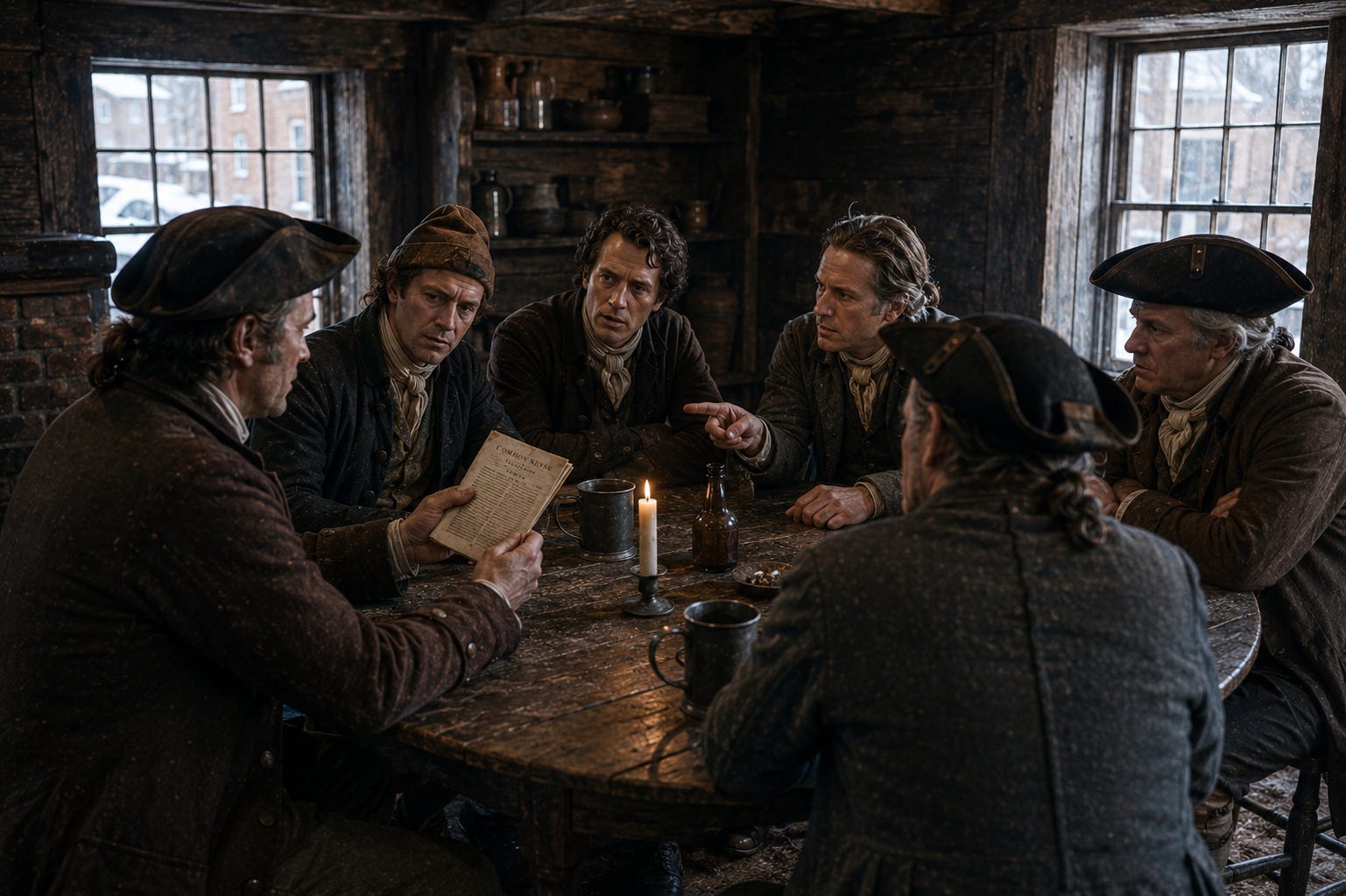
He made the argument clear enough to survive outside the pamphlet and enter ordinary conversation. I used to say in politics that your ideas are only as good as your ability to get people to act on them. Paine understood the same thing. The case for independence could not remain an argument among political leaders. It had to become something Americans could carry into their own conversations as they decided what came next.
The Argument Goes Public
Common Sense appeared on 10 January 1776 and was advertised five days later. Its reach soon extended beyond the original pamphlet as newspapers reproduced parts of Paine’s argument and critics responded in print.4 James Chalmers published Plain Truth, a direct rebuttal to Paine’s call for separation. Its title page also addressed “the inhabitants of America.”5
George Washington saw evidence of a shift in private letters from Virginia, which he told Joseph Reed showed Common Sense was working “a powerful change” in the minds of many men.6 John Adams admired Paine’s ability while distrusting parts of his argument. He wrote that he could not match the pamphlet’s “Strength and Brevity,” its “elegant Simplicity,” or its “piercing Pathos.” But he dismissed its biblical case against monarchy and called its proposed continental government “feeble.” The ideas were not new, Adams believed, but Paine had expressed them with unusual force.7

The question was no longer confined to Congress. It had moved through newspapers and private letters into military camps and disputes between Patriots and Loyalists. Paine did not create the independence movement by himself. British policy and the war had steadily weakened hope for reconciliation, while months of political organizing pushed the colonies closer to separation. But Common Sense gave the movement words it could use. Americans could make the case without first explaining the entire history of the imperial crisis.
Independence had become a public argument. Paine’s achievement was not simply that he explained the case for independence, but that he made it usable. He gave Americans language they could carry into their own arguments and make their own.
The title page addressed Common Sense to “the inhabitants of America.” At first, those words described its audience. By the time readers finished the pamphlet, they described the people who would decide what came next.
Second Continental Congress, “Second Petition from Congress to the King,” 8 July 1775
Thomas Paine, Common Sense, original title page, 1776
Thomas Paine, Common Sense, 1776, full text
Library of Congress, “250 Years Ago: Thomas Paine’s Common Sense”
James Chalmers, Plain Truth, 1776
George Washington to Joseph Reed, 1 April 1776
John Adams to William Tudor, 12 April 1776