


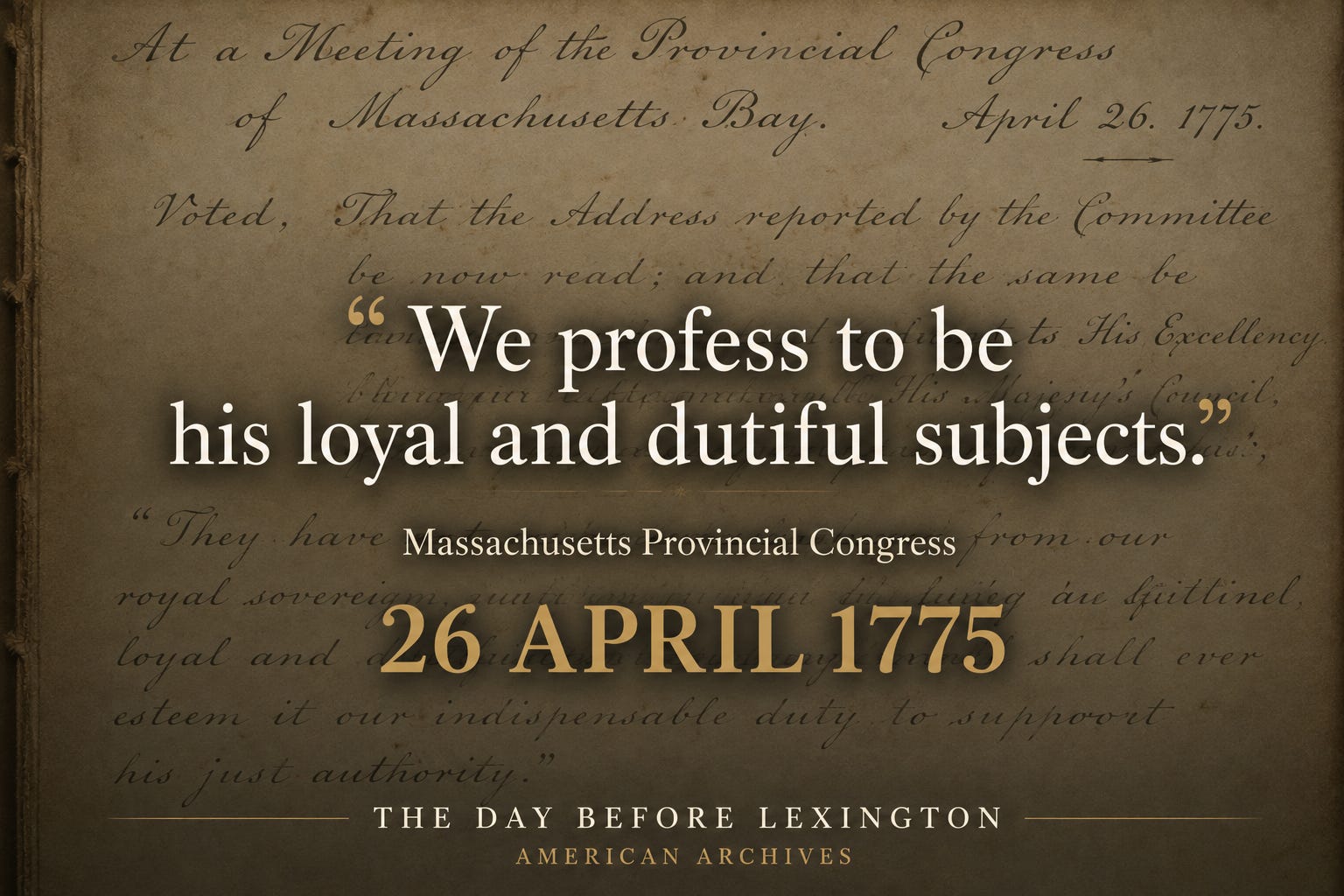
The words above were published a week after Lexington and Concord, which should give us pause. We tend to remember Lexington as the beginning of an independence movement already gathering momentum. Yet the men who had just watched the Massachusetts militia confront British regulars still described themselves as loyal subjects of the Crown. They condemned what they called the “persecution and tyranny” of the ministry, but they had not yet abandoned the political world they inherited.
The distance between Lexington and Independence is one of the easiest realities of the Revolution to overlook. Looking backward, the path seems direct. Looking through the documents of 1775, it appears far less certain.
Still Loyal, Already Preparing
The spring of 1775 was not calm. British troops occupied Boston, and few colonists still trusted royal officials. In Massachusetts, provincial leaders had already begun operating outside the normal channels of royal government, while preparing for the possibility that force might settle the conflict between colony and crown.
Yet preparation and loyalty existed side by side. The Massachusetts Provincial Congress repeatedly framed its cause in constitutional terms. Its members argued that British officials had violated long-established rights and exceeded their lawful authority. They spoke less as founders of something new than as defenders of liberties they believed already belonged to them.
To modern readers, that position can seem contradictory. To many colonists, it was not. They believed the problem was not the British constitutional tradition itself. The problem was that those entrusted to uphold it had begun to abandon it.
A Constitution Worth Saving
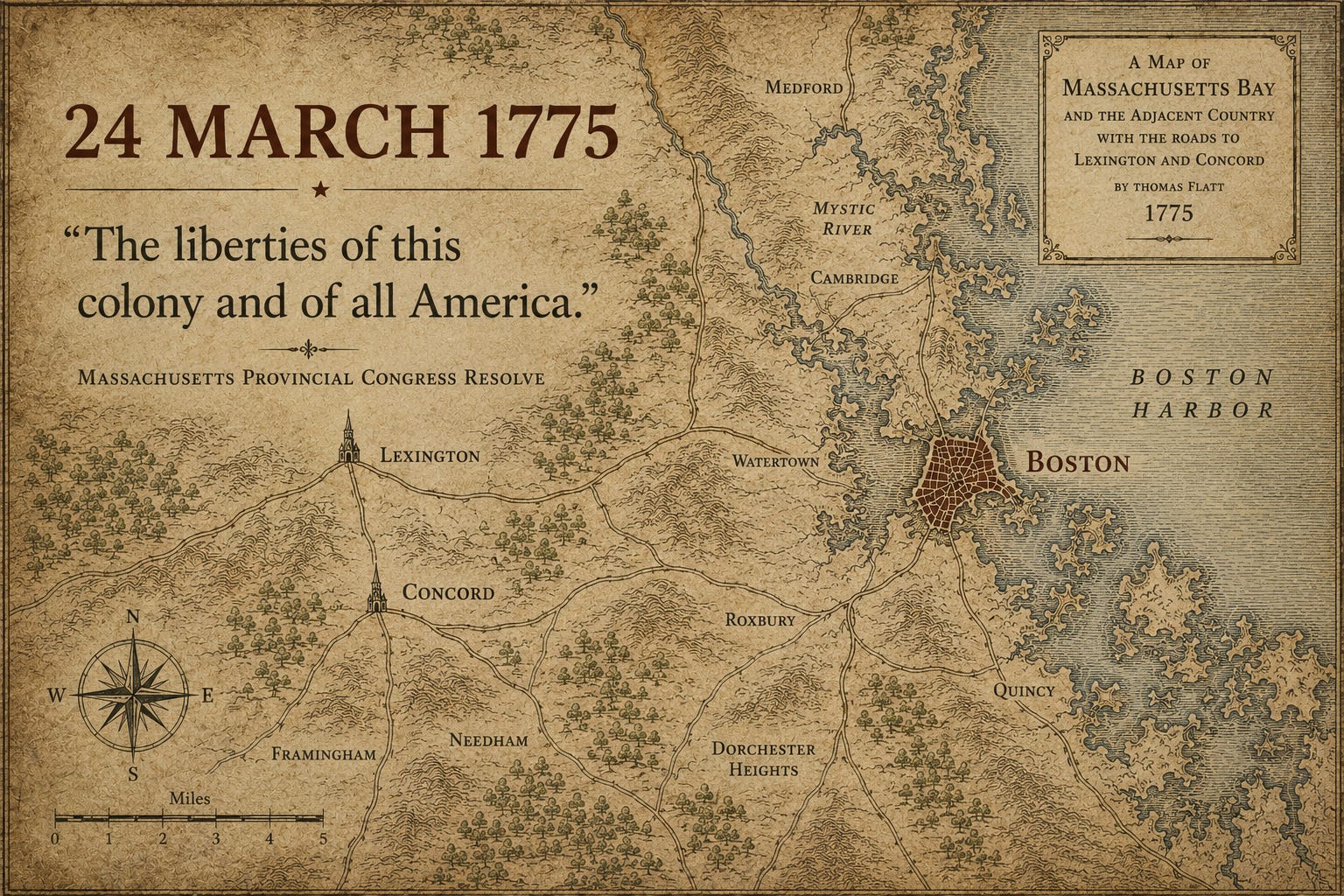
A resolve adopted on 24 March 1775 makes that understanding clear. The Provincial Congress urged towns and individual inhabitants to continue the measures already recommended for “putting this colony into a complete state of defence.” It also warned that any relaxation would bring “the utmost danger to the liberties of this colony and of all America.”
Those ideas belong together. Massachusetts prepared for a serious confrontation, but the Congress had not yet prepared for independence. It sought to defend what it regarded as constitutional liberty. The colonists wanted to preserve rights they believed they had inherited through law and feared Britain now threatened.
This is where modern readers can easily lose sight of the world the colonists inhabited. Leaders in Massachusetts did not usually describe those rights as American rights. More often, they described them as the rights of Englishmen. They cited charters, common law traditions, and constitutional principles that they believed bound both Parliament and the Crown. They did not argue that Britain lacked all authority over the colonies. They argued that authority had limits.
The political categories later generations would use had not yet hardened. The spring of 1775 did not pit committed Loyalists against committed advocates of independence. Many colonists opposed the course Britain had taken and prepared for armed resistance, while still hoping the constitutional relationship could be repaired. They feared what might happen next, but they had not yet agreed on what should happen afterward.
The Night Before
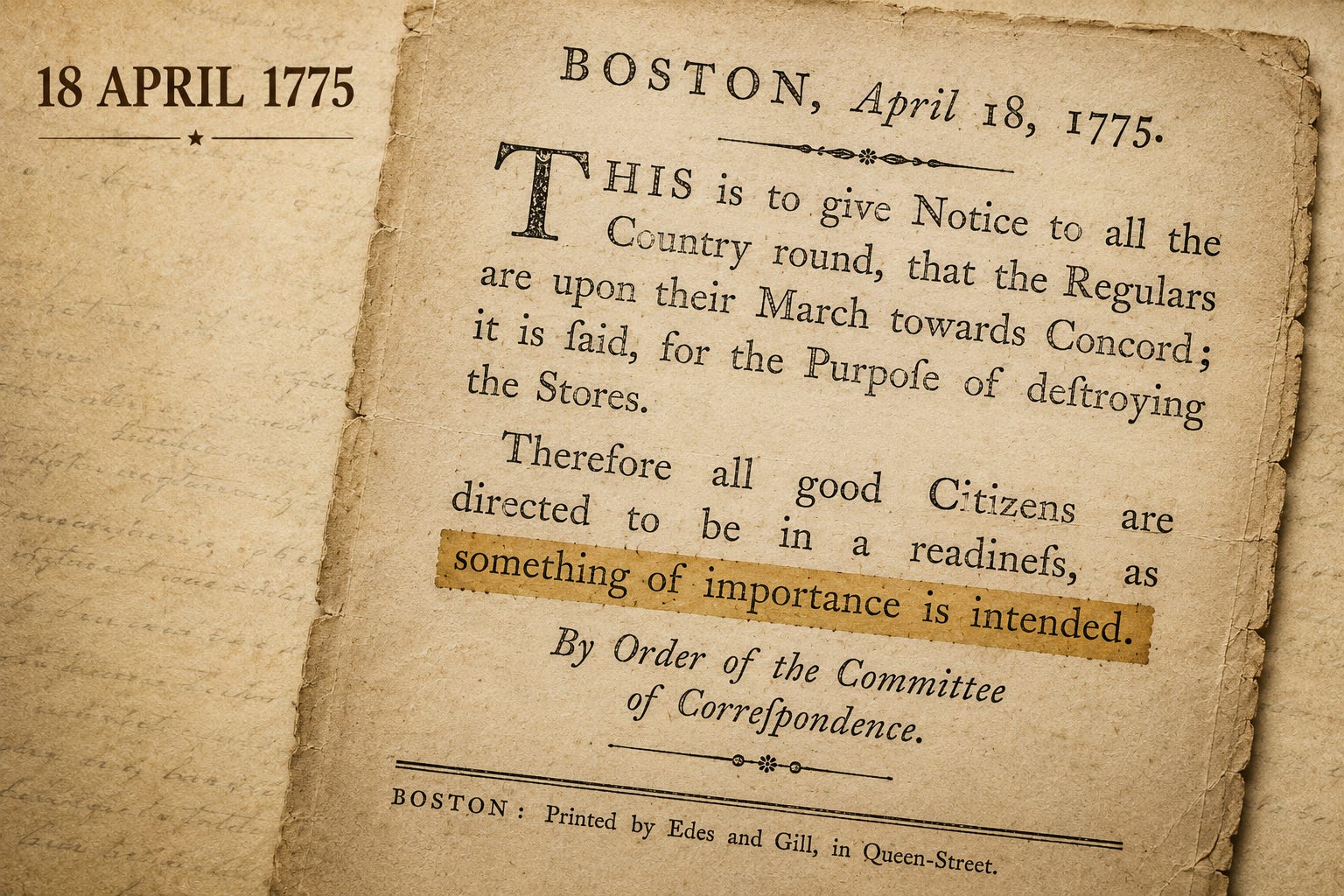
By mid-April, that fragile balance had begun to narrow. Reports circulated that General Thomas Gage might move against military stores outside Boston, and the warning network built over months of crisis began to matter in practical ways.
Paul Revere later testified that on the evening of 18 April, Dr. Joseph Warren sent for him and told him that British troops were expected to march “by water to Cambridge, and from thence to Lexington.” His account keeps the night grounded in what people knew at the time: troops were moving, leading men might be in danger, and the countryside had to be warned.1
That is the April 18 worth remembering. The concern was immediate and practical. Would troops seize supplies? Would they arrest leaders? Would force now settle disputes that petitions and political arguments had failed to resolve? Those questions mattered without a settled vision of independence.
In retrospect, independence can seem like the obvious destination. It was anything but obvious in the spring of 1775. Colonial leaders still framed the dispute as a fight over constitutional obligations and inherited rights, even as some prepared for the possibility of armed resistance.
The Declaration speaks with the confidence of a people who have reached a conclusion. The documents from the months before Lexington read like the work of people still wrestling with a question.
Farther From Independence Than We Remember
The Declaration of Independence now dominates our memory of the Revolution, but it remained distant in the spring of 1775. Not merely distant on the calendar, but distant in political imagination. Even after Lexington and Concord, many Americans continued to hope that Britain and the colonies could repair their constitutional relationship.
The Continental Congress offers another reminder of how much political ground remained. Congress had not yet treated independence as the inevitable result of the fighting in Massachusetts. To reach the Declaration, colonists first had to conclude not merely that British officials had acted improperly, but that the imperial relationship itself could no longer secure the liberties they sought to protect.
That conclusion came gradually as the war widened and reconciliation failed. In the spring of 1775, many Americans still stood between resistance and independence. The opening image makes that clear: even after Lexington and Concord, and even after blood had been shed, the Massachusetts Provincial Congress still described the colonists as loyal subjects of the Crown.
What Changed After Lexington
Lexington did not instantly create a movement for independence. It changed confidence that the existing relationship could be restored. Before the fighting, many colonists believed they could preserve constitutional liberties within the British system. After the fighting, that belief became harder to sustain.
The men who described themselves as “loyal and dutiful subjects” were not confused about who they were. They believed they defended a constitutional inheritance that stretched across the Atlantic and back through generations of English history. When they prepared for resistance, they hoped to preserve those liberties, not discard them.
The fighting at Lexington did not answer that question. It made the question harder to avoid. The Revolution did not begin with a settled vision of a new nation. It began with colonists trying to save a political world they believed was worth preserving, until events forced them to confront that it might no longer be repaired.
Sources
Journals of Each Provincial Congress of Massachusetts, 24 March 1775 Resolve.
Journals of Each Provincial Congress of Massachusetts, 26 April 1775 Address.
Paul Revere Deposition, 1775.
Journals of the Continental Congress, 1775–1776.
Peter Force, American Archives, Fourth Series.
Revere was one part of a wider warning network that included William Dawes, Samuel Prescott, and others. Henry Wadsworth Longfellow’s 1860 poem made Revere the central figure in public memory, but the historical warning system was broader and more local than the poem suggests.