


Only 12 years into our Republic, America had reached a major constitutional crisis. The election of 1800 was one of the most divisive in our history. Thomas Jefferson and Aaron Burr both ran on the newly formed Democratic-Republican ticket. When the electors met in December, they were given two votes: the winner would become president, and the second-highest, vice president. The Democratic-Republicans concocted a plan to make Jefferson president by having an elector withhold a vote, but at the last moment, the vote was deadlocked at 73 electoral votes. This threw the election to the U.S. House of Representatives.
The Federalists, having suffered the rejection of John Adams, chose chaos. Through 35 ballots, the House deadlocked between Jefferson and Burr until Alexander Hamilton convinced several Federalists to change their votes to Jefferson on the 36th ballot. The election, sometimes called the Revolution of 1800, more closely resembled a modern election than one in the 19th century.
The election had been a bitter political struggle fought by two competing parties for the first time in our history. In the years leading up to the election, Jefferson built Republican opposition to President John Adams and the Federalists. Republicans thought the Federalists pushed the federal government too far, through taxation and the Alien and Sedition Acts, while Federalists saw Jefferson and his movement as a threat to the federal government. When the House finally chose Jefferson, we witnessed the first transfer of power in our nation’s history.
When Jefferson took his oath on 4 March 1801, he clearly saw the deep political rifts. He had been elected to bring change to government and intended to follow that mandate. Yet his First Inaugural spent little time celebrating victory. Instead, he described our country as emerging from a “contest of opinion” settled through the Constitution.
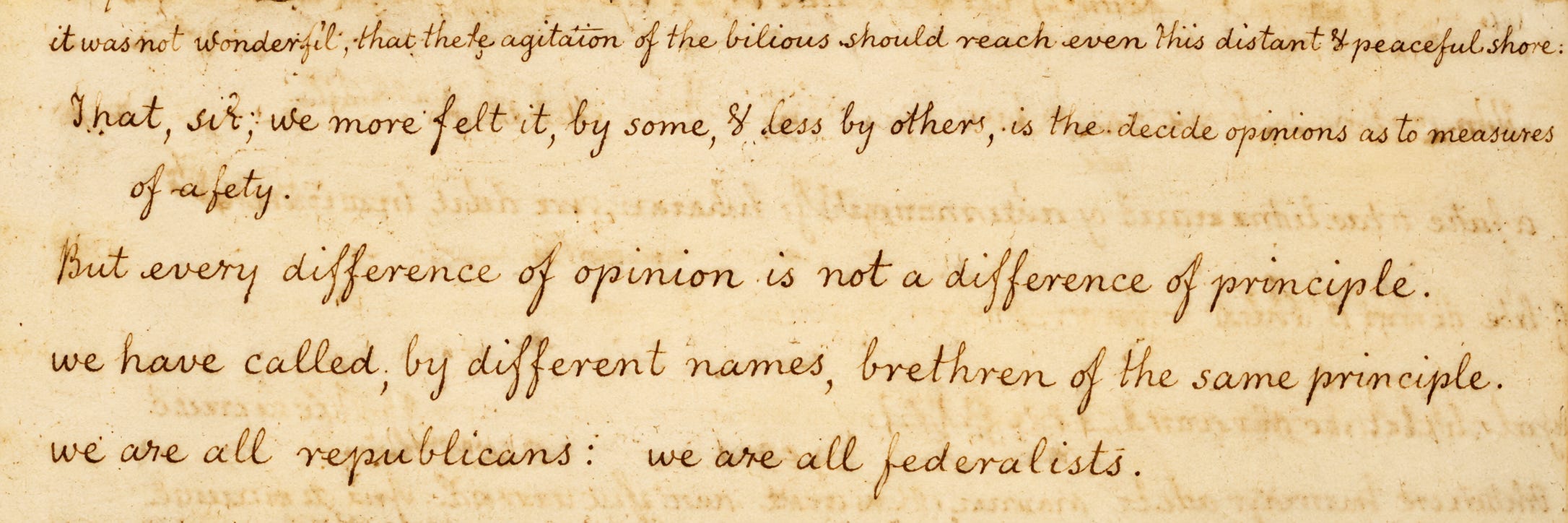
Jefferson did not use his inaugural to relitigate the campaign or humiliate the Federalists. He asked Americans to distinguish political disagreement from something more fundamental. “Every difference of opinion is not a difference of principle,” he told them. They had “called by different names brethren of the same principle.” Then came the line that defined the speech: “We are all Republicans, we are all Federalists.” Though Jefferson had won a bitter election, he began his presidency by reminding his fellow partisans that their opponents were still loyal citizens.
Jefferson won a campaign in which Federalists portrayed him as a danger to the country, while his own party labeled the Adams administration a threat to liberty. of abusing federal power. The Federalists in the House then spent 35 ballots trying to keep him from the presidency. His speech could have easily reflected bitterness as he began his administration, but he chose honor instead.


Jefferson acknowledged how uncertain his own judgment could be. “I shall often go wrong through defect of judgment,” he told the country. “When right, I shall often be thought wrong.” Winning the election did not end every argument over his ideas or character. He expected those disagreements to continue while he was in office and allowed for the possibility that his critics would sometimes have a point.
Unthinkable in our modern politics, that humility shaped the way he spoke about his political opponents. Jefferson would lead his party, but he also aimed to persuade others “by doing them all the good in my power.” Rather than expecting them to yield to his views as the victor, he sought to earn it through the way he governed.
Jefferson was unquestionably a Democratic-Republican. After years of opposing Federalist policies, he had no intention of abandoning his work on assuming the presidency. The Federalists could and would likely continue to oppose him and his policies. What changed on 4 March was that their well-being, by his election, had become part of his duty.
Jefferson offered a unique proposition to the American people in the face of such deep divisions. He was not challenging the losers to unite around him because he won. Instead, he was publicly challenging himself to govern people who might not agree with him and, in fact, viewed his policies as dangerous.
More than 200 years later, we have a full grasp of Jefferson’s actions versus his deeds. He was the leading voice of freedom, while personally owning slaves. The political system he led excluded much of the population from choosing its government. His view of who enjoyed full citizenship was far narrower than the lofty language he used in his inaugural.
Those contradictions not only defined Jefferson’s presidency in his lifetime, but remain attached to his legacy today. But the words were not limited by the man; instead, they became ideals embraced for the causes of equality, justice, and freedom.
Nothing in Jefferson’s election or his inaugural ended the new party system. The Federalists continued to oppose his administration, and Jefferson continued to pursue the changes that brought him to office. Neither side surrendered its principles simply because the transfer of power was complete.
That makes Jefferson’s promise to his opponents more striking. He had spent years trying to defeat the Federalists and had just survived their effort to deny him the presidency. Yet once he held the office, he did not ask them to submit to the victor. He said he would try to earn their confidence “by doing them all the good in my power.” Jefferson had won the election. He chose to let his conduct in office determine what kind of victory it would be.
What a novel approach. Reconciliation. Humility. Admitting that he's flawed. Seriously, a number of presidents have recognized their imperfections and the vast majority have committed to be a president for all the people. I can't wait to go back to that fundamental idea.